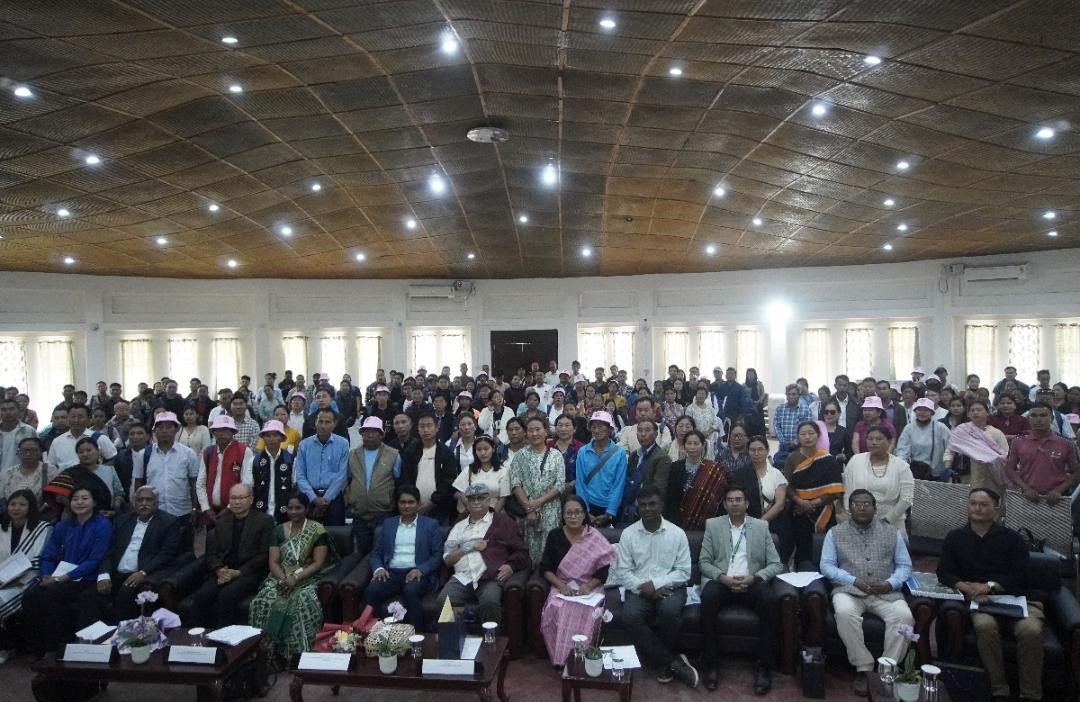
The Plant Genetic Resources (PGR) Conservation awareness programme cum training on organic farming is being conducted from 19 to 20 February at Angh Hall, Agri Expo Chümoukedima, Nagaland.
According to a press release by the Nagaland University PRO, the programme is organized by the ICAR–National Bureau of Plant Genetic Resources, New Delhi, in collaboration with the School of Agricultural Sciences (SAS), Nagaland University, Medziphema campus and the Department of Agriculture, Government of Nagaland.
Speaking at the inaugural session, Sidramappa M. Chalkapure, IFS, Chief Conservator of Forests (D&P) and Member Secretary of the Nagaland State Biodiversity Board, Government of Nagaland, as the special guest highlighted on the community-led biodiversity conservation and the role of traditional knowledge while stating that the programme brought together scientists from the premier institution National Bureau of Plant Genetic Resources, New Delhi, and farmers representing all 17 districts of Nagaland.
Chalkapure emphasized the strong link between biodiversity conservation, traditional knowledge, and sustainable livelihoods, appreciating the platform for bringing together scientists, farmers, village leaders, and local stakeholders for collective learning rather than top-down knowledge transfer.
He highlighted the importance of biodiversity and explained the two conservation approaches—in situ and ex situ—stressing that while institutions focus mainly on ex situ conservation, farmers and local communities are the primary custodians of in situ conservation. He noted that Naga communities have conserved biodiversity for generations, with women playing a key role in seed preservation, though this knowledge is now threatened by modernization and lifestyle changes.
Addressing governance, he pointed out that only about 5–10% of Nagaland’s land is under protected areas, while nearly 90% of biodiversity conservation responsibility rests with communities due to the state’s unique landholding system. He emphasized the role of village-level Biodiversity Management Committees (BMCs) and demonstrated a People’s Biodiversity Register (PBR), highlighting the need for proper documentation, prior community consent, and Access and Benefit Sharing (ABS).
He also cautioned against climate change, forest fires, and unsustainable practices, underscoring the importance of community forest conservation for biodiversity and water security. Referring to traditional systems such as jhum, alder-based farming, and Zabo farming, he concluded by reiterating that communities have always been the true custodians of biodiversity.
Dr. Sushil Pandey, Principal Scientist, ICAR–National Bureau of Plant Genetic Resources, presented an overview of the programme, highlighting the objectives and importance of Plant Genetic Resources (PGR) conservation and organic farming with special reference to Nagaland and the North Eastern Hill (NEH) region and also noted that the Government of India accords special priority to the NEH region, including targeted initiatives under SCSP and TSP, and that ICAR-NBPGR functions as a consortium integrating biodiversity conservation with inclusive development.
Download Nagaland Tribune app on Google Play

He informed that under the NEH component, a five-year action plan (2026–2031) is being formulated, with Nagaland University identified as the lead centre for programme implementation in the state where the initial phase will focus on cereals, millets, vegetables, and medicinal plants, with germplasm supply, characterization, and evaluation to support future crop improvement.
Dr. Pandey emphasized that agrobiodiversity conservation is a national priority and highlighted that ICAR-NBPGR maintains the world’s second-largest gene bank, conserving about 4.8 lakh germplasm accessions in long-term storage at –20°C. He also shared that a second National Gene Bank, with an investment of ₹500 crore, is being established at Keylong, Himachal Pradesh as a strategic backup to ensure national genetic resource security.
Concluding, he stressed that conservation, characterization, and utilization must go together, with the ultimate goal of identifying valuable genes and developing improved varieties for the benefit of farmers, ensuring sustainable agricultural development in Nagaland and the wider NEH region and also
He also stated that the ICAR–NBPGR acknowledged its association with the School of Agricultural Sciences, Nagaland University since 2025, which began with the successful conduct of a Plant Genetic Resources awareness programme. He emphasized that the success of this initiative has played a key role in further strengthening and expanding the collaboration between the two institutions through continued academic and extension activities.
Senior Professor Prof. L. Daiho, SAS, Nagaland University, delivered brief remarks underscoring the role of academic institutions in promoting biodiversity conservation and sustainable agriculture and highlighted the responsibility of universities in research, documentation, capacity building, and fostering collaboration between scientists and farming communities to ensure the preservation and sustainable utilization of genetic resources.
The session was chaired by Prof. Akali Sema, Professor In-charge, Research Cell, SAS, Nagaland University while interpretation support during the programme was provided by Dr. Mary Odyuo, Associate Professor, Department of Extension Education, SAS, Nagaland University, and Nzanthung, PhD Scholar, Department of Horticulture, SAS, Nagaland University and invocation was delivered by Dr Sibino Dolie, Technical Assistant, AICRP on Soybean, SAS, NU and concluded with a vote of thanks proposed by Prof. A.K. Singh, Centre In-charge, AICRN on Potential Crops, Department of Soil Science, SAS, Nagaland University.
The programme also included a visit to the exhibition stalls, where germplasms of various crops, including rice, millets, soybean, and other important crops, were displayed for the participants.
The programme began with a welcome address by the chairperson, followed by the introduction of farmers and delegates where 200 farmers from across all 17 districts of Nagaland participated in the programme and during the inaugural day of the commenced following the registration of participants, farmers and officials from various departments participated actively in the programme.
The overall event was coordinated by Prof. Akali Sema, with the active support of a dedicated team of faculty members, scientists, and students of SAS, Nagaland University.
The first day of the programme concluded successfully with active participation and meaningful discussions, setting a strong foundation for the subsequent sessions of the training programme and on the second day.