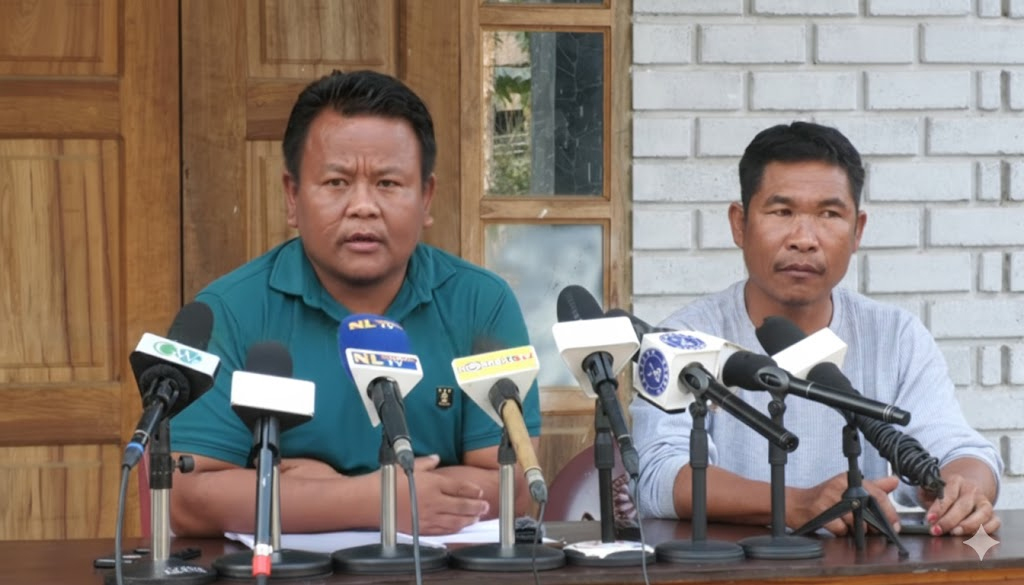
The Maova Village Council on Saturday maintained that the February 13 violent confrontation involving members of the Chakhroma Public Organization and the Chakhroma Youth Organization was neither anticipated nor provoked by the village authorities, asserting that the incident stemmed from a small land dispute that escalated unexpectedly.
Addressing a press conference, Maova Village Council Chairman, Sutminlal Vaiphei said the council convened the media interaction to place on record the village’s version of events and to inform the people of Nagaland about what he described as the actual sequence of developments.
He clarified that the press conference was not intended as a rebuttal but as an effort to prevent misinformation and promote peace.
Vaiphei stated that neither the Village Council, Gaon Buras, nor village youth received any official communication regarding the arrival of members of the Chakhroma organizations. According to him, the village only received informal information around 9 a.m. on the day of the incident that a large number of people were heading towards Maova. Upon receiving the information, he said the village immediately alerted the administration and the police, while most villagers had already left for their daily work. As a precautionary measure, about 20 to 30 youths were asked to remain in the village while the rest of the villagers were away.
He further informed that vehicles carrying members of the visiting groups began arriving shortly afterward, following which officials including the Extra Assistant Commissioner and police personnel reached the village.
Vaiphei said a meeting was initiated at the Chairman’s residence involving village leaders, the administration, and police officials with the intention of resolving the matter peacefully. However, while the discussions were underway, a scuffle reportedly broke out among youths on the roadside, which quickly escalated into violence.
The Chairman stated that both the Extra Assistant Commissioner (EAC) and a police personnel sustained injuries while attempting to control the situation. He said that given the large crowd, it was difficult to ascertain who was responsible for the injuries and expressed concern over social media narratives blaming Maova villagers.
Vaiphei said that even he was physically struck during the chaos and described the incident as unfortunate, while wishing speedy recovery to the injured officials.
He claimed that the number of people who arrived at the village was in the thousands, whereas Maova had only a small group of youths present along with women villagers. Vaiphei alleged that several women were assaulted during the confrontation and that some women working in agricultural fields were chased and beaten.
He further stated that villagers were largely helpless due to being heavily outnumbered and could only watch as properties were vandalized.
Vaiphei alleged that attackers damaged household belongings of several residents, including those belonging to a pastor of the Kuki Baptist Association in Maova. He stated that the Pastor was also assaulted while attempting to intervene but escaped with minor injuries. He also recounted that when shops caught fire during the violence, he personally warned individuals present near the burning structures about LPG cylinders stored inside, which later exploded, intensifying the damage.
The Chairman appealed to citizens across Nagaland not to communalize the incident, stating that the conflict was purely a village-level issue and not connected to any broader ethnic or regional tensions. He expressed concern over misleading social media posts and urged the public to allow administrative authorities to handle the matter and restore peace.
Responding to queries from the media, Vaiphei acknowledged that an investigation into the incident is ongoing. Addressing questions about an earlier agreement concerning land use restrictions, he said Maova village, established in 1933, follows its own administrative norms and that development activities such as rubber plantations, piggery farms, and fisheries have been allowed following consultations with the Village Council and GBs.
He denied allegations that the village had obstructed developmental activities or violated previous agreements, including issues related to fencing around church land.
Vaiphei reiterated that the immediate trigger for the violence was a minor land dispute between two individuals, adding that efforts had been made by local stakeholders to resolve the matter before it was escalated through organizational intervention.
Responding to a query on who owns the land in question and who was claiming it, Vaiphei informed that the landowner is a villager. He said the other party’s landowner also spoke to resolve it but it could not be resolved within them and because of that the CPO lodged a complaint.
Download Nagaland Tribune app on Google Play

He also claimed that the Village Council had responded to a notice issued by the Chakhroma organization in December, stating that copies of their response were submitted to the district administration.
On allegations that Maova villagers had prepared weapons and planned an ambush, Vaiphei categorically denied the claims, asserting that the village had no prior knowledge of the visit and that any defensive actions taken by villagers were purely in self-defence. He explained that women were present at the site based on the local belief that their presence discourages violence.
He also dismissed speculation linking the incident to the ongoing situation in Manipur, stating that the Maova conflict was unrelated and should not be interpreted through any broader political or ethnic lens.
“This is absolutely not related to the Manipur issue. Maova doesn’t know what happened in Manipur. And they [Manipur] don’t know what happened here. It is not related at all,” he said.
Vaiphei welcomed any forensic or administrative investigation into allegations of explosives or ammunition use, stating that the village had nothing to hide and was open to scrutiny by law enforcement agencies.
The Chairman said the village council, elders, and GBs would soon convene meetings to discuss further steps towards restoring peace and resolving the dispute through dialogue, preferably in the presence of the administration and concerned organizations.