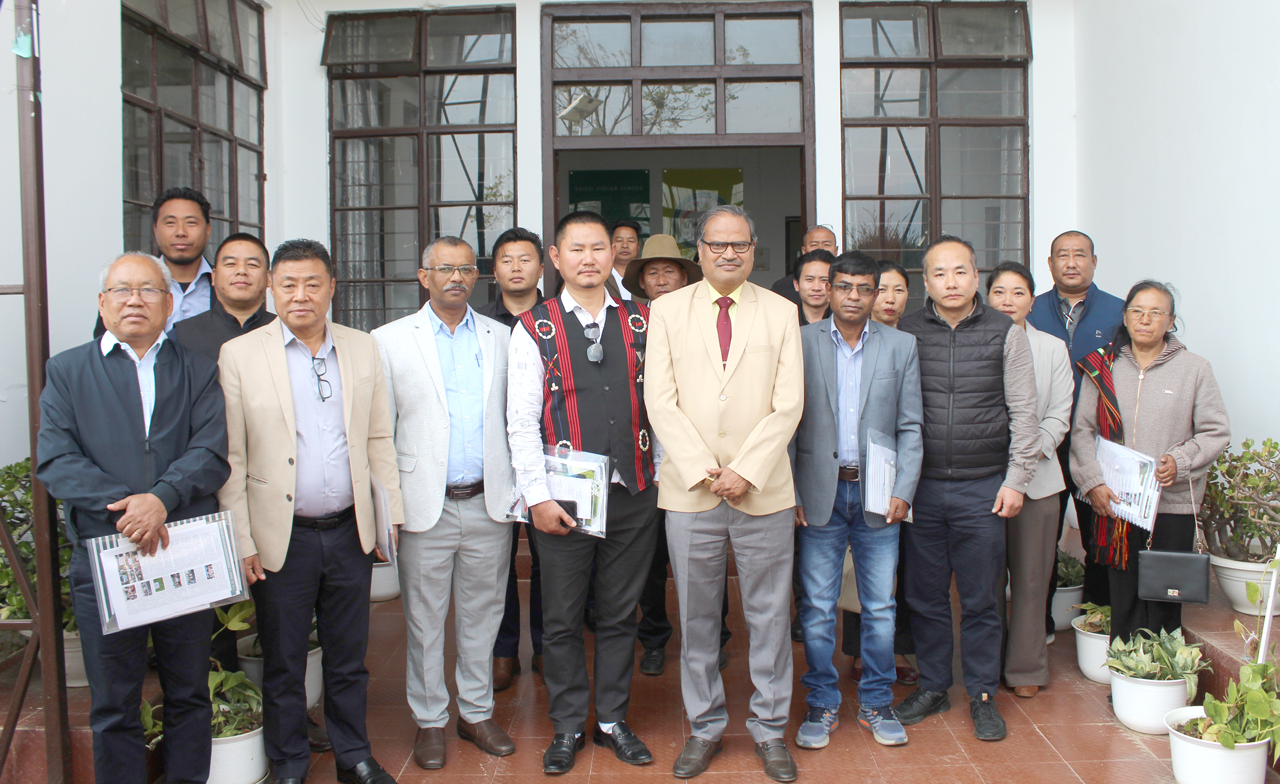
The 16th Scientific Advisory Committee (SAC) meeting under the Indian Council of Agricultural Research (ICAR) Krishi Vigyan Kendra (KVK) was held at the conference hall of Nagaland University, Lumami, Zunheboto, on February 16.
The meeting was chaired by Prof JK Patnaik, Vice-Chancellor of Nagaland University. The welcome address was delivered by Yangemongla, Assistant. Dr Rakesh Kumar Chaurasia, Principal Scientist and Head, KVK Zunheboto, presented the Annual Progress Report for 2025, followed by the presentation of the Annual Action Plan for 2026 by Dr Visakho Shunyu, CTO (GPB and Agronomy).
L Holuto Ayemi, Chairman Farmer Producers Organization (FPO), Zunheboto district, acknowledged KVK’s efforts in reaching remote villages located nearly 90 km from the centre. He emphasized the need for follow-up visits after initial interventions to ensure lasting impact on farmers. He also called for greater focus on animal husbandry and livelihood activities, noting the prevalence of animal diseases in the district. He suggested more training programmes on animal health management and integrated farming systems. Additionally, he stressed the need for increased funding to expand outreach to more remote areas.
Kakuto Assumi, a farmer from Litami village, highlighted irrigation problems, challenges in coffee plantations, and crop destruction caused by elephants.
H Ghukhali Sema of Naghuto village shared her success story, stating that after attending KVK training programmes in 2018 on value addition such as jackfruit chips, tomato pickle, and wine making she now earns around ₹3,500 per month, amounting to approximately ₹40,000 annually.
She expressed gratitude to KVK for enabling her to become self-reliant.
Another farmer, Itohei from Khrimito, said KVK had assisted villagers with pigs and poultry and provided training in preparing chips and pickles, which has contributed to their livelihoods.
SAS officials emphasized the importance of integrated farming systems, especially given limited resources and cropping constraints in the region. They also discussed the issue of elephants entering agricultural fields, linking it to floods in Assam and large-scale exploitation of forest areas in Nagaland for timber extraction, which has driven wildlife into farming areas. Members pointed out that rabi soybean has not been successful in Nagaland and recommended focusing on indigenous crops suited to local conditions.
Representatives from the Department of Livestock and Animal Husbandry NU highlighted the importance of the Sumi Ne (Sumi goat), a rare long-haired goat found in high-altitude hilly areas such as Satakha and Keltomi. The animal’s natural fibre is traditionally used for making jewellery by the Sumi community. However, its population is critically low, with only a few animals remaining.
The Vice-Chancellor noted that the population of the Sumi goat is declining as farmers are reluctant to rear it due to crop damage and fencing challenges. He described the situation as serious and stressed the need for conservation. He further remarked that while artificial intelligence is increasingly being used in agriculture, it is equally important to preserve and protect indigenous genetic resources, even if large-scale commercialization is not immediately feasible.
Dr Rakesh Kumar Chaurasia added that some villages rear the Sumi goat along with mithun and emphasized the need to multiply and conserve the breed.
A fruit scientist and board member from the Horticulture Department recalled that in 2014, Nagaland was declared a horticulture state. He suggested greater emphasis on minor fruits and vegetables, noting that citrus crops across the Northeast are facing a “complex decline.” He added that Nagaland’s climate is comparable to Ethiopia’s, making it suitable for high-quality coffee production, but stressed the importance of proper processing to enhance market value.
Download Nagaland Tribune app on Google Play

In his concluding remarks, the Vice-Chancellor commended KVK for its efforts to reach remote areas and acknowledged its satisfactory work.
He stated that Naga farmers are enlightened, dynamic, and proactive. “First, let us protect our culture, and then we can think about scaling up,” he remarked.
He informed that there are three KVKs under Nagaland University and assured that the University and SAC would continue to collaborate and share resources. He emphasized that the institution’s role is to provide training and resources for the benefit of farmers.
Dr. Kundan Kumar, SMS (Agricultural Extension), delivered the vote of thanks.
Addressing the media after the programme, the Vice-Chancellor described the SAC meeting as successful, with active participation from the farming community, scientists, and KVK staff. He said the inputs received from farmers were enlightening and that KVK’s efforts in technology transfer and field testing have had a substantial impact on the farming community.
Among the key decisions taken was the need to protect and conserve the endangered Sumi goat for its long fibre, which has commercial potential for the Sumi community. He said efforts would be made to secure funding from agencies such as National Bank for Agriculture and Rural Development (NABARD) to undertake conservation and experimental initiatives in the cooler hill zones where the goat is uniquely found.
He further stated that despite the limited mandate of ATARI, the University aims to extend technologies developed by the School of Agricultural Sciences (SAS) to benefit the farming community. The farmers, he added, expressed enthusiasm and satisfaction with the proceedings of the meeting.