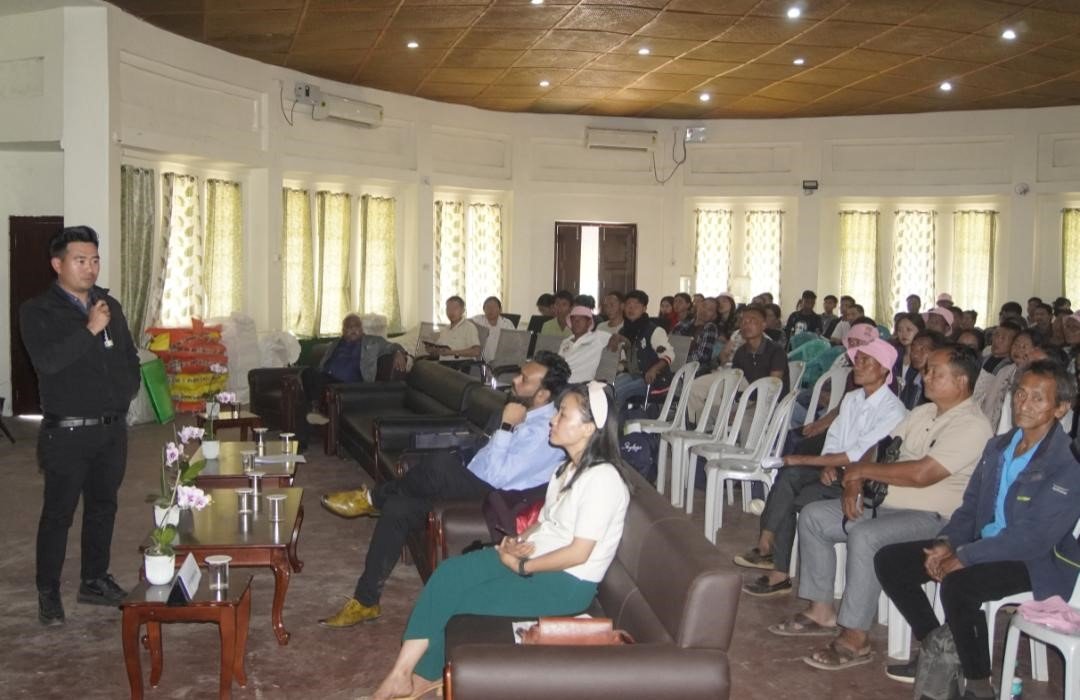
Awareness and Training Programme on Plant Genetic Resources Conservation and Organic Farming was organised at Angh Hall, Agri Expo, Chümoukedima, Nagaland during February 19–20 February, informed a press release issued by Nagaland University.
On day one, the first technical session was chaired by Dr. Sushil Pandey, Principal Scientist, ICAR-NBPGR, New Delhi, with Dr. Sentirenla Jamir, Assistant Professor, Department of Horticulture, School of Agricultural Sciences (SAS), Nagaland University, as the Co-Chairperson.
The session featured expert presentations addressing various dimensions of plant genetic resources and local biodiversity. Dr. Chithra Devi Pandey presented an overview of vegetable genetic resources conserved in the National Genebank and emphasized their critical role in ensuring future food and nutritional security. Somitam Pielie, representing the Nagaland Bio Resource Mission, delivered a presentation on the medicinal and aromatic plants of Nagaland, highlighting their conservation potential and value for sustainable development. Daniel Konyak from the State Agricultural Research Station (SARS) outlined ongoing crop germplasm conservation initiatives undertaken by the station. He encouraged farmers to actively participate in conservation efforts to safeguard indigenous varieties.
On day two, first technical session was chaired by Prof. Akali Sema, Professor In-Charge, Research Cell, SAS, Nagaland University, with Dr. Graceli Yepthomi, Assistant Professor, Department of Horticulture, SAS, Nagaland University, as Co-Chairperson. The session commenced with a lecture by Prof. C. S. Maiti, Department of Horticulture, SAS, Nagaland University, on “Genetic Resources of Horticultural Crops in Nagaland and Utilization.” He reported that approximately 800 germplasm accessions are conserved at the State Agricultural Research Station (SARS), Yisemyong. He underscored the importance of registering local varieties under the Government of India framework to ensure ownership rights, recognition, and benefit-sharing. He also noted that 103 citrus genotypes had been collected, of which 93 unique types were registered with ICAR-NBPGR, New Delhi. Prof. Maiti also highlighted several disease-resistant and locally-adapted crops, including rough lemon, local banana, passion fruit, kiwi, tree tomato, king chilli, and indigenous vegetables. He described Nagaland as a biodiversity hotspot rich in resilient local varieties. However, he identified major challenges such as limited resources, inadequate infrastructure, insufficient manpower, and low awareness among youth. He stressed the need for stronger legal backing, government incentives, and improved farm economics to promote sustainable conservation. He further emphasized that community land resources offer substantial potential for maintaining genetic diversity.
Dr. G.D. Harish, Senior Scientist and Officer-in-Charge, ICAR–NBPGR Regional Station, Shillong, in a lecture on “Role of ICAR-NBPGR in Conserving Plant Genetic Resources of the North Eastern Hill Region (NEHR)” highlighted the rich biodiversity of the region and noted that India has eight centres of origin for various crops, with the North East playing a pivotal role with states such as Nagaland and Mizoram identified as major biodiversity hotspots due to high concentration of traditional landraces and germplasm. Dr. Harish elaborated on germplasm conservation techniques such as cryopreservation, systematic processing, monitoring, and viability testing conducted every ten years to ensure long-term preservation. He emphasized the importance of community participation, particularly through community seed banks, to strengthen local resilience, climate adaptation, and seed security.
Dr. Wasifur Rahman, Executive Member (Research and Development), Green Commandoes Forum (GCF), Agripreneur and owner of ASOMI Polyseeds Pvt. Ltd., Assam, speaking on “Conservation, Consumption and Commercialisation of Local Food – The Green Commandos’ Way of Climate-Smart Hill Farming and Bio-Happiness” highlighted sustainable farming approaches that integrate conservation with livelihood enhancement. Through a presentation on “Initiatives of Green Caravan in Organic Farming” Mr. Manen Ozukum, Chief Operations Manager, Green Caravan, shared practical experiences from grassroots-level organic farming initiatives, emphasizing farmer engagement, market linkages, and improved transportation systems. He encouraged farmers to adopt agriculture as a primary livelihood and motivated youth participation and mentioned the role of OneCert Asia International Pvt. Ltd. As a third-party agency facilitating organic certification for interested farmers.
Download Nagaland Tribune app on Google Play

Second technical session of day two was chaired by Prof. Malini B. Sharma, Head, Department of Genetics & Plant Breeding, SAS, Nagaland University, with Dr. Debika Nongmaithem, Assistant Professor, Department of Agronomy, SAS, Nagaland University, serving as Co-Chairperson. Prof. Sharma in a lecture on “Biodiversity and Ecosystems in the Context of Nagaland” discussed ecosystem diversity, conservation challenges, and the importance of integrating biodiversity considerations into agricultural planning. She emphasized the need to balance human needs with ecological sustainability and highlighted the interdependence of biotic and abiotic components. She also drew attention to diverse ecosystems ranging from hot water springs to micro-ecosystems, underscoring their interconnected nature. Major threats identified included excessive chemical use, deforestation, monocropping, and climate change. She concluded by stressing that biodiversity conservation is essential for securing future agricultural productivity and livelihoods. Dr. Sabbithi Pavan, Assistant Professor, Department of Entomology, in his lecture on “Insect Biodiversity of Nagaland and Its Importance to Agriculture” explained the ecological significance of insects, emphasizing that many species are beneficial rather than harmful. Pollinators such as honey bees and dragonflies, natural pest controllers like praying mantis and ladybird beetles, and decomposers all contribute to sustainable agriculture. He highlighted the presence of approximately ten species of stingless bees in Nagaland, noting their potential as an additional source of income. He also referred to jhum cultivation practices and cautioned against excessive chemical use, which negatively impacts beneficial insects and soil health. He stressed the need for identification, documentation, and conservation of beneficial insect species.
The technical sessions encouraged productive dialogue among scientists, academicians, practitioners, and farmers, reinforcing the importance of conservation-driven and sustainability-oriented agricultural development in the region. Interpretation support in all the three technical sessions were provided by Dr. Mary Odyuo, Associate Professor, Department of Extension Education, SAS, Nagaland University, and Nzanthung, PhD Scholar, Department of Horticulture, SAS, Nagaland University, ensuring smooth communication and active interaction between the speakers and participants.