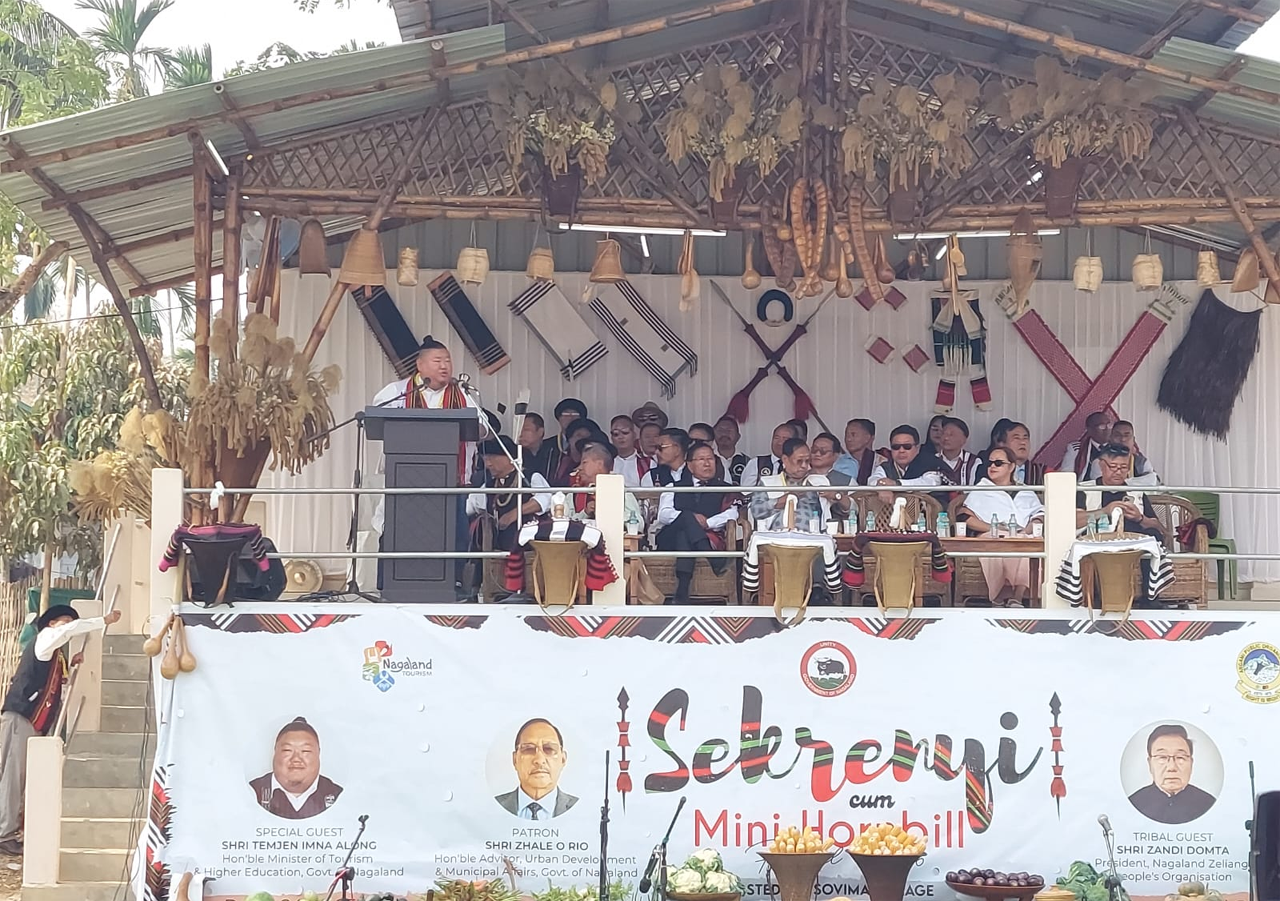
Nagaland Minister for Tourism and Higher Education, Temjen Imna Along on Wednesday called for greater unity among Naga tribes and renewed commitment to preserving indigenous culture while addressing the Sekrenyi cum Mini Hornbill Festival, organized by the Angami Public Organization at Sovima village.
Addressing community leaders, tribal representatives, church elders, and members of the public, Along expressed appreciation for being part of the Sekrenyi celebrations, describing the festival as a powerful reflection of Angami heritage and Naga identity. He emphasized that indigenous communities must preserve their traditions, culture, and way of life even as they embrace faith and modern progress.
“The indigenous people, if we do not preserve our heritage of our culture, of our tradition, and of our way of life, then we will not be able to take ourselves as an entity of a progressive people,” he said.
The Minister stated that cultural preservation is essential for sustaining identity and ensuring progress as a people. Referring to the transformative impact of the Hornbill Festival and Mini Hornbill initiatives under the leadership of Chief Minister, Neiphiu Rio, Along said such platforms have strengthened cultural consciousness while allowing communities to celebrate tradition alongside faith.
Reflecting on the social and political challenges faced during the 1990s, Along observed that there was a time when Naga were at the crossroads of “heavy Naga political issue”. However, he noted that renewed focus on traditional attire, festivals, and indigenous practices has helped reclaim cultural pride.
While highlighting the strength derived from tribal identity, Along expressed concern over divisions among Naga tribes. He questioned why, despite growing literacy and stronger cultural awareness, unity among the indigenous tribes of Nagaland remains elusive.
“I don’t know why we are somehow not able to be united. Why as we have built our identity stronger, why we have not been able to come together as indigenous tribes and citizens of Nagaland?” he questioned.
“We are going to suffer long term because of what we are trying to inculcate amongst us today in division,” he further said, adding, “We belong to each tribe as an identity, as a heritage, but we live together, work together, and have to aspire together as Nagas of Nagaland.”
He urged the leaders, youths and literate people to engage in constructive dialogue and find proper manner and proper way of putting forward their thoughts.
Patronizing illegal immigrants could have long-term consequences
The Minister also raised concerns over the issue of illegal immigration, terming it one of the major challenges facing the state. He said patronizing of illegal immigrants who are from Bangladesh, who are from hinterlands somewhere, could have long-term consequences for indigenous communities.
He cited example of Assam, where out of 35 districts, 17 districts are filled with Bangladeshi Muslims, where population is more than 40 percent.
Nagaland Tribune app on Google Play

At the same time, he clarified that legitimate residents and non-Naga Indian citizens engaged in business and livelihood activities should be supported within the framework of the law, including the Inner Line Permit system.
“Nowadays in Kohima too, it’s getting filled with Bangladeshi Muslims). And our Angami brethren are patronizing them. Please do not take me wrong,” he said.
Calling for responsible leadership, Along urged citizens to support voices that promote unity rather than division. He lamented the growing culture of agitation and confrontation, saying Nagaland must strive to build a society rooted in patience, dialogue, and mutual respect.
“We want a community that is steady, a community that is patient, a community that listens to each other and a community that builds each other,” he said.
Commending the Angami community for organizing an inclusive Sekrenyi celebration with participation from various Naga tribes, the Minister highlighted the festival’s theme of purification as a symbolic call for internal renewal and reconciliation. He expressed hope that such platforms would strengthen bonds among Nagas and foster cooperation across tribal lines.
In his address, President of the Angami Public Organization (APO), Thejao Vihienuo reflected on the historical and spiritual roots of Sekrenyi, the sacred festival of purification traditionally observed by the Angami people. He noted that in the past, forefathers worshipped unknown spirits, offering prayers and rituals as they understood them. Sekrenyi was then a time of sanctification and a means to foretell the fortunes of the coming cultivation season and new year, a season marked by renewal, reflection and hope, he added.
He said today, with the Angami community having overwhelmingly embraced Christianity, the ancestral rituals are no longer practiced. However, he emphasized that the deeper essence of Sekrenyi, the call to purify one’s soul and renew one’s spirit, remains profoundly meaningful.
“If God, in His greatness, had instilled in the hearts of our ancestors the need for purification and dedications, then we, in our present faith, have even greater reason to observe this festival in a renewed spirit,” he said.
The President maintained that Sekrenyi continues to carry spiritual and cultural significance. The festival is now seen as an occasion to dedicate oneself afresh, renew one’s bond with the Creator and Lord and Savior, and seek blessings for the people and the land. “It is with this purpose and vision that we are gathered here today,” he stated.
Advisor, Urban Development & Municipal Affairs, Zhaleo Rio was the patron of the festival. The event was also graced by Salhoutuonuo Kruse, Minister for Women Resource Development & Horticulture, Nagaland and Abu Metha, Advisor to CM and Chairman of IDAN, Nagaland.
Indigenous Games competition was also held on the occasion.