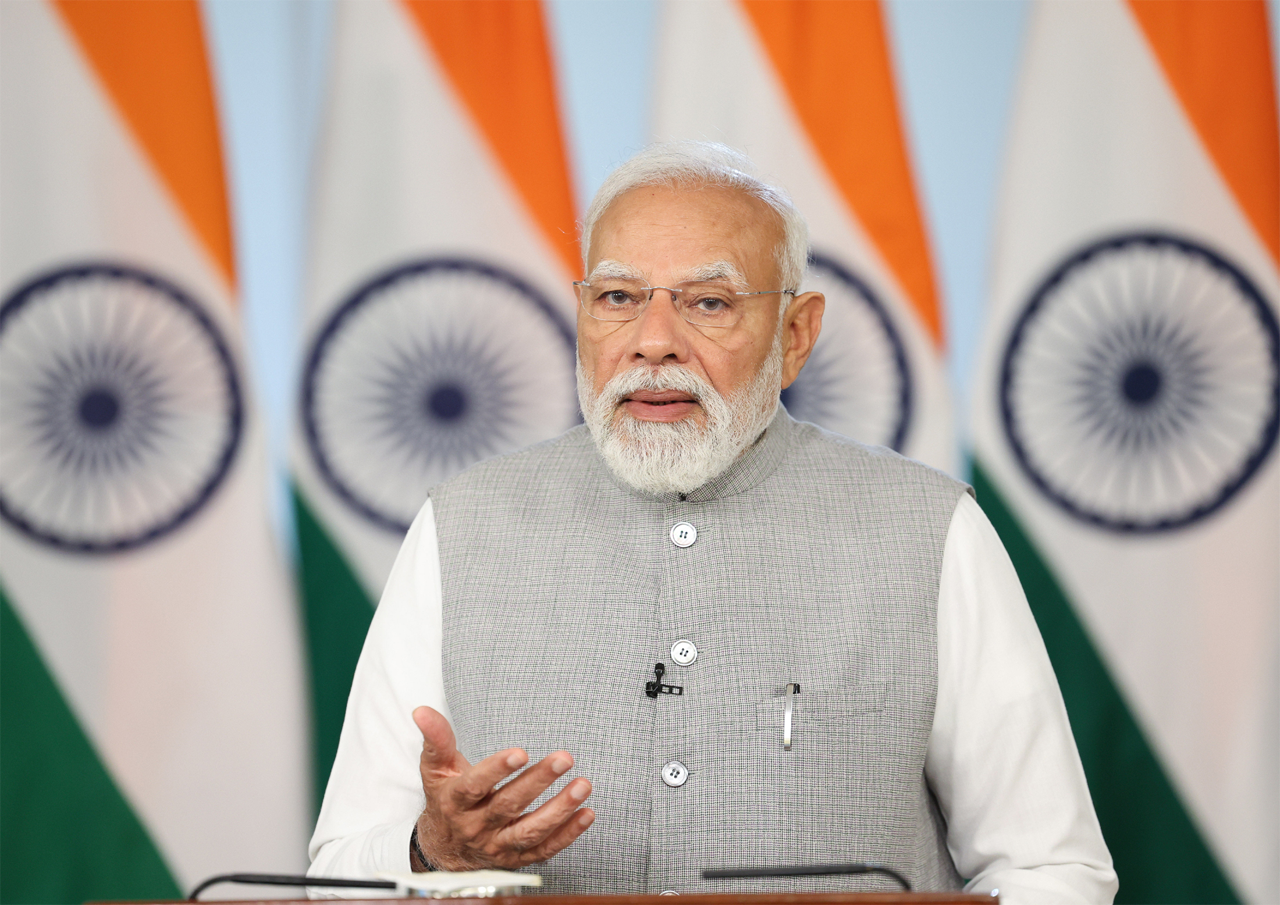
Prime Minister Narendra Modi on Friday urged g stakeholders to focus on effective implementation, delivery excellence and long-term nation building as India moves toward its goal of becoming a developed nation by 2047.
Welcoming participants from industry, academia, financial institutions and policymaking circles at the first post-Budget webinar of the year on “Technology, Reforms and Finance for Viksit Bharat,” the Prime Minister said the national budget must not be viewed as a short-term trading document driven by stock market reactions or income tax discussions. Instead, he described it as a policy roadmap that should be assessed on durable parameters such as infrastructure expansion, ease of credit flow, improvements in Ease of Doing Business, transparency in governance and the creation of new opportunities for citizens.
He emphasized that nation building is a continuous process and that every budget represents a step toward the larger objective of a developed India by 2047. Reforms, allocations and policy changes, he said, must be seen as part of this long journey.
Highlighting the importance of the post-Budget webinars, the Prime Minister said they should go beyond idea exchange and evolve into effective brainstorming platforms focused on implementation. Suggestions grounded in practical experience, he noted, would help refine economic strategies and improve outcomes. When industry, academia, analysts and policymakers collaborate, implementation improves and results become more precise.
Reflecting on India’s economic trajectory, the Prime Minister said the country has demonstrated extraordinary resilience over the past decade, driven by conviction-led reforms. He cited simplification of processes, improved Ease of Doing Business, expansion of technology-led governance and institutional strengthening as key contributors to this resilience. To maintain momentum, he stressed that reforms must be judged by their ground-level impact rather than announcements.
Download Nagaland Tribune app on Google Play

He called for greater use of artificial intelligence, blockchain and data analytics to enhance transparency, speed and accountability, alongside continuous monitoring through grievance redressal systems.
On infrastructure, the Prime Minister noted that over the past decade, the government has prioritized building long-term productive assets such as highways, railways, ports, digital networks and power systems. Public capital expenditure, he said, has increased significantly—from around ₹2 lakh crore 11 years ago to over ₹12 lakh crore in the current budget—sending a strong signal to the private sector.
He urged industry and financial institutions to step forward with fresh energy, greater participation in infrastructure, innovation in financing models and stronger collaboration in emerging sectors. Strengthening project sanction methodologies and improving appraisal quality through rigorous cost-benefit analysis and lifecycle costing would help reduce waste and delays, he added.
On foreign investment and financial markets, the Prime Minister said the government is working to simplify the foreign investment framework to make it more predictable and investor-friendly. Steps are also being taken to activate bond markets and ease bond transactions to improve access to long-term finance.
He described bond market reforms as key enablers of sustained growth and stressed the need to ensure predictability, deepen liquidity, introduce new instruments and manage risks effectively to attract long-term foreign capital. He invited stakeholders to provide clear and practical suggestions based on global best practices to strengthen both the foreign investment framework and bond markets.
Calling for a collaborative approach, the Prime Minister proposed developing a Reform Partnership Charter as a shared commitment among government, industry, financial institutions and academia. Such a charter, he said, would become an important guiding document on the path to a developed India.
He urged stakeholders to seize the opportunities presented in the budget and focus on swift, simple and inclusive implementation. Emphasizing that pre-budget consultations serve a different purpose, he clarified that the present focus should be on translating budget provisions into effective ground-level action for the benefit of all.