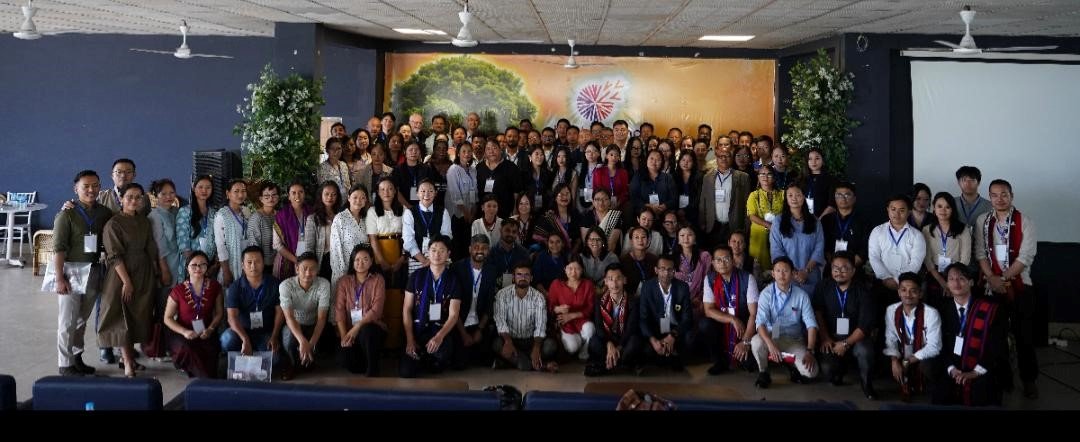
The North East Shiksha Samvaad 2026, held at Tetso College, Chümoukedima, convened a diverse group of educators, policymakers, civil society leaders, and institutional representatives to collectively reflect on building a future-ready education ecosystem in the Northeast.
The Shiksha Samvaad is a vital platform under the Shikshagraha movement—a nationwide, people-led effort to ensure every child in India has access to quality education, particularly within public schools, informed a press release.
Supported by HDFC Bank Parivartan in association with Mantra4Change and ELEVATE Foundation, the Samvaad brought together participants from across the region, including representatives from Samagra Shiksha, NECTAR, the Nagaland Board of School Education (NBSE), NGOs, and educational institutions.
Kevisato Sanyu, Founder, of NagaEd & Director of ELEVATE Foundation emphasised the shared responsibility of shaping education, stating, “We are the architects and designers of what education is.” He further highlighted the spirit of the Samvaad, noting, “We live freely. We disagree generously and we all leave with at least one resolution.”
The welcome address by Dr. Hewasa L. Khing (Principal of Tetso College) underscored the importance of contextual learning, emphasising the need to pick the thread of cultural and indigenous knowledge throughout the discussions. She also reflected on addressing both strengths and gaps in the system, particularly the transition of young people into the real world.
The first keynote by Dr. Darlando Thamni Khathing, Vice Chancellor of North East Christian University, highlighted the urgency of aligning education with a rapidly changing world. He noted, “Our education system must prepare for the changes that are happening, so that our students are future ready.” Stressing adaptability, he added, “It is important to inculcate a flexible mindset in our children and our education system, not to avoid, but to adapt to changing times.” He further emphasised that “the question is not where the opportunities are—they are already there. The question is to identify what needs to change and align in our education systems to be ready to tap into those opportunities.”
The first panel discussion, “From Infrastructure to Learning Impact: What is Changing on the Ground?”, was moderated by Ransom Lungleng and brought together experts working across education systems and implementation. Panelists included Dr. Bijano Murry, Joint Mission Director, Samagra Shiksha, Benjamin Vinito Chishi, Consultant, NECTAR, and Ruth Jami, GT, GMS Jaukie Sector B. The discussion highlighted on-ground realities, bridging policy and practice, and the ongoing shift from infrastructure-focused inputs to meaningful learning outcomes.
Download Nagaland Tribune app on Google Play

The second keynote by Dr. Mary N. Odyuo, Associate Professor, Nagaland University focused on redefining educational outcomes. She remarked, “As we move forward, we must redefine what education success really is. Our education system should support real world preparedness.” Her address emphasised nurturing not just academic achievement, but also confidence, identity, and life skills among learners.

The second panel discussion, “It Takes a Village: Building an Ecosystem for Future-Ready Children”, explored the importance of multi-stakeholder collaboration. Panelists brought diverse expertise, including youth development and community leadership, education program implementation and NGO leadership, early childhood education and systems operations. The discussion reinforced that enabling future-ready learning requires strong partnerships between communities, institutions, and government systems.
The event also featured a cultural interlude by Tetso College’s Dance Club. In the closing remarks, Shiroi Lily Shaiza-Sanyu, Co-founder, NagaEd urged participants to sustain the momentum beyond the event, encouraging them to continue engaging with one another and not let the Samvaad become a one-time dialogue, but rather an ongoing collective effort toward transforming education.