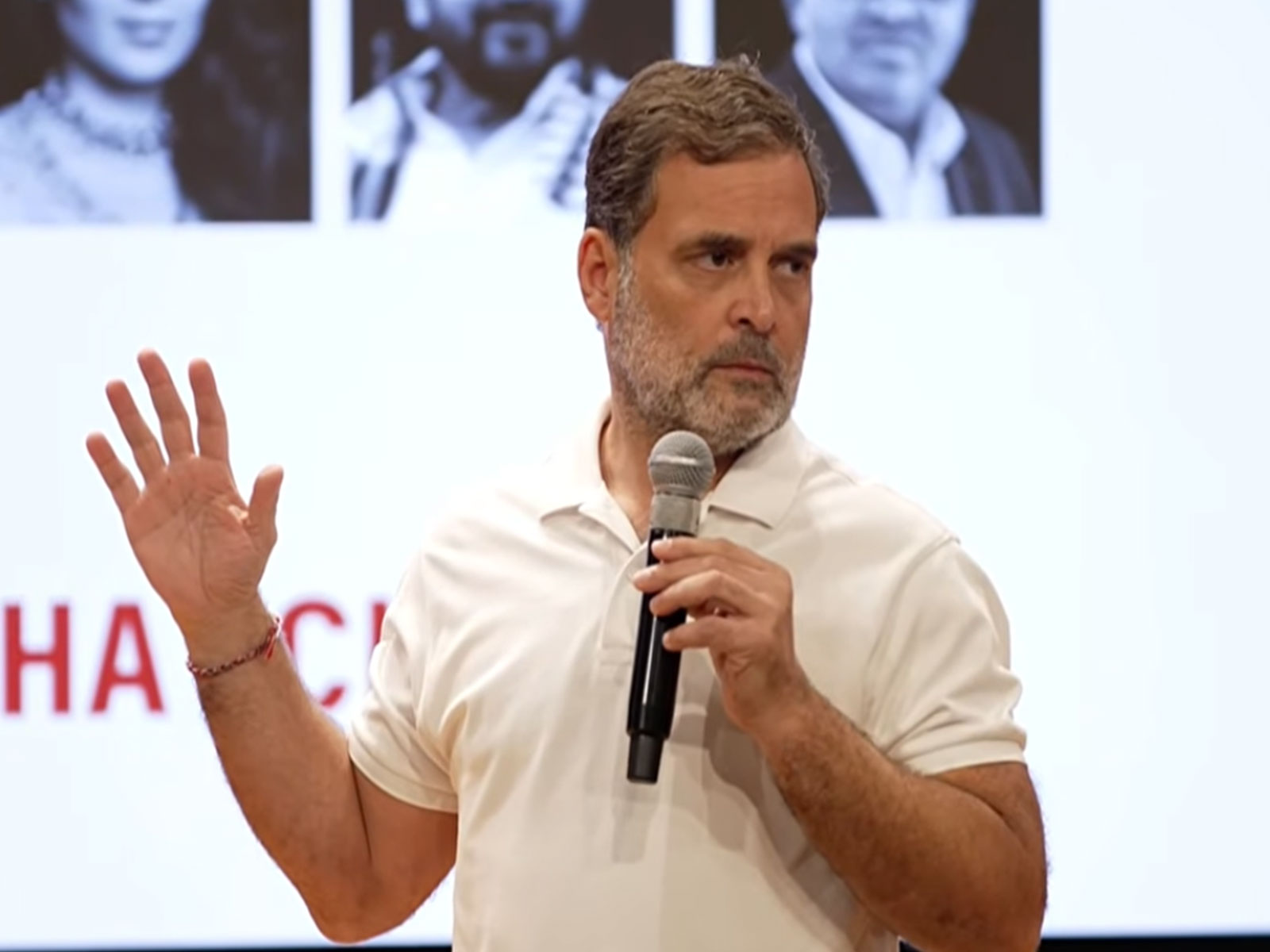
Congress MP and Leader of Opposition in the Lok Sabha Rahul Gandhi on Thursday demanded the resignation of Chief Election Commissioner Gyanesh Kumar, alleging serious irregularities in the electoral process and accusing the Election Commission of failing to adequately protect the sanctity of the vote.
Addressing a press conference at New Delhi, Gandhi launched a strong attack on the BJP-led government and the Election Commission, alleging that the electoral process and democratic institutions were being undermined.
“These people are Deshdrohis… A person who attacks the vote and fundamentally destroys India’s democratic institutions is nothing less than a deshdrohi. You can’t give him some other words. Deshdrohis will be punished. CEC Gyanesh Kumar must resign immediately,” Gandhi said.
He also alleged that Prime Minister Narendra Modi and Union Home Minister Amit Shah would be investigated for what he described as a conspiracy to “steal elections”.
“The fact is that the Prime Minister and the Home Minister of this country have attacked and destroyed the democratic architecture of India,” he alleged.
Questions SIR process
Gandhi’s remarks came in response to a report by The Indian Express claiming that Election Commissioners Sukhbir Singh Sandhu and Vivek Joshi had raised objections on several occasions over decisions and orders related to the Special Intensive Revision (SIR) of electoral rolls and other electoral matters.
According to the report cited by Gandhi, the two Election Commissioners raised objections at least 14 times over a period of 10 months. The reported disagreements included issues relating to Form 6, deletion of voters and access to electoral-roll databases.
Gandhi welcomed the reported objections, saying the two commissioners had acted appropriately in raising concerns.
“The two Election Commissioners have done a wise thing, and I appreciate it,” he said.
He accused the Central government and the poll panel of undermining democratic institutions and said the Congress would not remain silent if the electoral process was compromised.
“We are not going to let democracy be destroyed in India and sit silent, and the people responsible for this are going to be punished,” Gandhi said.
The Election Commission, however, has rejected the suggestion that the reported objections represented institutional dissent over its final decisions. The poll panel said operational queries, inputs and suggestions raised during the draft stage were part of its normal administrative and decision-making process.
The ECI maintained that all decisions taken by the Commission, including those relating to the SIR exercise, were unanimous and had the approval of all three Election Commissioners.
‘Vote is foundation of Constitution’
Gandhi said the controversy went beyond individual electoral procedures, arguing that the vote formed the foundation of India’s constitutional and institutional structure.
“The vote is the foundation of our country. Because it is from the vote, which is supposed to be protected by the Election Commission, that our Constitution gets its power. From the Constitution, our laws are made; and from our laws emerge our institutions. This is a chain,” he said.
He described the alleged manipulation of the electoral process as an attack on the broader democratic system.
“This is not just an attack on the vote. This is an attack on the idea, on the basic infrastructure, on the expression of every single Indian person,” he said.
Gandhi repeatedly used the phrase “vote chori” while alleging irregularities in the electoral process, also referring to what he called “kanoon chori” and “sanstha chori”.
“If the vote has been destroyed, then our Constitution has been destroyed. If our Constitution has been destroyed, our laws are illegal. If our laws are illegal, our institutions are meaningless,” he said.
Download Nagaland Tribune app on Google Play


Questions absence of anti-incumbency
Gandhi also questioned what he described as the apparent absence of anti-incumbency against the BJP in several states.
Citing his long involvement in politics, he said anti-incumbency was a fundamental feature of Indian electoral politics and had historically affected governments and political leaders across parties.
“I come from a political family, and I have spent more than 50 years in a political family. In India, there is a fundamental force called anti-incumbency that very quickly starts to resist any government. It does not spare anybody,” he said.
Referring to former Prime Minister Indira Gandhi, he said that even after the 1971 Bangladesh war and a period of high popularity, her government subsequently faced strong anti-incumbency.
Gandhi also cited electoral changes in Haryana, Maharashtra, Uttar Pradesh, Madhya Pradesh and Gujarat, arguing that political power had historically shifted between parties in these states.
“We can understand the popularity of a person, and the performance of a government, but we cannot understand how anti-incumbency disappears,” he said.
He argued that the issue warranted scrutiny of the electoral process rather than being viewed solely through the prism of the popularity or performance of a particular government.
Opposition, BJP positions
The allegations have triggered a political debate over the functioning of the Election Commission and the process of electoral-roll revision.
Congress leaders have questioned the Commission’s decision-making process and raised concerns over the reported objections during the SIR exercise. The BJP and the Election Commission have defended the revision process and rejected suggestions that the reported internal discussions reflected a lack of unanimity in the Commission’s decisions.
The Election Commission has maintained that the SIR and other electoral decisions were taken in accordance with established procedures and with the approval of all three commissioners.
(with ANI inputs)
