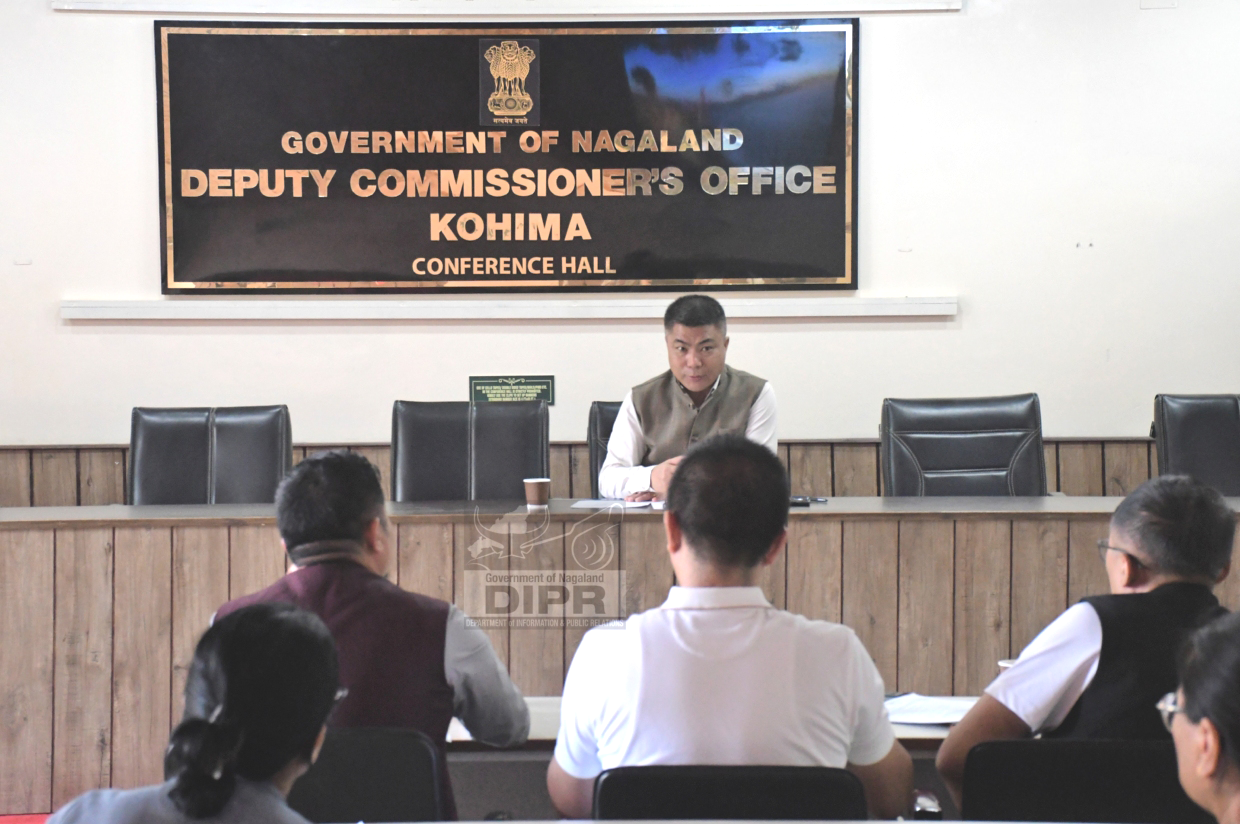
In a major effort to institutionalize citizen’ participation in governance, the Kohima District-Level Coordination Committee (DLCC) held a vital meeting for the “Reform Utsav” campaign on September 30 at the DC’s Conference Hall, Kohima.
The meeting was chaired by the Deputy Commissioner Kohima, B Henok Buchem. The core objective of this newly structured initiative is to systematically capture public feedback, ideas, and suggestions, transforming them into actionable administrative, procedural, and structural reforms.
During the session, Deputy Commissioner, B Henok Buchem announced that the “Reform Utsav” campaign will officially launch on October 2. The rollout is designed to run in convergence with the People’s Plan Campaign (PCC) and the Gram Panchayat Development Plan (GPDP).
The primary aim of the programme is to foster public awareness and directly engage citizens in conversations regarding citizen-centric administrative reforms, ensuring these ideas are integrated into local development frameworks.
Download Nagaland Tribune app on Google Play


The Deputy Commissioner highlighted a comprehensive list of central schemes, laws, and national campaigns that will form the core “Reform Agenda” distributed to the public during the awareness drive such as:
Sanitation & Water: Jal Jeevan Mission, Swachh Bharat Mission (G), Swachh Seva Aankelan, and JSB: Catch the Rain.
Legal Reforms: Bharatiya Nyaya Sanhita (2023), Bharatiya Nagarik Suraksha Sanhita (BNSS 2023), and Bharatiya Sakshya Adhiniyam (BSA 2023).
Welfare & Livelihood: One Nation One Ration Card (ONORC), Pradhan Mantri Garib Kalyan Anna Yojana (PMGKAY), Lakhpati Didis, and Watershed Development Projects.
Social & Digital Growth: Nasha Mukt Bharat Abhiyan, Digital Transformation in the Cooperative Sector, SVAMITVA, VB-G-RAM-G, and the National Consumer Helpline.
The committee members deliberated extensively on execution strategy, logistics, and manpower allocation for the grand launch.
The DC issued a directive to all Administrative Officers and Block Development Officers to maintain seamless coordination within their respective sub-divisions. Further, he explicitly requested key sectors particularly the Medical, Education, and Social Welfare departments to depute dedicated officials to oversee the ground operations.
In his closing remarks, the DC urged all line departments to take an active, visible role in the launching program. He emphasized that direct engagement with the public is essential to capturing raw feedback, which will ultimately make public service delivery simpler, faster, and far more effective for the citizens of Kohima.
