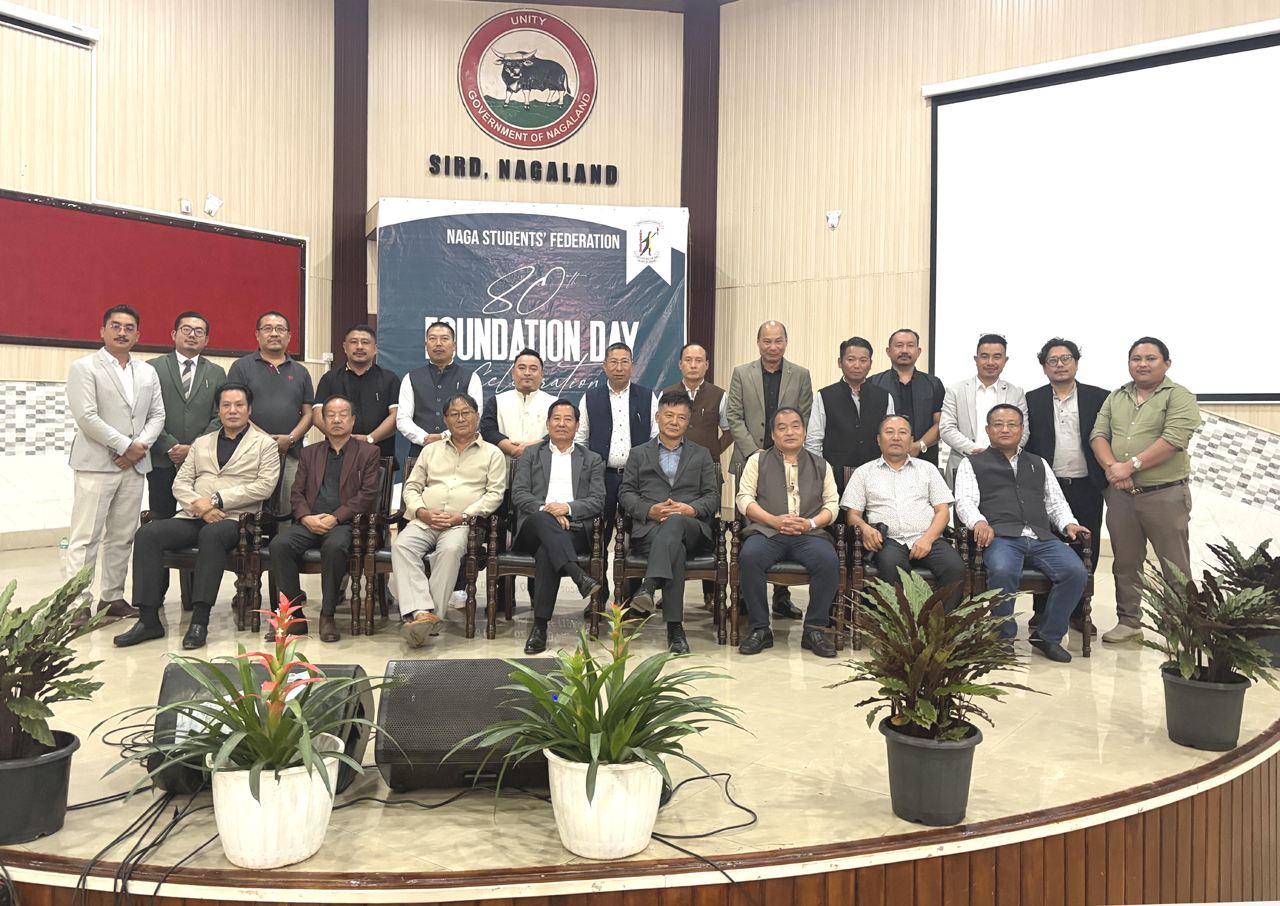
Nagaland Lok Sabha MP, Supongmeren Jamir on Thursday called upon members of the Naga Students’ Federation (NSF) to renew their commitment to the Federation’s founding ideals, uphold unity beyond political affiliations and inspire younger generations to serve the Naga people.
Addressing the 80th Foundation Day celebration of the NSF at Directorate of State Institute of Rural Development on Thursday , Jamir said the occasion was not only an opportunity to pay tribute to former leaders and members who had dedicated their lives to the organisation, but also a time for present members to reflect on their responsibilities and reaffirm their commitment to its principles.
He said the NSF had provided a common platform for generations of Naga leaders to serve the people, with many senior members having contributed significantly to the organisation’s journey. He acknowledged the contributions of former members who were no longer alive, stating that their efforts had helped sustain the federation and its mission.
Jamir emphasised that the Foundation Day should go beyond commemorating the past, urging members to consider what renewed dedication and commitment they could offer to the organisation each year.
Recalling the NSF’s enduring principles, he said the Federation had consistently stood for the unity of its members, the protection of their rights and the responsibility of safeguarding students’ interests.
Addressing the younger generation, the MP said the present members would eventually take over leadership responsibilities and pursue different professional paths, including public service, politics and other fields. However, he urged them to carry forward the values and lessons gained through their association with the NSF.
He further highlighted the organisation’s unique position in bringing together people across political differences, stating that leaders belonging to different political affiliations had continued to unite under the NSF banner for the larger cause of Naga unity.
“The Naga Students’ Federation is above any political party,” he said, stressing the need to preserve the organisation’s dignity and maintain its non-partisan character.
Jamir also urged members not to allow prevailing political circumstances to weaken the federation’s unity or dilute its commitment to the broader Naga cause.
Looking towards the future, he expressed hope that the present generation would remain committed to the organisation’s growth and live to witness its centenary celebration. He called for the blessings of the Almighty to grant members longevity and enable them to be part of the NSF’s 100-year milestone.
In another significant suggestion, Jamir urged the present NSF leadership to compile a comprehensive record of the organisation’s former office-bearers dating back to 1947, documenting not only their names and designations but also their subsequent careers and contributions to society.
He said such documentation would serve as an important historical record and inspire younger generations by highlighting the achievements and public service of former NSF leaders.
Jamir expressed confidence that senior members would be willing to contribute to the initiative, adding that a well-documented record of the federation’s alumni would help preserve its legacy and demonstrate how serving the organisation had shaped generations of leaders.
He concluded by encouraging the present leadership and younger members to uphold the NSF’s principles and work collectively towards strengthening the organisation for future generations.
NSF President calls for Naga unity, says Federation must uphold collective aspirations
NSF President, Mteisuding said the Federation was formed in 1947 during a crucial period in Naga history, when the departure of the British from India and the Naga people’s aspirations presented significant challenges.
He said that following the formation of the Naga Club and the Naga National Council (NNC), visionary Naga leaders recognised the need for the youth and student community to take an active role in advancing the aspirations of the Naga people.
With this vision, he said, the NSF was established as a platform to carry forward the collective aspirations of the Nagas.
Taking the opportunity to address the gathering, the NSF president urged people, particularly the younger generation, not to view the federation solely as an organisation concerned with students and youth.
He emphasised that while the NSF would never shy away from addressing issues affecting students and young people, its responsibility also extended to the larger political, social and collective aspirations of the Naga people.
Download Nagaland Tribune app on Google Play


Mteisuding observed that the Nagas were currently facing numerous challenges and stood at a crucial juncture, cautioning that divisions and tribalistic mindsets were weakening the collective strength of the people.
He said the NSF continued to stand firm because of the guidance and support of its senior members, its constituent units and the prayers of the Naga people.
Highlighting the geographical spread of the Naga population, he reminded the gathering that Nagas live across state and international boundaries, including Nagaland, Manipur, Assam, Arunachal Pradesh and Myanmar.
He cautioned against becoming complacent within the existing state boundaries, describing Nagaland as a temporary arrangement in the broader context of Naga aspirations.
The NSF president stressed that the history and sacrifices of earlier generations must not be forgotten, urging the Naga people to rise above regional and tribal divisions and strengthen their sense of shared identity.
Referring to challenges faced by Naga communities in the southern Naga areas, he said the NSF had repeatedly raised such concerns, adding that the present circumstances demanded greater unity and collective action from the people.
He further stated that the NSF, through a resolution adopted at its Second Federal Assembly, had reaffirmed its commitment to safeguarding Naga unity and collective identity.
Calling for solidarity among Nagas irrespective of their geographical location, Mteisuding urged the people to embrace one another and work together towards a common future.
He maintained that unity remained essential for addressing the challenges confronting the Naga people and preserving their collective aspirations for generations to come.
Krome highlights Naga struggle and right to self-determination
Dr Neingulo Krome, Secretary General of the Naga Peoples Movement for Human Rights (NPMHR), highlighted the historical struggles, collective sacrifices and the Naga people’s right to self-determination while speaking on “Naga Struggle and Rights”
Tracing the history of Naga resistance to the British invasion of Naga territory in 1832, Krome said the Nagas resisted British advances for 48 years before the colonial forces established a foothold in the region. He noted that the period was followed by 67 years of British colonial rule before the Naga political struggle entered another phase after 1947.
He highlighted the significance of 1947, when the NSF was formed, describing the subsequent decades as a period marked by military oppression and atrocities affecting Nagas on both sides of the Indo-Myanmar border.
Referring to the first ceasefire and peace talks between India and the Nagas in 1964, Krome said the negotiations failed to resolve the central question of sovereignty. Recalling the position attributed to then Prime Minister Indira Gandhi that India could offer anything except sovereignty, he said the Naga leadership maintained that sovereignty was fundamental to the people’s aspirations.
Krome emphasised that the Naga struggle was a collective movement in which every family and section of society contributed. Recalling the formation of the Naga Army in 1956, he said a system was established under which one young person from every 10 Naga families was expected to join the movement. Where families could not provide a recruit, they were required to contribute towards supporting another recruit.
He said the struggle extended beyond those who took up arms, as others worked in paddy fields, gathered resources, collected weapons and supplied rice to sustain the movement. He described the Naga movement as a collective struggle built on the sacrifices and contributions of ordinary people.
On the question of rights, Krome asserted that the Nagas’ distinct history and identity formed the basis of their claim to national identity and self-determination. He maintained that the statehood arrangement under the Indian Constitution had not fulfilled the political aspirations of the Naga people.
Expressing concern over the prolonged uncertainty surrounding the Naga political issue, he said younger generations had grown up amid confusion during nearly three decades of ceasefire. He stressed the need for greater clarity and a deeper understanding of the people’s historical and political aspirations.
Krome concluded by urging Nagas to reflect seriously on their history and rights, asserting that the community must acknowledge its own historical experiences and understand its aspirations.
Earlier the programme was chaired by NSF VP Vimeyiekho Vitso. The foundation day began with the hoisting of the NSF flag, followed by a procession and honorary welcome of senior NSF leaders. The invocation was offered by Rev Fr Dr Vizosieo Solomon Vizo, Director of Don Bosco Hostel, Kohima Science College, Phezhu, Jotsoma.
A tribute titled “You Are Our Heroes” was presented by Kevi Children Home, Kohima, in honour of NSF pioneers and leaders, while Badze Leshüki presented “God Bless Nagaland.”
One of the highlights was the formal declaration of “Powered 60” by NSF General Secretary Kenilo Kent, an initiative aimed at providing full sponsorship to 60 aspirants preparing for competitive examinations. A rendition of “Kuknalim” was presented by Lochumbeni K. Kikon, a Class IX student of Isaiah Ability Higher Secondary School, Wokha. The programme also featured a pledge for Naga unity.