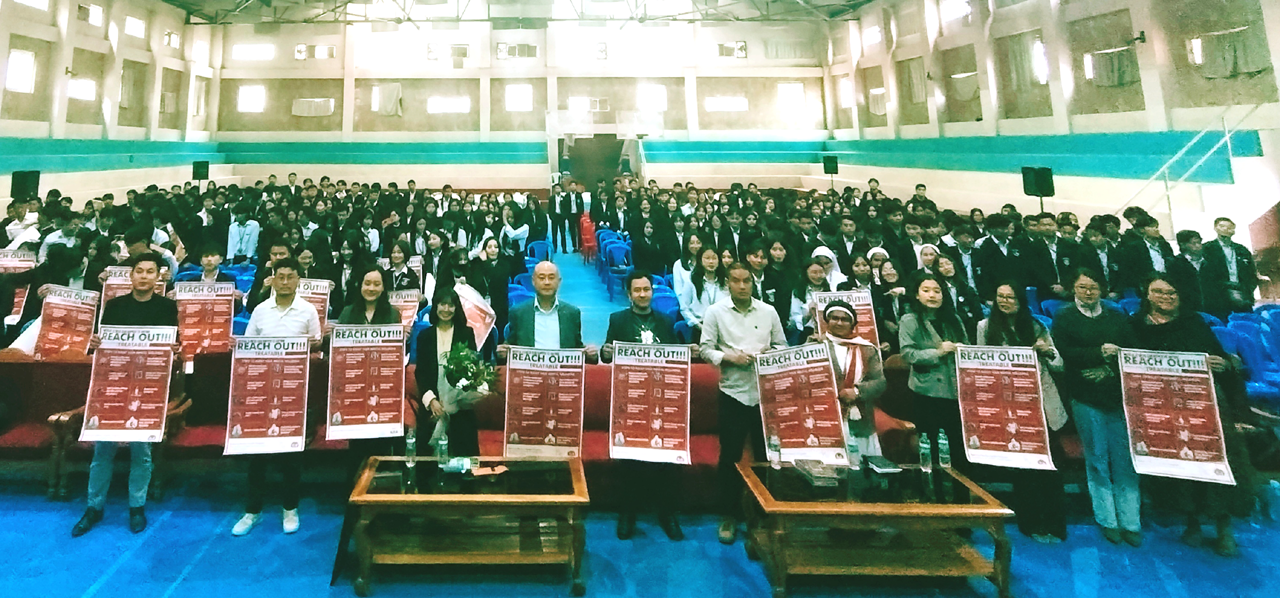
The Alumni Association of St. Joseph’s College (Autonomous), Jakhama, in collaboration with the District Mental Health Programme (DMHP), Kohima, under the National Health Mission, Nagaland, organised a mental health awareness programme on Monday at the Bishop Abraham Memorial Indoor Stadium on the college campus.
Veronica Nriame, Psychiatric Social Worker at Naga Hospital Authority Kohima (NHAK), was the keynote speaker.
The programme began with a role-play depicting four conditions—walking normally, trying to hear, being physically challenged and being blind—to illustrate that when discussing depression and anxiety, one cannot always know what is happening in another person’s mind.
Addressing the gathering, Nriame said stigma continued to surround mental health and called for a change in mindset. She emphasised that mental health was not about being “half crack”, but about understanding oneself, practising self-care and living with purpose. She said mental healthcare was a basic right and as important as physical health.
Speaking on depression, she identified sleep disturbances, lack of concentration, loss of pleasure, frequent crying and feelings of emptiness as possible symptoms that could lead to isolation. She cautioned against self-diagnosis, stressing that only a medical professional should diagnose a mental health condition.
On anxiety, she explained that nervousness was normal but could develop into a disorder when it led to avoidance of situations, panic and trauma. Citing a case involving a person who experienced sexual abuse during the COVID-19 pandemic and subsequently suffered traumatic nightmares, she stressed that medication and therapy went hand in hand.
Highlighting gadget and gaming addiction, Nriame described addiction as a condition in which a person loses control over their behaviour. She expressed concern that phone addiction was leading to social isolation among teenagers and urged students to practise digital detox, giving priority to books and human connections over mobile phones.
On drug and alcohol abuse, she said she had seen college students in uniform queuing for Opioid Substitution Therapy at NHAK to overcome drug dependence, with some clients having started using drugs as early as Class 8. She explained that addiction was treatable through detoxification, followed by rehabilitation. Warning that dependence could begin with small amounts, she cited the case of a 60-year-old struggling to regain control of his life and called for collective efforts to make Nagaland free from drugs and alcohol.
Addressing suicide prevention, she said suicide was not a sign of weakness but an indication that a person needed help. Referring to the impact of frequent parental conflicts on teenagers, she said some young people resorted to self-harm in such circumstances. She emphasised the importance of timely intervention and urged everyone to become a source of hope and support for those in distress.
On stress, Nriame described it as an interaction between an individual and their circumstances, noting that it remained a part of life. She said stress should not always be viewed negatively, as it could also build confidence and motivate people to achieve their goals. She encouraged participants to identify the sources of their stress.
Speaking on mental wellness, she highlighted the importance of emotional regulation through naming and validating emotions, identifying triggers, meditation, conversations, journalling and maintaining good sleep habits. She also stressed building resilience, improving self-esteem and confidence, using technology wisely, maintaining good nutrition and exercising regularly.
Download Nagaland Tribune app on Google Play


She noted that exercise releases endorphins and can improve memory and mood, while activities such as gardening, cooking and pursuing hobbies provide opportunities to unwind. Encouraging students to acknowledge and express their feelings, she said the heart and mind were precious and that people should find healthy ways to release what troubled them, including dancing and singing.
Nriame concluded that mental and emotional wellness were not luxuries but essential to a healthy and fulfilling life. She urged students not to turn to alcohol or drugs when feeling sad, but instead to share their concerns with counsellors and people they trusted.
She also outlined available pathways to mental healthcare, including Tele-MANAS (Tele Mental Health Assistance and Networking Across States), the digital arm of the DMHP, and the District Mental Health Programme at NHAK. She said the facility had psychiatrists, psychiatric social workers, psychiatric nurses and clinical psychologists, offering free consultation, therapy and medicines.
The DMHP is currently functional in 11 districts of Nagaland—Kohima, Dimapur, Wokha, Phek, Longleng, Tuensang, Mokokchung, Kiphire, Peren, Mon and Zunheboto. Those seeking assistance can contact 9402079798.
Earlier, Rev Fr C Joseph, Counsellor, SJC (A), invoked God’s blessings, while Edward Patton, Vice President (General), chaired the programme. The welcome address was delivered by Thepfuvizo Peter Vizo, President, and the vote of thanks by Dr Emilo Kikon, Joint Secretary of the Alumni Association, SJC (A).