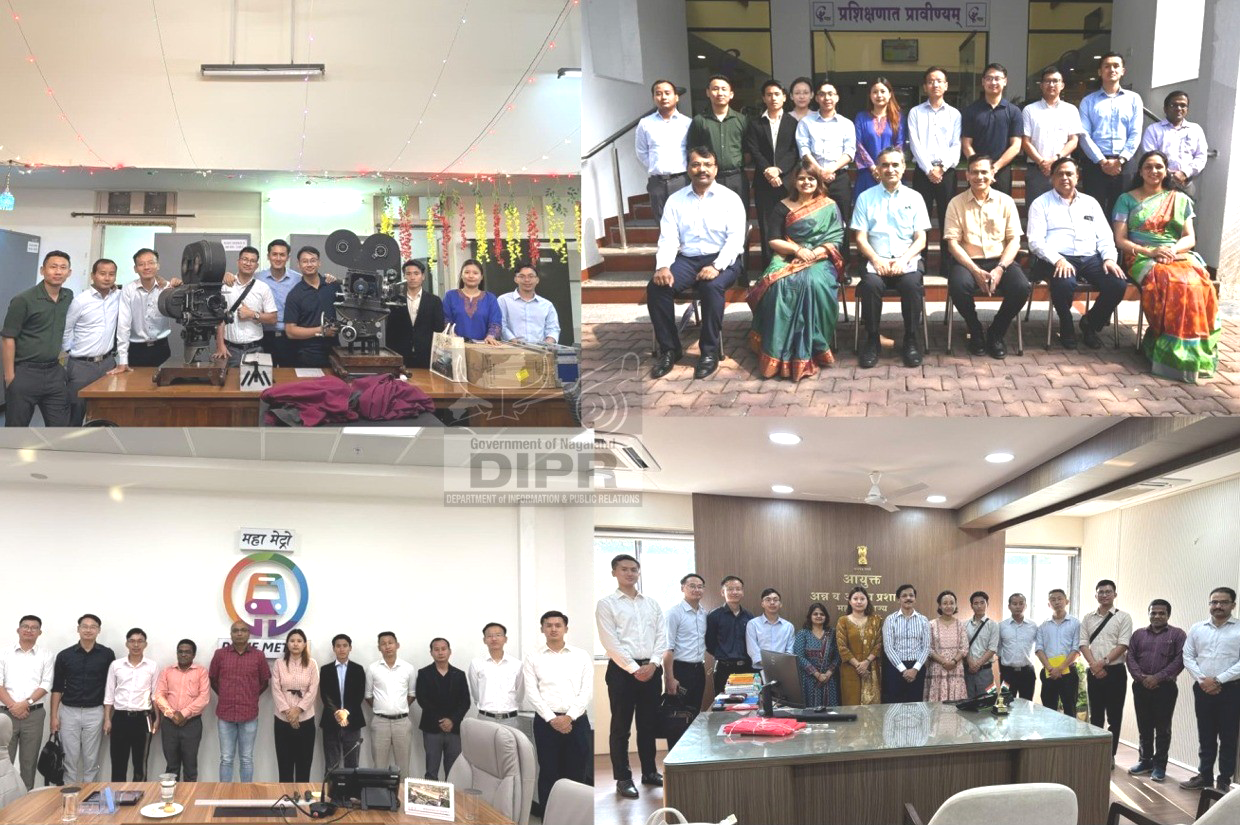
The Nagaland Civil Services Probationers, Batch of 2025, commenced the Maharashtra leg of their Bharat Darshan on November 1, reporting to the Yashwantrao Chavan Academy of Development Administration (YASHADA), Pune. The five-day programme combined classroom interactions with institutional visits and cultural and heritage exposure, presenting a broad view of Maharashtra beyond its identity as India’s financial and industrial centre.
The classroom sessions covered the functioning and policy priorities of the Maharashtra Government, including the Maharashtra industrial policy, startup ecosystem, ethical use of artificial intelligence, legal case studies and the environmental work of the 14 Trees Foundation. Discussions on land administration highlighted digitisation and easier access to land records. Initiatives associated with the MahaBhumi platform illustrated how technology can improve access, traceability and transparency in land-related services.
Sessions with the Women and Child Development Department drew attention to support, care and rehabilitation for vulnerable women and children, including widows and orphaned children. The discussions underscored the importance of linking welfare delivery with protection, institutional and community-based care, rehabilitation and pathways to self-reliance.
The probationers were also introduced to Maharashtra’s startup and entrepreneurship initiatives, including incubation, mentoring, seed-funding and innovation linkages that can help young enterprises access markets and finance.
Field engagements included the Innovation Hub at the National Chemical Laboratory (NCL), an interaction at the Food and Drug Administration (FDA), Maharashtra, and a visit to the Pune Metro project to understand urban mobility and public transport infrastructure. At the Film and Television Institute of India (FTII), Pune, the probationers were introduced to the institutional ecosystem supporting cinema, television and the creative arts.
The programme also explored Maharashtra’s cultural and natural heritage. The visit to Asia Plateau, Panchgani, provided an opportunity to engage with its institutional and developmental setting. At Devrai Art Village, the probationers observed how local artisans work with materials such as metal and stone while experimenting with contemporary forms that draw upon traditional Indian artistic practices. The visit demonstrated the potential of craft-based livelihoods, design innovation and responsible tourism to support local communities.
The field exposure to Mahabaleshwar included visits to Kate’s Point and Arthur’s Seat, offering an appreciation of the region’s distinctive topography and tourism potential. At MAPRO, the group observed the processing and marketing of locally associated food products, including jams, crushes, confectionery and chocolates.
Download Nagaland Tribune app on Google Play


The visit illustrated how value addition, branding and visitor experiences can strengthen a regional tourism economy and create linkages for local producers. The group also visited Prabhat Studios, gaining an appreciation of the region’s film heritage.
The Maharashtra leg offered practical lessons for adapting governance innovations to Nagaland’s context. Digitised land records and online mutation services point to the value of accurate, updated and accessible records, supported by clear workflows and citizen-facing services. The welfare interventions discussed by the Women and Child Development Department reinforce the need for coordinated protection, rehabilitation and livelihood support for vulnerable women and children.
The startup ecosystem offers useful ideas for strengthening entrepreneurship in Nagaland through local incubation, mentoring, institutional partnerships, access to finance and market linkages, particularly for enterprises rooted in crafts, agriculture, food processing and tourism.
The visits to NCL, FDA and Pune Metro further highlighted the importance of research-industry collaboration, effective regulatory administration and integrated urban infrastructure. Devrai Art Village and MAPRO demonstrated how local skills and products can be connected to wider markets through innovation, quality, packaging and tourism. These experiences provide a useful basis for considering how state-level initiatives may be adapted to Nagaland’s geography, institutional capacity and local strengths.
The five-day programme, coordinated by YASHADA, offered the probationers practical insights into Maharashtra’s governance, innovation and cultural landscape, and valuable perspectives for responsive, locally grounded administration in Nagaland.