Scholars from India and abroad explore the relationship between literature, art, music, indigenous knowledge and ecology
Nagaland University’s Kohima Campus witnessed an international gathering of scholars on November 12 with the inauguration of a two-day seminar titled “Where Trees Become Texts in Environmental Humanities: Art, Music, Literature & Pedagogy”. Jointly organised by the Department of English and the Department of Teacher Education, the seminar is being held on November 12 and 13 in hybrid mode at the Conference Hall of the Department of Commerce, Kohima Campus, Meriema.
The seminar brings together 20 national and international resource persons, along with research paper presentations by scholars from India and other parts of the world. The interdisciplinary initiative seeks to explore the connections between literature, art, music, education, indigenous knowledge and the natural environment.
The inaugural programme was graced by Prof Jagadish Kumar Patnaik, Vice-Chancellor of Nagaland University and Chief Patron of the seminar, virtually. Others present included Prof. Lungsang Zeliang, Dean, School of Humanities and Education and Co-Patron; Prof MAJ Khan, Head, Department of English; Prof Nigamananda Das, Senior Professor, Department of English and Advisor to the seminar; academicians, faculty members, research scholars, students and invited delegates from various institutions.
Delivering the inaugural address, Prof Patnaik emphasised the growing importance of interdisciplinary academic engagement in responding to contemporary environmental concerns. He highlighted the responsibility of universities to encourage intellectual innovation, ecological awareness and socially relevant research.
He observed that environmental challenges should not be viewed merely as scientific or technological problems, but also as ethical, cultural and educational questions requiring collective intellectual engagement. He said the seminar’s location in Northeast India, a region known for its rich biodiversity and indigenous ecological traditions, added particular relevance to the deliberations.
Prof Zeliang, in his address, highlighted the transformative role of the humanities and education in cultivating environmental consciousness. He emphasised the importance of understanding the natural world as an integral part of human culture, collective memory, indigenous identity and literary imagination.
He also stressed the need for educational approaches that encourage sensitivity towards biodiversity, ecological interdependence and sustainable living. The relevance of indigenous ecological traditions, particularly those associated with communities in Northeast India, provided an important context for the seminar, he said.
The welcome-cum-concept note address was delivered by Dr Subhashis Banerjee, Assistant Professor, Department of English and one of the conveners of the seminar. Introducing the theoretical foundations of the event, he began with an original rhythmic poem celebrating the silent wisdom of trees and their intimate relationship with human existence.
The poem portrayed trees as witnesses to history, custodians of memory and symbols of hope, resilience and ecological continuity. Reflecting on the suffering of nature under human exploitation, it also emphasised the possibility of renewal through compassion, coexistence and environmental responsibility. Its central metaphor suggested that every leaf carries a language, every seed preserves a story and every tree embodies an unwritten text awaiting sensitive interpretation.
Building on this poetic introduction, Dr Banerjee discussed environmental humanities as an interdisciplinary field connecting literature, philosophy, cultural studies, art, music, ecological criticism and pedagogy. He highlighted the emerging relevance of phytohumanities, plant agency, ecological aesthetics and more-than-human perspectives in contemporary academic discourse.
He observed that the metaphor of trees becoming texts challenges conventional anthropocentric understandings of knowledge and encourages scholars to recognise plants and landscapes as meaningful participants in cultural, historical and ecological relationships. He also highlighted the importance of indigenous ecological knowledge systems, particularly in Northeast India, where forests, rivers, mountains and plant life remain deeply embedded in oral traditions, community identities and cultural practices.
Dr Banerjee expressed gratitude to Prof John Charles Ryan for his scholarly contributions to plant humanities and ecological literary studies, which provided intellectual encouragement for conceptualising the seminar. He also acknowledged the resource persons from India and abroad who accepted the invitation to participate, including academicians who undertook long journeys and made personal arrangements to attend.
He thanked the university authorities, collaborating institutions, faculty colleagues, research scholars, student volunteers and administrative personnel for their support. Special appreciation was extended to Dr Prasenjit Pal, Assistant Professor, Department of Teacher Education and Co-Convener of the seminar, for his involvement in planning and coordinating the event.
Prof Khan welcomed the guests and participants and acknowledged the significance of organising an international seminar on an emerging area of academic inquiry. The programme also recognised the academic guidance of Prof Das, whose scholarly encouragement and institutional support contributed to the development of the event. The inaugural ceremony included a felicitation programme honouring distinguished academic personalities and visiting resource persons.
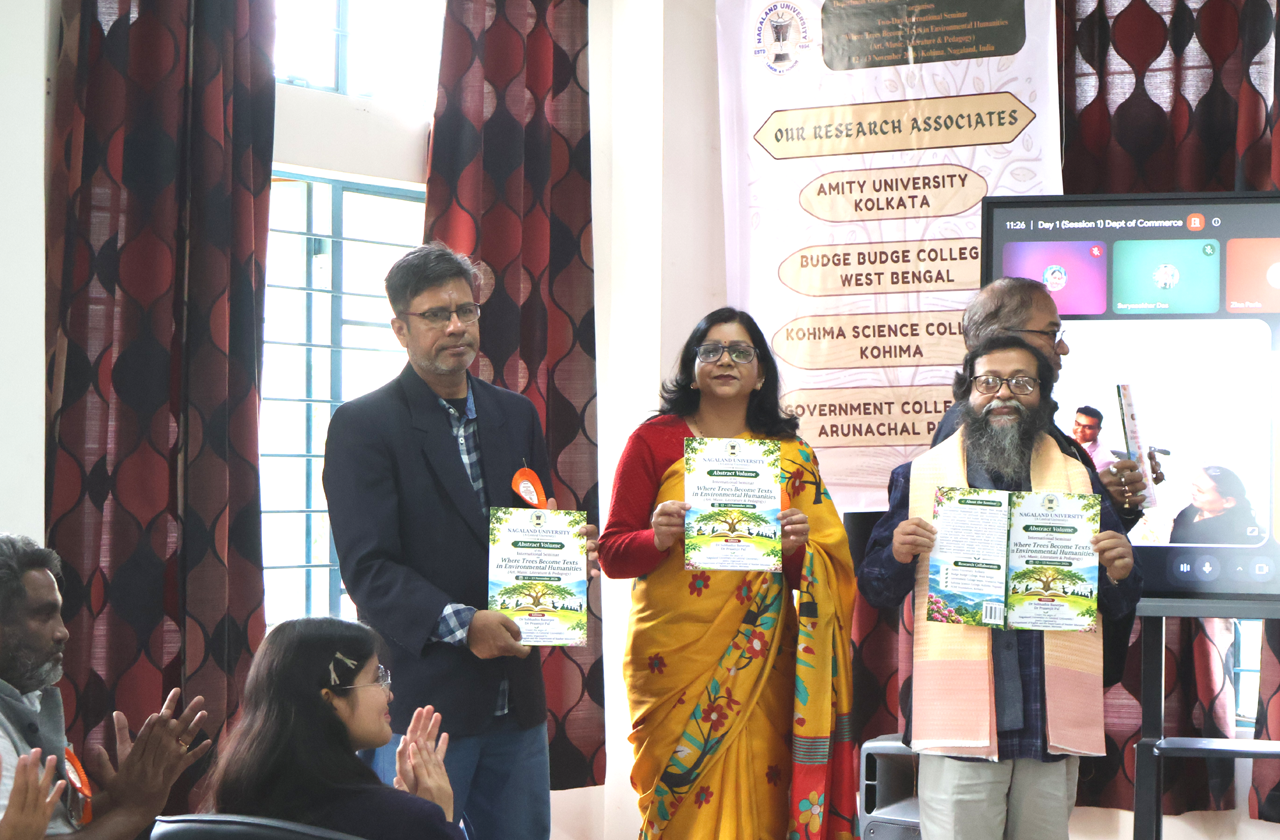
A major highlight was the ceremonial release of the seminar’s Abstract Volume, edited by Dr Banerjee and Dr Pal. The publication brings together research abstracts representing diverse perspectives on environmental humanities, literature, ecological philosophy, indigenous knowledge, plant studies, music, artistic expression and pedagogy. Its release marked an important step towards documenting the academic contributions and promoting research dissemination and international scholarly exchange.
The first day’s plenary sessions featured scholars from reputed national and international institutions. Prof Syamal Chakrabarti, Department of Chemistry, University of Calcutta, delivered the principal plenary lecture, contributing to the seminar’s interdisciplinary orientation.
Download Nagaland Tribune app on Google Play


The first parallel session featured Prof Nigamananda Das, Senior Professor, Department of English, Nagaland University; Prof Angshuman Kar, Professor and Director, Centre for Australian Studies, Department of English and Culture Studies, University of Burdwan; Dr Teresa Botelho, Faculty of Social Sciences and Humanities, NOVA University of Lisbon, Portugal; and Prof Himadri Lahiri, Retired Professor and Adjunct Professor, Department of English, Netaji Subhas Open University, formerly University of Burdwan.
The second parallel session brought together Dr Aniket De, Assistant Professor, Department of History, University of California, San Diego, USA; Dr Nikoleta Zampaki, Adjunct Lecturer, Department of English Studies, University of Information Technology and Management, Poland; Dr Mai Thi Khanh Van, Lecturer, School of Hospitality and Tourism, Hue University, Vietnam; Prof Niladri Sekhar Dash, Professor and Head, Linguistic Research Unit, Indian Statistical Institute, Kolkata; Dr Amrita Bhattacharya, Associate Professor, Amity Institute of English Studies and Research, Amity University Kolkata; and Dr. Prithwa Deb, Assistant Professor, Department of English, Debraj Roy College (Autonomous), Assam.
Other resource persons associated with the two-day seminar include Prof Pawel Piszczatowski, Professor and Director, Environmental Humanities Centre, Faculty of Modern Languages, University of Warsaw, Poland; Dr Francis Joy, University of Lapland Arctic Centre, Rovaniemi, Finland; Dr Keitaro Morita, Rikkyo University, Tokyo, Japan; Prof Somdev Banik, Professor and Head, Department of English, Tripura University; Dr Pritha Banerjee, Assistant Professor, Department of English, Vidyasagar Metropolitan College; Dr Shreya Chakravorty, Assistant Professor and Head, Department of English, Budge Budge College; Gireesh Cholayil, Assistant Professor, Department of English, Government College, Kondotty, University of Calicut; Dr Tanuka Chatterjee, Assistant Professor, Department of English and Modern European Languages, University of Lucknow; and Prof Anju Verma, Professor and Head, Department of Teacher Education, Nagaland University.
The seminar is being organised in collaboration with Amity University, Kolkata; Budge Budge College, West Bengal; Government College Seppa, Arunachal Pradesh; Kohima Science College, Nagaland; and PURE Foundation, Kolkata.
The first day’s proceedings provided a platform for scholars from different disciplines to examine the natural world through literature, art, music and pedagogy. The deliberations highlighted the importance of recognising ecological wisdom embedded in indigenous traditions while engaging with contemporary developments in environmental philosophy, posthumanism and interdisciplinary literary criticism.
The participation of scholars from international institutions also provided an opportunity to strengthen Nagaland University’s academic links and promote global intellectual collaboration.