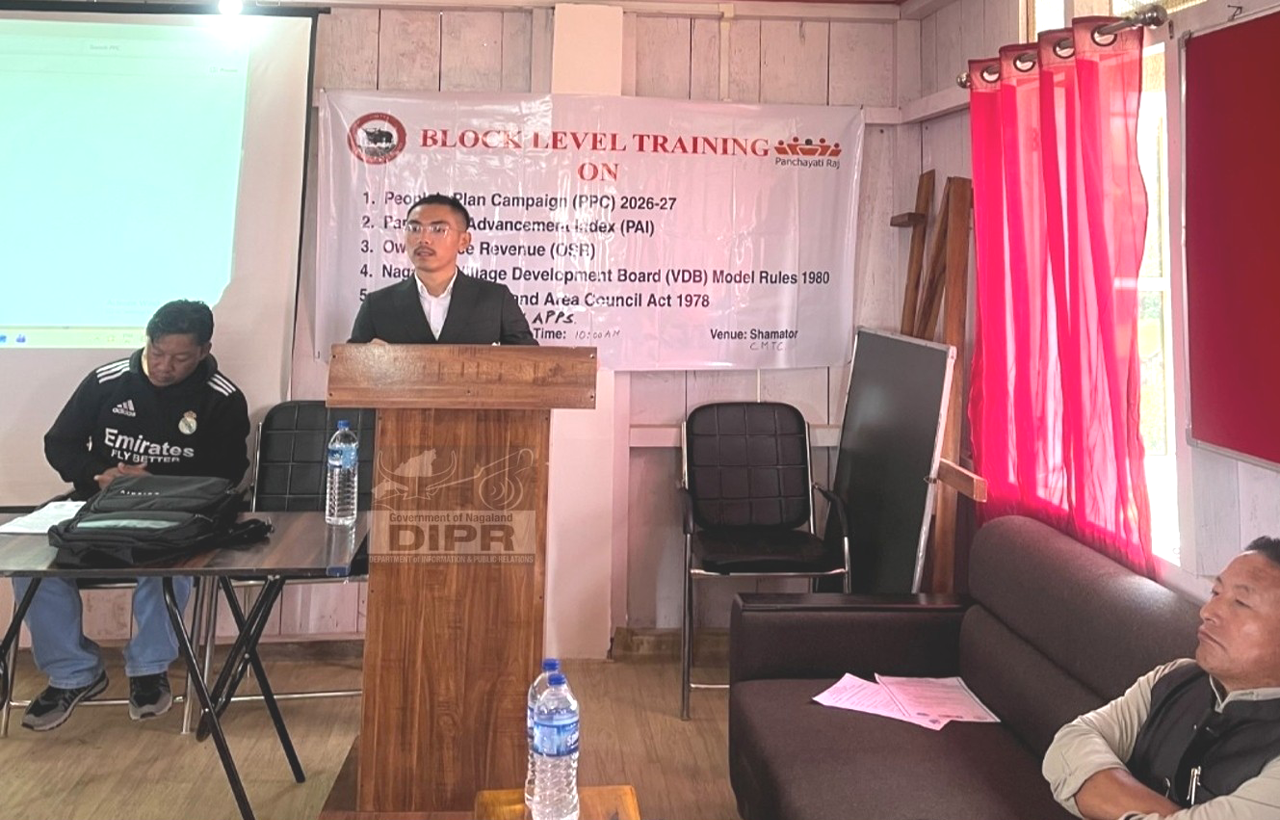
A Block Level Training under the Revamped Rashtriya Gram Swaraj Abhiyan (RGSA) was conducted at the Community Management Training Centre, Shamator on November 13.
The programme commenced with a welcome address by Block Development Officer (BDO), Shamator, Penwang Konyak, who welcomed the participants and highlighted the importance of the training in strengthening grassroots governance and enhancing the institutional capacity of village-level functionaries.
The training covered key aspects of rural governance and development, including the People’s Plan Campaign (PPC), preparation of the Gram Panchayat Development Plan (GPDP), utilisation of the Panchayat Nirnay App, Nagaland Village Council Act, VDB Model Rules, Panchayat Advancement Index (PAI) and Own Source Revenue (OSR). The sessions focused on familiarising participants with relevant provisions, planning mechanisms, digital platforms and institutional responsibilities essential for effective village administration and participatory development.
Addressing the gathering, EAC (HQ), Shamator, Mekato J Aye, highlighted that the aspirations and developmental needs of rural communities are changing with time. He emphasised that village-level institutions must look beyond the conventional approach of managing government schemes and funds, and take a more proactive role in identifying emerging community needs and planning initiatives that are sustainable, community-driven and future-ready.
Download Nagaland Tribune app on Google Play


He stressed that every Village Council must develop a forward-looking vision for its village, taking into account local resources, aspirations, opportunities and long-term developmental priorities.
He further underscored the importance of understanding the legal and institutional framework governing Village Councils and Village Development Boards, noting that these institutions have distinct but complementary responsibilities. Emphasising transparency, proper coordination and collective responsibility, he observed that institutional effectiveness depends on individuals understanding and respecting their respective roles and mandates. He reminded participants that positions may change and individuals may come and go, but institutions must remain stronger than any individual.