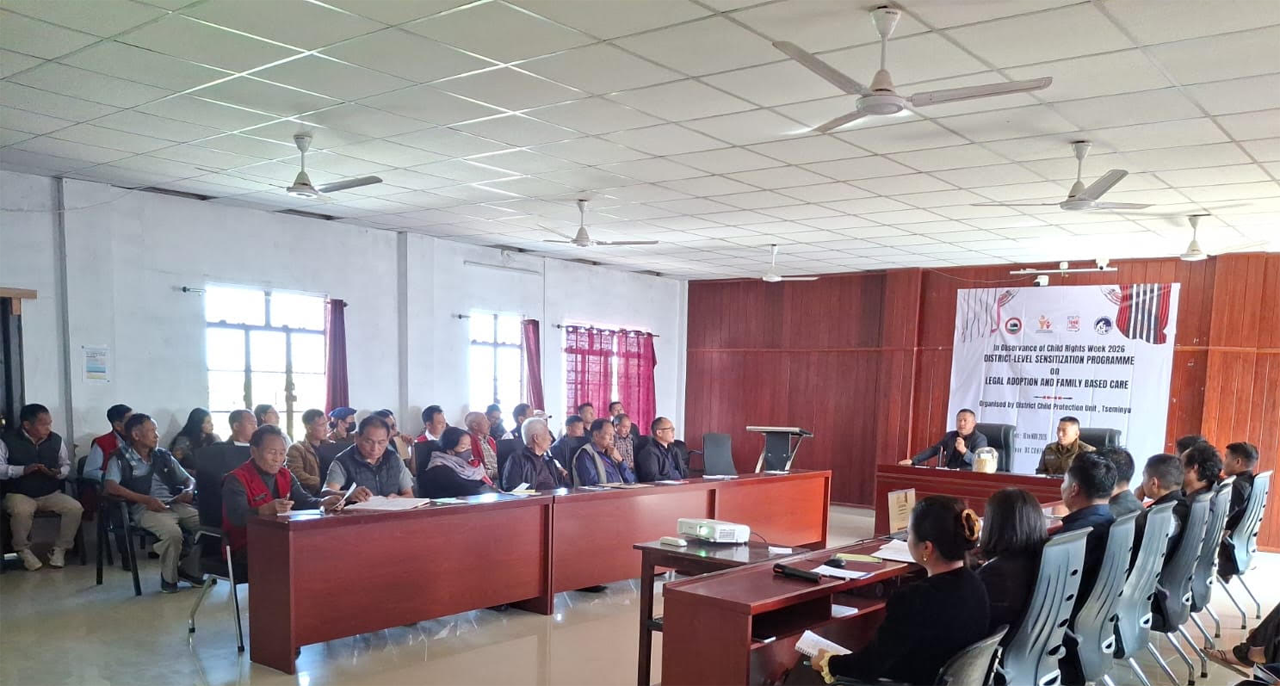
The District Child Protection Unit (DCPU), Tseminyu, organised a District-Level Sensitisation Programme on Legal Adoption and Alternative Family-Based Care on November 16 at the DC Conference Hall, Tseminyu, in observance of Child Rights Week 2026. The programme focused on child protection, care, and rehabilitation.
The programme began with a welcome address by Ajano Ezung, Protection Officer (NIC), DCPU. Japheth Woch, Deputy Commissioner, Tseminyu, introduced the DCPU team to the participants. In his address, he emphasised the importance of awareness and understanding of child protection laws, reiterating that ignorance of the law is no excuse.
He also highlighted the importance of collective responsibility in safeguarding children. Throughout the programme, the Deputy Commissioner moderated the discussions following each technical session, facilitating interaction and deliberations between the speakers and participants.
The technical sessions covered three key areas: Legal Adoption and Alternative Family-Based Care, Children in Need of Care and Protection (CNCP), and Children in Conflict with Law (CCL).
Adv Berta Tep, Advocate, Gauhati High Court, Kohima, spoke on Legal Adoption and Alternative Family-Based Care, explaining the legal framework under the Juvenile Justice (Care and Protection of Children) Act, 2015, and the Adoption Regulations, 2022. She highlighted that adoption is a legally regulated process and not merely a private arrangement between families. She explained the categories of children eligible for adoption, namely orphaned, abandoned and surrendered children, and stressed that a child must be declared legally free for adoption through the prescribed procedures.
She also elaborated on alternative family-based care, including foster care, sponsorship and kinship care, emphasising that children should be provided with a safe, stable and nurturing family environment. She further highlighted the role of the Central Adoption Resource Authority (CARA), State Adoption Resource Agency (SARA) and district-level stakeholders in ensuring proper coordination and adherence to legal procedures.
Sogwalo Magh, Chairman, Child Welfare Committee (CWC), Tseminyu, presented on Children in Need of Care and Protection (CNCP), explaining that a child is any person who has not completed 18 years of age. He highlighted the different circumstances under which children may require care and protection, including abuse, neglect, exploitation, abandonment, trafficking and lack of adequate parental care.
He also elaborated on the statutory role of the CWC in receiving children, conducting inquiries, deciding suitable care and rehabilitation measures, and facilitating restoration and family-based care wherever appropriate.
Download Nagaland Tribune app on Google Play


He emphasized on mandatory reporting of abandoned, lost or unsupported children within the stipulated 24 hours, the importance of contacting Child Helpline 1098, DCPU or CWC, and the need to maintain the confidentiality and identity of children. He stressed that the best interests, safety and dignity of the child must remain the primary consideration in every intervention.
Jetilo Apon, Member, Juvenile Justice Board (JJB), Tseminyu, spoke on Children in Conflict with Law (CCL), highlighting the distinction between ordinary childhood misbehaviour, which requires proper parental guidance and correction, and criminal offences, which must be addressed through the appropriate legal process. He emphasised the responsibility of parents and guardians in supervising and guiding children and highlighted the role of Village Councils, Gaon Buras, churches and community leaders as important partners in child protection.
He further cautioned against concealing criminal matters or settling them privately at the family, clan or village level when intervention by the competent authorities is required.
During the session, it was reported that Tseminyu recorded seven CCL cases involving 18 boys and no girls during 2025–2026. The cases were mostly related to petty offences, with lack of proper guidance, awareness and supervision identified as contributing factors. All cases received during the period had been disposed of as of October 2026, with no pending cases.
The programme concluded with a vote of thanks by Kvulo Kent, Project Coordinator, Child Helpline (CHL), Tseminyu.