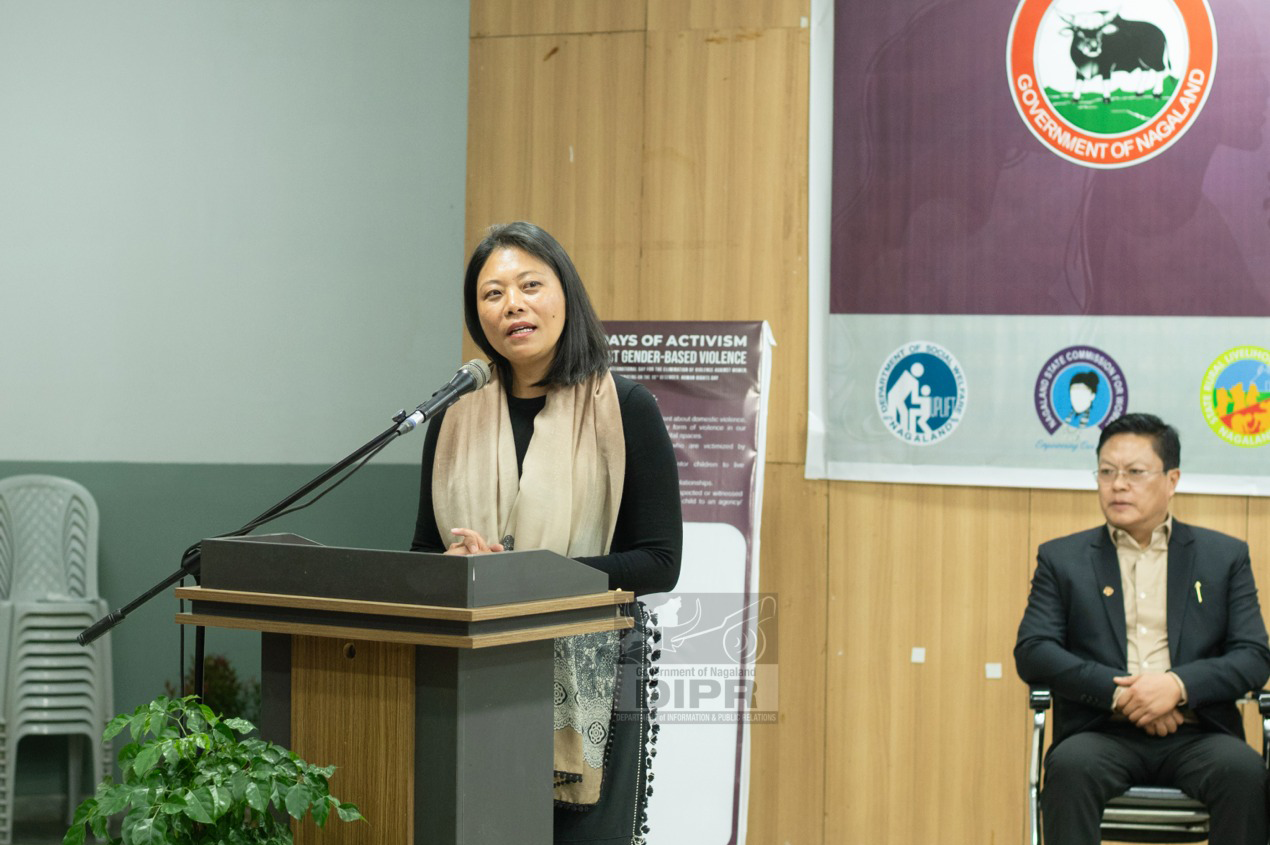
Nagaland must establish a culture of zero tolerance towards violence against women and girls, MLA and Advisor for Industries and Commerce Hekani Jakhalu Kense said on Wednesday, calling for collective action to address abuse, challenge social stigma and ensure justice for survivors.
According to a DIPR report, she was addressing the state-level observation of the International Day for the Elimination of Violence against Women at the Capital Convention Centre, Kohima, on November 25. The programme was held under the theme, “UNiTE to End Violence against Women and Girls: Ensure Justice, Protect Survivors, End Impunity.”
Jakhalu said society must first understand the scale of violence against women before discussing ways to ensure justice, protect survivors and end impunity. Citing the World Health Organization and UN Women, she noted that one in every three women experiences violence during her lifetime, making gender-based violence one of the most widespread human rights violations globally.
She cautioned that statistics portraying Nagaland as one of the safest places for women might not reflect the actual situation, particularly as harassment, abuse and violence were often normalised and treated as ordinary occurrences.
Pointing out that violence against women takes different forms, she said domestic violence remained largely hidden behind closed doors. Many cases go unreported because of social expectations, fear of ostracisation and the belief that domestic matters should remain private. She observed that family members and neighbours were often aware of abuse but hesitated to intervene.
“We cannot keep waiting for something irreversible to happen before we act,” she asserted.
Jakhalu said patriarchal structures further aggravated the problem, with women frequently pressured to endure abuse in the name of family honour. Divorce remained highly stigmatised, while women who leave abusive marriages were often shamed instead of supported. Economic dependence, concerns about children and fear of social backlash also kept many women trapped in abusive relationships.
She criticised the tendency to question victims rather than hold perpetrators accountable, pointing to questions such as “What was she doing?” and “Why didn’t she report it?”. Survivors, she said, might remain silent because of fear of retaliation, further harm, loss of privacy, social judgement or the belief that reporting abuse would make little difference.
Emphasising the lasting impact of abuse and trauma, she said violence could affect survivors’ emotional well-being, relationships and sense of self, while increasing the risk of anxiety, depression, self-harm and suicide.
To illustrate the scale of the issue, Jakhalu referred to Nagaland’s estimated population of 20 lakh, including around 10 lakh women. If one in three women experienced violence during their lifetime, she said, the figure would amount to approximately three lakh women, urging society to reflect on what this meant for the state.
She said the observance should not remain a one-day event but should lead to sustained reflection and action. Addressing violence against women, she stressed, was not the responsibility of the government alone. Churches, civil society organisations and individuals must also play their part.
While acknowledging the church’s role as a moral and ethical foundation of communities, she said religious institutions sometimes remained silent or prioritised family unity at the expense of women’s well-being. She also called for sustained awareness campaigns to educate women about their legal rights and encourage them to report abuse without fear of stigma.
Delivering the keynote address, Secretary of Social Welfare Limawabang Jamir, IAS, said violence against women and girls remained a serious human rights concern across age groups, geographical boundaries and socioeconomic backgrounds.
He outlined initiatives undertaken by the Ministry of Women and Child Development under Mission Shakti, including the Hub for Empowerment of Women, Beti Bachao Beti Padhao, One Stop Centres (OSC) and Women Helpline 181.
Download Nagaland Tribune app on Google Play


Jamir informed that from the establishment of the first Sakhi One Stop Centre in 2016 until October 2026, the centres in Nagaland had addressed 2,121 cases of gender-based violence. Women Helpline 181 had attended to 3,568 cases involving gender-based violence and information-seeking calls.
Marking the 10th anniversary of the One Stop Centres in Dimapur and Kohima and Women Helpline 181, he appreciated the teams for their decade of service to women. He also urged students to contribute to preventing gender-based violence through peer-led initiatives, digital safety awareness and reporting mechanisms, while encouraging survivors to seek help through available services.
He congratulated the Nagaland State Rural Livelihoods Mission (NSRLM) on the launch of three additional Gender Resource Centres in the Rural Development blocks of Dhansiripar, Jalukie and Shamator, as well as the fifth edition of Nayi Chetna under the Deendayal Antyodaya Yojana–National Rural Livelihoods Mission.
Chairperson of the Nagaland State Commission for Women (NSCW), W Nginyeih Konyak, in her concluding remarks, called for translating awareness into concrete action in homes, educational institutions and communities. She urged students to stand against cyberbullying, harmful stereotypes and peer pressure, and encouraged women to know their legal rights, pursue financial independence and seek support through institutions such as the NSCW, One Stop Centres and Women Helpline 181.
Stressing the need for stronger institutional coordination, Konyak said no single agency could independently address gender-based violence, human trafficking and cybercrime. She called for coordinated efforts among the Commission, Social Welfare Department, Mission Shakti, One Stop Centres, law enforcement agencies, District Legal Services Authorities and NSRLM to ensure a survivor-centred approach based on confidentiality, dignity and timely justice.
She also underlined the need for greater representation of women in decision-making platforms, community leadership and economic enterprises, adding that protecting women’s rights required collective vigilance from men, community leaders, civil society organisations and young people.
The programme featured the release of an awareness video and an anniversary special edition of the newsletter of Sakhi One Stop Centres, Dimapur and Kohima, and Women Helpline 181, highlighting their 10 years of service. It was also informed that more than 30% of cases reported to the One Stop Centres involved domestic violence.
The occasion further marked the launch of the 16 Days of Activism against Gender-Based Violence, Nayi Chetna 5.0 and three Gender Resource Centres. A pledge-taking and signature campaign was led by OSD/Additional Director, Social Welfare, Imkongzenla.
The programme was chaired by State Programme Manager, NSRLM, Khriezovonuo Lhoungu, while Keduoneituo Yhome, Pastor of Phezoucha Baptist Church, pronounced the invocation.
The event was jointly organised by Mission Shakti under the Department of Social Welfare, NSCW and NSRLM.