A one-day Information Education Communication (IEC) Awareness Programme-cum-Waste Management Training was conducted on 12 September at Town Hall, Wokha.
The event was organized by the Department of Urban Development and Wokha Town Council in collaboration with Living for Environment (LIFE) NGO Dimapur.
With Nicksungla Jamir, founder and chairperson of LIFE, as the resource person, the special focus of the programme was segregation at source and plastic waste management.
A total of 212 trainees from different wards and colonies, representatives from Wokha District Chamber of Commerce and Industries (WDCCI), GBs, sanitation committees from all colonies, educational institutions, local taxi union, auto union, shopping malls, SHGs & ALF, and Anganwadi Workers under Wokha town took part in the IEC Awareness Programme-cum- Training on Waste Management.
Resource person Jamir emphasised on properly segregating and disposing dry and wet garbage waste which, she pointed out, accelerate composting, recycling, and incineration. This process then helps reduce waste at landfill and eventually prevents land, water, and air pollution. Jamir appealed to the gathering to maintain waste bins and containers to deposit such waste so that it can be converted into rich organic compost.
Earlier in the day, the team had conducted an IEC programme at Bhandari, also in Wokha district, where 22 people attended the training.
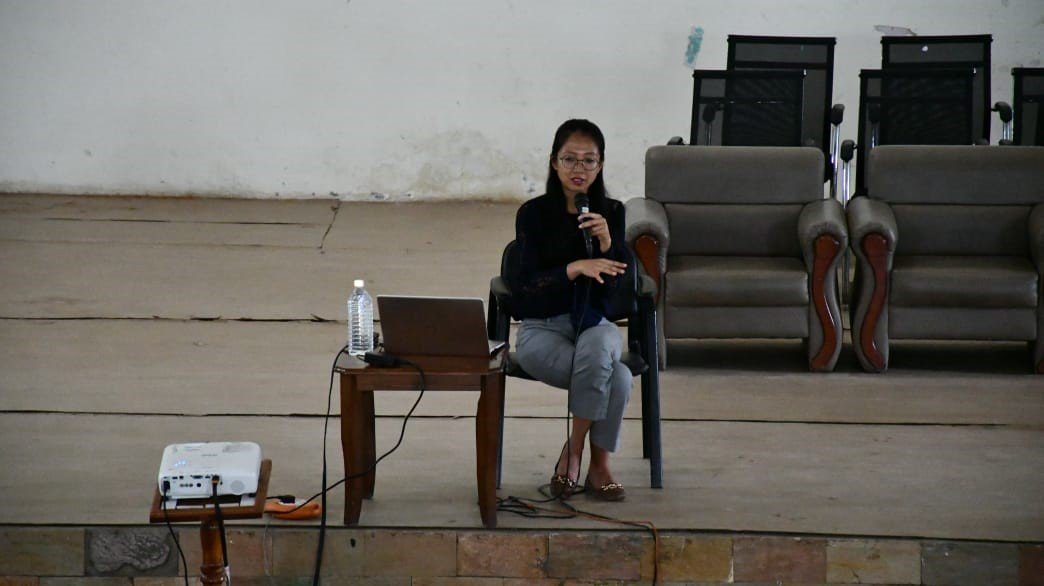
Resource person Nicksungla Jamir speaking at the waste management training in Wokha.
Living for Environment (LIFE) NGO was ‘formed on 27 April 2016 by like-minded youth who wanted to protect, conserve, and preserve the environment’ with the ambition ‘to act and create awareness before it is too late’.
In 2018, the organisation shifted their focus from trainings to research after realising the difficulty of getting accurate data and information.
Nicksungla told Nagaland Tribune that the NGO’s first collaboration was with Dimapur Municipal Council while the first assessment was done with Chümoukedima followed by Dimapur and Kohima.
Later the organisation got introduced to the Urban Development Department (the nodal agencies). In 2019, LIFE was asked to undertake the waste assessment of the whole state and since then the NGO has been working with the department, the chairperson of LIFE informed.
In June 2022, the organisation released the report of their inspections of the Urban Local Body (ULB) and submitted it to the Urban Development Department. Seeing the report, the department realised that IEC training was necessary in the state and invited LIFE to be the resource person.
Jamir said that the biggest challenge was changing the mindset. “Because of the rampant development/urbanisation people have become so used to the convenient lifestyle that they don’t want to inculcate the practice,” she said.