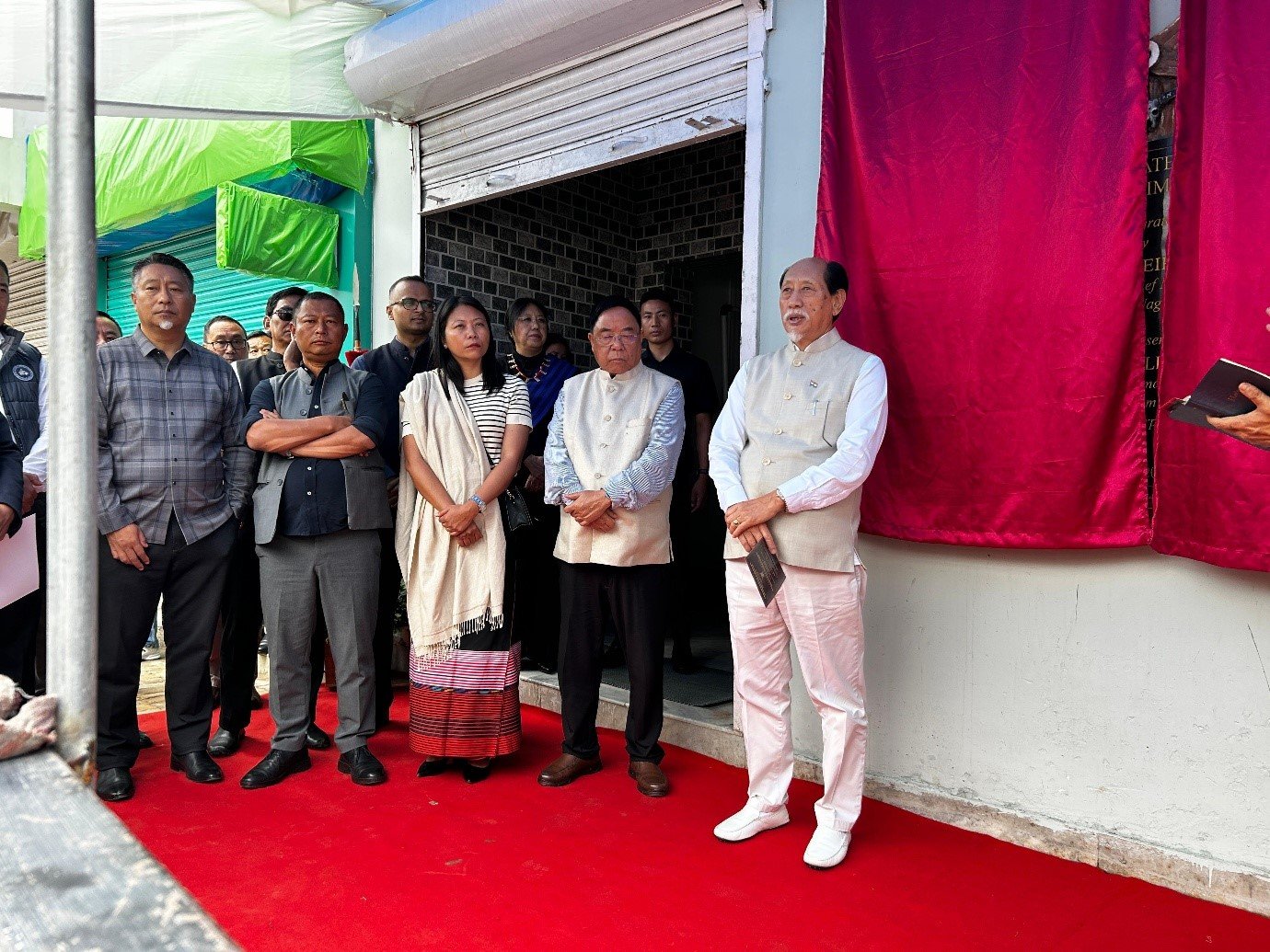
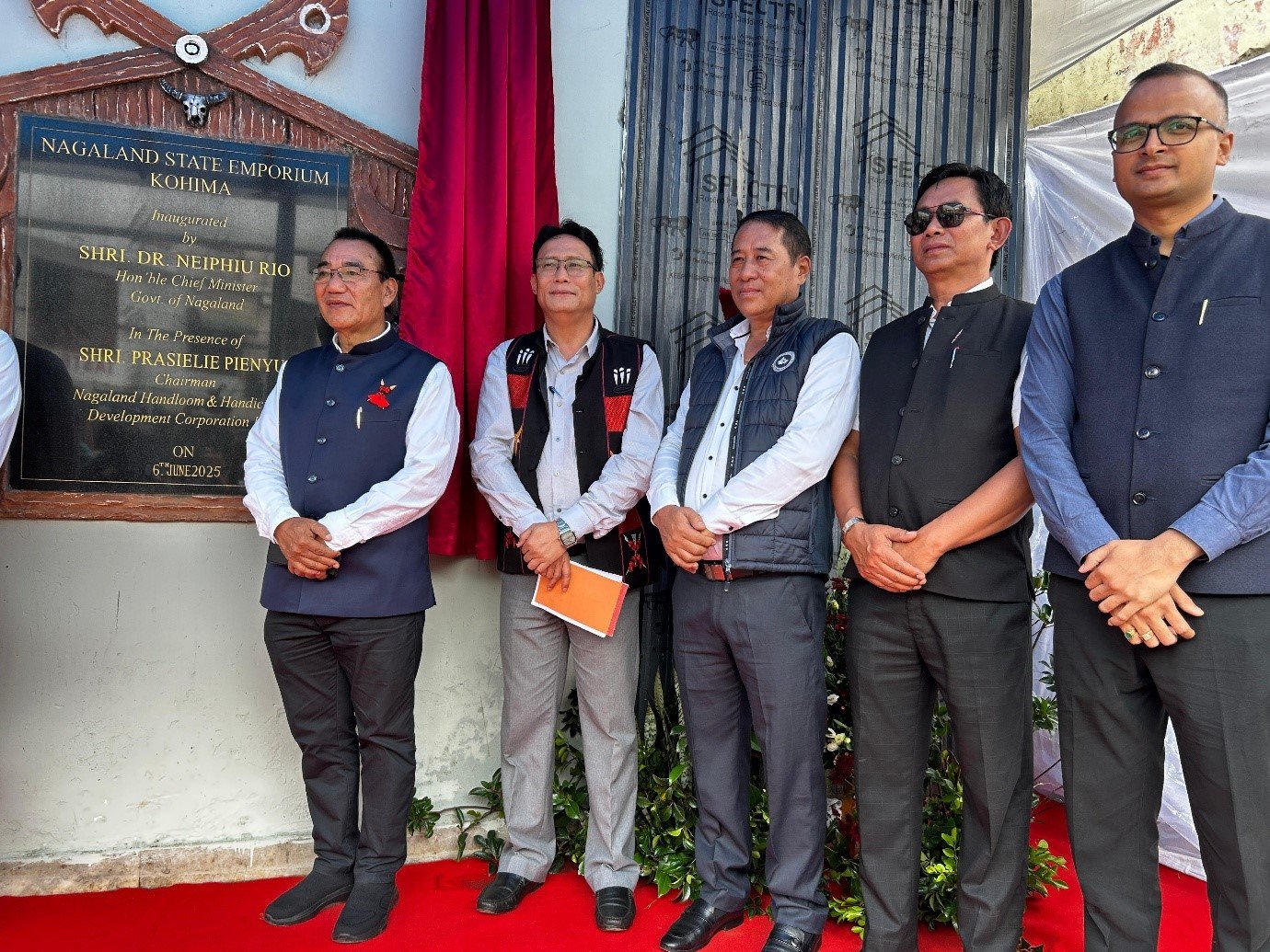
The new multi-storey building of the Nagaland State Emporium Complex in the state capital Kohima was inaugurated by Chief Minister Dr. Neiphiu Rio on June 6. The emporium is located opposite to the Old NST Station.
In his speech, Rio stated that the building fulfilled a long-standing need, emphasizing that the State Emporiums are the pride of the state. He described the emporium as a representation of the identity of different tribal communities.
Rio expressed appreciation for everyone involved in making the new building a reality. Highlighting that Nagaland, with its 17 major tribes and numerous sub-tribes, showcases unity in diversity through its vibrant traditional attire for both men and women, Rio asserted that the emporium is the identity of all our different tribes.
He pointed out that Nagaland possesses immense talent and heritage, with every piece of craftsmanship reflecting the spirit of ancestors and rich cultural traditions. He urged the department of Industries, Nagaland Handloom and Handicrafts, Women Resource Development department, and all stakeholders to collaborate in bringing forward these initiatives.
Rio also stressed the importance of preserving the originality of Naga culture and traditions, whether in clothing, songs, or other forms of expression. “We are a proud people, and as a state, we have protected, promoted, and commercialized our heritage thus far,” he said.
He emphasized the need to document tribal traditions, including food and clothing, ensuring that such documentation is done with the approval of the respective tribes.
“While preserving our culture and drawing inspiration from it, we must not lose its originality. The essence must remain intact,” he said.
He suggested that local expert weavers and stakeholders form a committee to produce samples of each tribe’s traditional attire, which should then be approved by tribal leaders before being sold.
The chief minister also raised concerns over the quality of traditional clothing available in the market, stating that many products do not meet expected standards.
“This year’s Hornbill Festival will be grander, with invitations extended to celebrities and world-renowned leaders. We hope Nagaland becomes the most visited tourist state, so we must ensure consistent supply and sufficient production to meet demand,” he said.
He underscored the importance of quality checks in traditional wear, as they represent Nagaland’s image, especially when taken home by tourists.
Rio encouraged cooperation among departments and stakeholders, urging both men and women to engage in weaving and supply. He mentioned the availability of the Chief Minister’s Micro Finance Scheme for those interested in starting their businesses.
He further added that it is time to bring Naga women back into weaving and explore ways to improve their livelihoods through weaving.
Download Nagaland Tribune app on Google Play

He noted that the state emporium is often the first destination for tourists, calling for it to be a grand showcase of Nagaland’s identity. He said the emporium is an advertisement for the state. “We have been allotted space in Guwahati for another emporium, but no progress has been made,” he mentioned, suggesting that private agencies or individuals should take up the task. He also proposed a grand emporium at Dimapur airport, the only airport in Nagaland.
Earlier, Prasielie Pienyii, chairman NHHDC Ltd. delivered the welcome address. He informed that the project was initiated in 2013 by CM Rio and that its inauguration marks a significant milestone in the history of the Nagaland Handloom and Handicraft Development Corporation.
Currently, the corporation operates seven emporiums—one each in Delhi and Kolkata, and five in Nagaland (Kohima, Dimapur, Mokokchung, Tuensang, and Phek).
“These emporiums are more than marketplaces; they celebrate our identity, values, and traditions. They provide artisans with recognition and opportunities while promoting sustainable livelihoods and preserving crafts for future generations,” Pienyu said.
The newly inaugurated complex has seven floors, housing the state emporium on the first floor, three shopping floors, a restaurant, a library, and a well-furnished conference hall with two guest rooms. The project, constructed by M/S Avituo and Company under the supervision of the Engineering Wing of the Industries and Commerce Department, cost Rs. 11.25 crore.
Earlier, “Naga unity shawl” for both men and women was unveiled by MLA and advisor for Industries and Commerce Hekani Jakhalu and chief minister Rio.
It was informed that the shawl indicates that Nagaland state is blessed with rich ethnic diversity of 17 tribes and those different tribes have their own unique traditional attires and
ornaments with every tribe having their unique traditional shawls. However, there is no common shawl which helps identity the Nagas in general. Hence the idea of launching the unity shawl for both men and women assembled with Naga motifs representing Naga identity was developed.
The Naga unity shawls are first produced at Weaving Production Centre, NHHDC Ltd. Dimapur, Nagaland. The men’s shawl has three panels – top and bottom panels consists
of black, red and white stripes of different sizes. The colour combination in the shawl are commonly found in all the Naga men’s shawls- black and red being the dominant colours.
The middle panel is white with black line on the border where different design motifs are painted/embroidered commonly used which represents all the Naga tribes.
The women’s shawl has one panel with three sections– top and bottom sections are multi-coloured stripes, a blend of all the colours commonly used by Naga women, designed to give a modern, harmonious look, signifying unity among the diverse Naga tribes. The middle section/portion is white on which different motif designs are embroidered/painted, mainly inspired from traditional ornaments, crafts and the various aspects of Naga women’s skills and beauty.