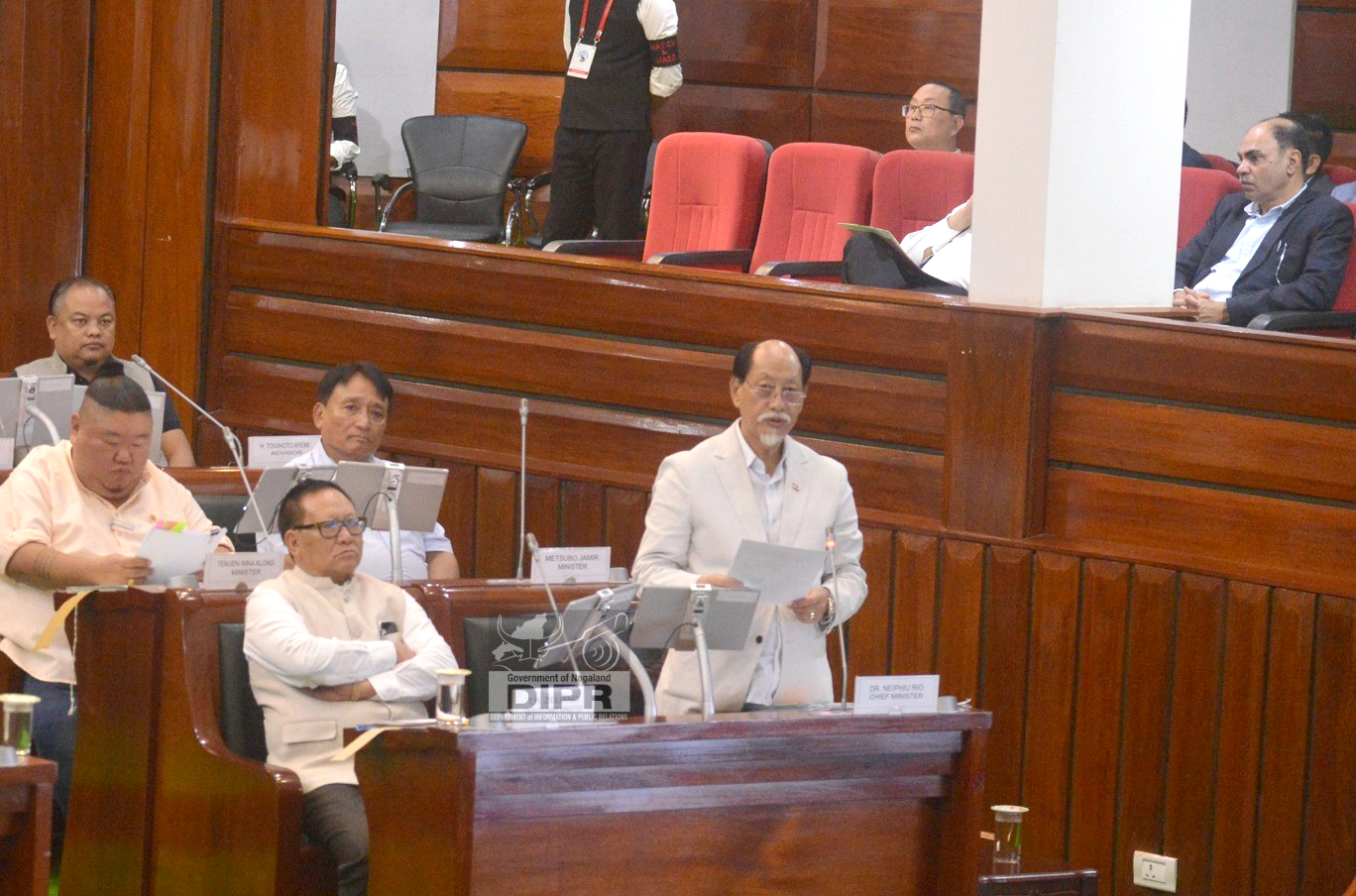
Chief Minister Neiphiu Rio on Tuesday underlined that addressing the rising unemployment crisis in Nagaland required a shift in mindset, promotion of entrepreneurship, and strengthening of skill-based growth.
In his concluding remarks to the discussion on unemployment in the Nagaland Legislative Assembly, Rio cautioned that unemployment, if left unattended, could become a “time bomb,” but if channelled properly, it had the potential to turn into an opportunity for growth and progress.
Describing the issue as one of “urgent public importance,” he thanked legislators for their active participation, saying their contributions reflected the seriousness of the House in addressing the concerns of youth, whom he called the “future and hope of the State.”
The Chief Minister stressed that the problem should be seen not only as unemployment but also as “unemployability,” pointing to the need for quality education, skill training, and attitudinal change. He directed the Department of Employment and Skill Development to carry out a comprehensive study and furnish reports so that corrective measures could be initiated.
Highlighting the overdependence on government jobs as a major hurdle, Rio said it was necessary to change the mindset of youth, parents, and society at large. “We must broaden opportunities in entrepreneurship, private industries, skill-based occupations, and service sectors,” he said.
On unemployment statistics, he noted that data over the years had often been inflated or misreported, stressing that discrepancies must be corrected to create a reliable record base for sound policy decisions.
Citing the recent Forest Guard recruitment where 20,000 candidates applied for only 150 posts, Rio said this illustrated the magnitude of the crisis. He suggested decentralisation of recruitment examinations to ensure transparency, fairness, and better management.
The Chief Minister also highlighted the Chief Minister’s Micro-Finance Scheme, under which youth could avail loans up to ₹15 lakh without collateral, with repayment starting only after five years. However, he emphasised that banks required proof of basic competence and work experience, making it essential for applicants to undergo training and acquire skills before accessing financial assistance.
Handloom and handicrafts, Rio said, held strong potential for sustainable livelihoods. The government, he added, was working to introduce cluster-based production, ensure quality control, and set up yarn banks. If organised properly, Naga handicrafts could find markets beyond the State and emerge as commercially viable products, he added.
Rio also urged youth to embrace entrepreneurship and self-employment. He remarked that outsiders often secured jobs in Nagaland more easily than locals because they were willing to take up any opportunities and adapt to market demands. He admitted that all major industries in Nagaland had failed due to an unconducive business environment created by unresolved political issues, multiple taxation, and lack of investors. These conditions, he added, had also affected other sectors, such as sports, where the absence of sponsors hindered young talent.
Calling Nagaland a consumer society overly dependent on imports, Rio said there was an urgent need to shift toward production and self-reliance. He pointed out that in 2024 alone, the State lost ₹443 crore due to departments failing to utilise sanctioned funds on time, leading to penalties and reduced central allocations He also urged departments and officers to exercise diligence in fund management, stressing that such lapses weakened the State’s financial position and deprived people of intended benefits.
He reiterated that unemployment was not solely a government problem but a collective responsibility of legislators, departments, parents, and youth. As India aspired to become a developed nation by 2047, he said, Nagaland too must align by working harder, leveraging central programmes, creating an investment-friendly environment, and equipping its youth with employable skills.
Concluding his speech, Rio called for transforming the unemployment challenge into an opportunity for growth through mindset change, efficient governance, and societal collaboration.
Download Nagaland Tribune app on Google Play

DISCUSSION HOUR
Initiating the discussion, Advisor Hekani Jakhalu said unemployment remained one of the greatest challenges facing Nagaland’s youth despite their talent, creativity, and entrepreneurial spirit.
Citing Census 2011 and the Periodic Labour Force Survey (PLFS) 2023-24, she noted that Nagaland’s overall unemployment rate stood at 7.1% against the national average of 3.2%, while youth unemployment (15–29 years) had surged to 27.4%. Urban youth unemployment, she pointed out, was highest at 39.6%. Despite government initiatives, thousands continued to queue for unemployment certificates, reflecting both joblessness and lack of employable skills, she observed.
“Unemployment is the symptom, but unemployability is the illness,” she said, emphasising the gap between education and market demands. She urged reforms in education, vocational training, internships, and entrepreneurship support, along with a change in mindset among parents and youth who continue to over-rely on government jobs. She also called for improving power and road infrastructure to attract investors, while underlining the urgency of resolving the Naga political issue for economic growth.
Advisor Dr. Kekhrielhoulie Yhome raised concerns about the dignity and wages of workers in the private sector. Proposing a sectoral wage structure under the Nagaland Minimum Wages Act, he stressed that Nagaland’s talents lay in the service sector and urged aligning vocational education with domestic and international labour markets. He said steps were underway to integrate vocational skills under the National Education Policy (NEP) 2020, including music certifications and trade skills linked with global standards, to enhance youth mobility and employability.
Higher Education & Tourism Minister Temjen Imna Along confirmed that unemployment in Nagaland rose sharply from 4.3% in 2022-23 to 7.1% in 2023-24. He said the steepest rise was among educated and urban youth, with postgraduates recording 27% unemployment, diploma holders 36.2%, and graduates 19.2%. However, he noted that the worker population ratio had improved significantly from 32.8% in 2017-18 to 68.1% in 2023-24, mainly due to agriculture, allied sectors, tourism, arts, and soft skills.
Along called for more youth-linked education, private sector growth, self-employment, and entrepreneurship, urging urban youth to shed overdependence on government jobs and social media criticism, and instead contribute productively to the economy.
Advisor Wangpang Konyak questioned the role of employment exchanges, which he said had reduced to centres for issuing unemployment cards rather than linking job seekers with opportunities. He urged Nagas to change their mindset, move beyond aspirations for white-collar jobs, and embrace skilled and blue-collar work. He stressed aligning education with global standards, skilling youth for private sector employability, and encouraging entrepreneurship, agriculture, and small businesses.
MLA Dr. Neisatuo Mero described educated unemployment as a severe problem, citing CMIE data showing Nagaland’s unemployment rate at over 20%, the highest in India. Warning that unchecked joblessness could lead to social issues such as crime, substance abuse, and corruption, he suggested promoting nano-retail, poultry, piggery, and church-sponsored institutions for large-scale employment.
Advisor Temjenmenba said over 70,000 job seekers were registered with employment exchanges as of December 2023, but less than half had tertiary education, and very few possessed technical degrees. “Unemployment is no longer just about numbers—it’s about quality, dignity, and relevance,” he said, calling for strengthening technical education, integrating vocational skills through NEP 2020, and closer coordination between industries, IT, and skill development departments. Drawing lessons from Assam’s workforce preparation for a semiconductor hub, he urged Nagaland to equip youth for emerging sectors like renewable energy, agro-tech, digital services, and manufacturing.
MLA Nyamnyie Konyak expressed concern over rising unemployment among educated youth, which he said had risen from 7% earlier to nearly 30%. Referring to the recent Forest Department recruitment drive, he pointed out that though the minimum qualification was Class 8, applicants included PhD holders, creating unfair competition for genuinely eligible candidates. He also highlighted the physical endurance test, where one candidate completed a 24 km run in 1 hour 24 minutes, suggesting such talent should be considered for sports-related departments.
Warning of youth frustration leading to alcoholism and social unrest, he urged creation of industries in both urban and rural areas, promotion of handloom and handicrafts, lifting restrictions under NLTP, and exploring industries like oil refineries at Dikhu.
Advisor TN Mannen said Nagaland’s greatest asset was its youthful, largely educated population, but the State had failed to convert this into an advantage. Stressing the difference between employment and employability, he called for skill development and vocational training to make youth job-ready. He warned that saturation of government jobs had bred inefficiency and stressed encouraging youth towards opportunities in the private sector, entrepreneurship, and self-employment.
He also emphasised strict merit-based implementation of government self-employment schemes and the importance of creating an investment-friendly environment with improved infrastructure and security to attract investors.
Mannen further noted challenges in accessing finance due to lack of proper land records. However, he said, the extension of the SARFAESI Act to Dimapur and Mokokchung in 2022 had enabled loans against land pattas. The government, he added, was contemplating cadastral surveys across all townships to expand this benefit while ensuring safeguards against alienation of land to non-Nagas.