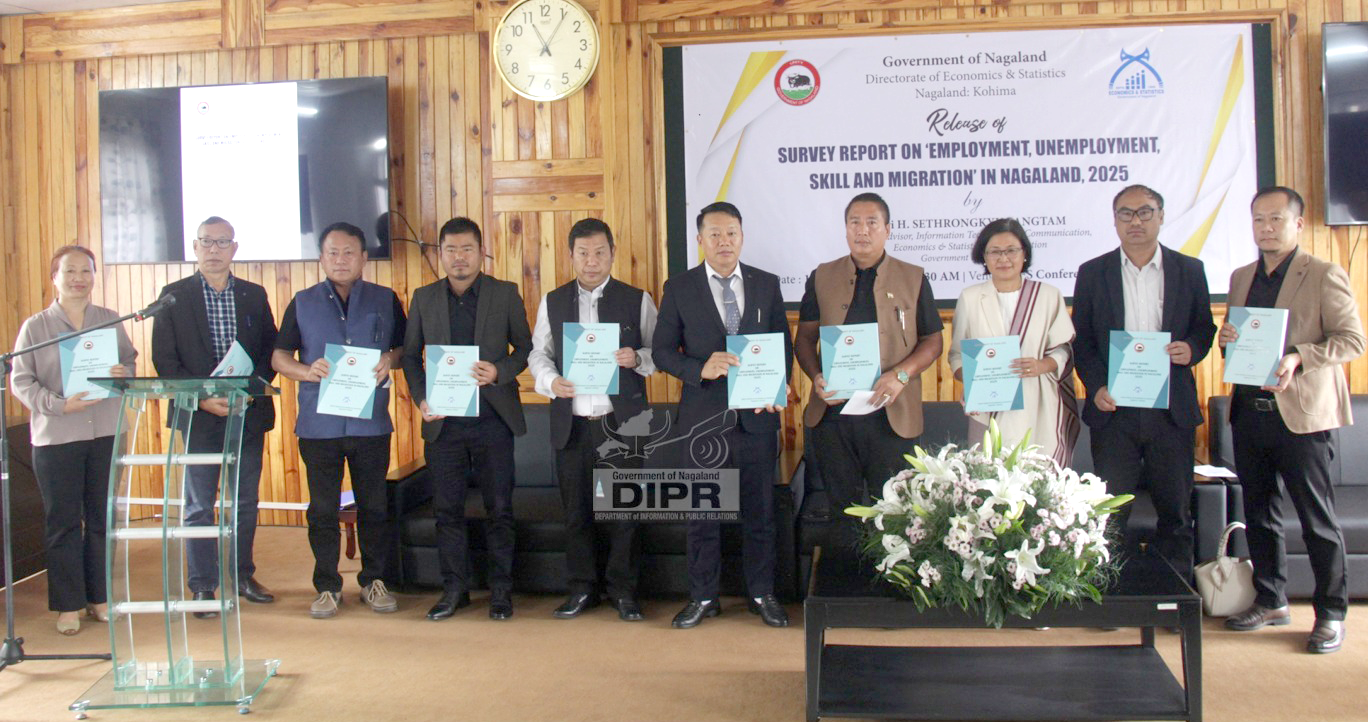
The Directorate of Economics & Statistics (DES) Nagaland on Friday released a comprehensive Survey Report on “Employment, Unemployment, Skill and Migration in Nagaland, 2025” at its Conference Hall, with Advisor for IT&C, Economics & Statistics and Evaluation, H. Sethrongkyu Sangtam, as the Special Guest.
Speaking at the programme, Sangtam described the report as a crucial tool for the State Government to formulate effective policies to address unemployment and promote balanced regional development. He emphasized that without quality district-level data, the vision of a “Viksit Nagaland” could not be realized.
Lauding the Department under Secretary Akunu S Meyase, IAS, and Director Neidilhou Keditsu for their efforts to bridge data gaps through initiatives like the Nagaland Sample Survey Unit (established in 2024), Sangtam said disaggregated district-level data was essential to identify challenges, leverage opportunities, and ensure inclusive development.
He noted that the Department had already contributed significantly by producing reports such as the District Domestic Product (2022) and District Consumer Price Index (2023), which are being used in policymaking. He also highlighted other annual publications, including the Nagaland Statistical Handbook, Price Indices, National Sample Survey, Village Level Per Capita Income, Disaster Statistics, Gender Statistics, Civil Registration, Nagaland Economic Survey, and Indices of Industrial Production.
On unemployment, Sangtam revealed that 71,034 applicants were registered with state employment exchanges as of March 31, 2025. He said the issue was also deliberated during the recent Nagaland Legislative Assembly session and highlighted in the Chief Minister’s address. Calling the survey “the first of its kind” under the state’s Sample Survey Unit, he said it would be a critical basis for framing labour policies and harnessing Nagaland’s demographic dividend.
He added that district-wise socio-economic data in the report would help address unique challenges in each district while strengthening policy implementation.
The Advisor urged policymakers, researchers, administrators, and stakeholders to make full use of the report, expressing confidence that it would enrich public discourse and strengthen policy formulation. He also appealed to DES officials to enhance their technical capabilities for producing timely, quality data in the service of good governance.
Download Nagaland Tribune app on Google Play

Reaffirming the State Government’s commitment to Prime Minister Narendra Modi’s vision of Viksit Bharat by 2047, Sangtam called on citizens and officials alike to work together towards making Nagaland a developed state when India celebrates its centenary of independence.
“Together with sincere and dedicated efforts by the state government and by the people of the state, we can achieve the dream of Viksit Bharat by 2047,” he said, extending appreciation to the Department for the publication and urging continued diligence and professionalism in their work.
According to a DIPR report, Director, Economics & Statistics Neidilhou Keditsu, presented the key findings of the survey report. The survey covered the entire state of Nagaland. District-wise reports were prepared for eleven districts with available population data, while newly created districts Shamator, Niuland, Chumoukedima, Tseminyu and Meluri could not be included. However, it was noted that household samples from such districts were merged within the existing districts.
Secretary Economics & Statistics, Akunu S Meyase, IAS also speaking at the programme acknowledged the collective effort and dedication of the staff of the department concerned in successfully completing the survey and compiling the data in a scientific manner. She said that the report would prove to be invaluable in use, crucial and timely for the policy makers to base their decisions in bringing development to the people of the State.
The survey reported that the average household size in Nagaland is four members, with household sizes ranging from one to eleven. The average monthly household expenditure was estimated at Rs.16,522, with the lowest at Rs.1,133 and the highest at Rs.3,61,647. The average age of people in the working-age group stood at 34 years.
On education, residents had an average of 11 years of formal schooling, with a minimum of one year and a maximum of 22 years. About 16% of respondents studied up to graduation, 4% were postgraduates and above, while 2% were illiterate. The findings also revealed that 92% of residents did not have any technical education or vocational/technical training.
The labour force participation rate in Nagaland was recorded at 56%. The employment rate was estimated at 83.92%, while the unemployment rate stood at 16.07%. At the district level, Wokha had the highest labour force participation rate with 75%, while Tuensang registered the lowest at 41%. Mon district recorded the highest employment rate at 91.08%, while Phek reported the lowest at 75%. In contrast, Phek registered the highest unemployment rate at 25%, while Mon had the lowest at 8.92%.
The survey further found that 56% of respondents were self-employed. Salaried employees accounted for 16% in the public sector and 13% in the private sector. A large share of respondents, 88% were ineligible for social security benefits. Similarly, 88% of those engaged in principal economic activity did not pursue any subsidiary activity.
Among the unemployed, 49% reported having submitted job applications or visited employers as part of their job search. More than half, at 55%, had remained unemployed for more than three years. In addition, 78% of unemployed respondents had no prior work experience. The absence of employment opportunities was identified as the main reason for unemployment by 58% of respondents.
On migration, the survey revealed that 55% of migrant respondents had moved from rural to urban settlements. A majority of 81% had resided in their present settlements for more than five years. The proportion of migrants who relocated for employment in the public sector was 27%. Before migration, 80% of migrant respondents earned Rs.10,000 or less at their place of origin. In their present settlements, 33% reported earnings between Rs.10,000 and Rs.20,000.
The survey also found that 63% of migrants owned immovable property in their present settlements, while 36% reported being happy in their current place of residence.