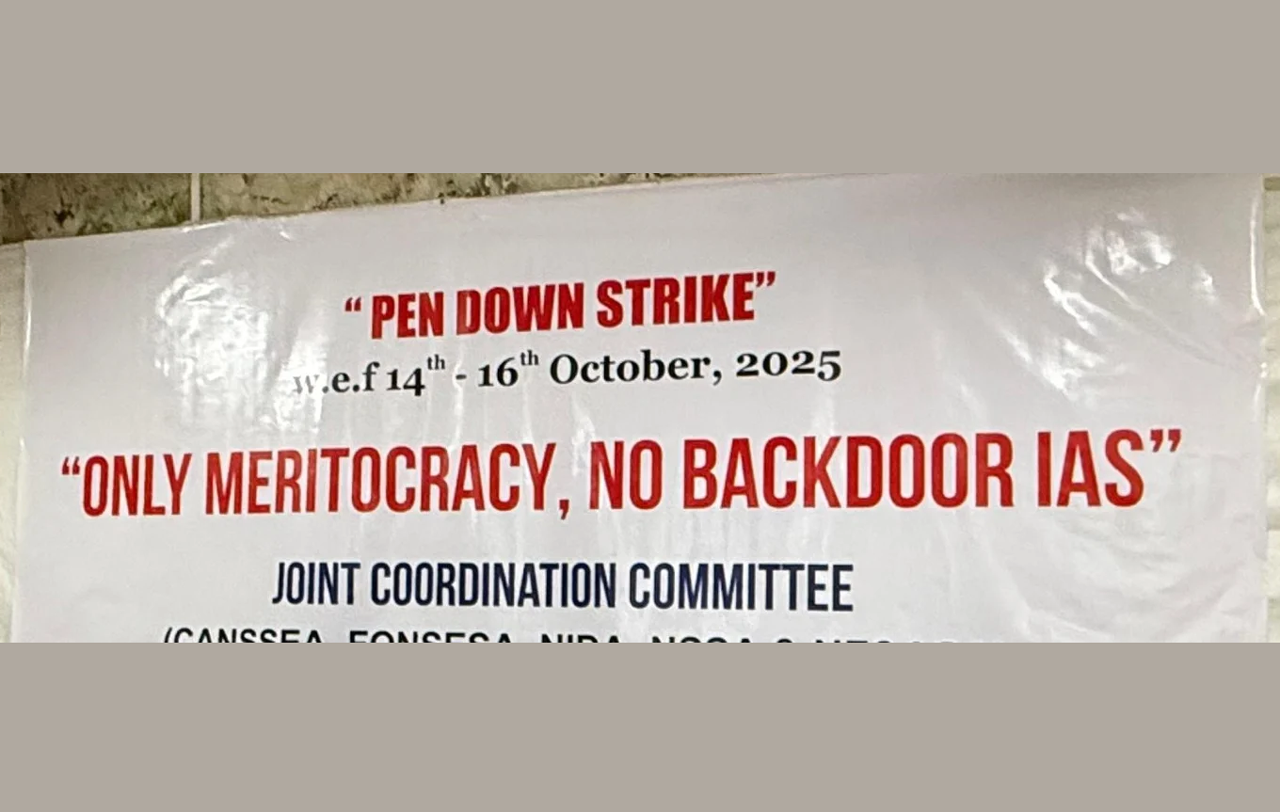
Reasserting its stand on upholding transparency and meritocracy in public service, the Joint Coordination Committee (JCC) has once again received overwhelming support from major State Service Associations across Nagaland in its demand for the withdrawal of backdoor appointees from the select list for induction into the Indian Administrative Service (IAS) cadre.
The Nagaland Secretariat Service Association (NSSA), in its Executive Meeting held on October 9, reaffirmed its total support and cooperation with the JCC in the collective effort to safeguard meritocracy and fairness in the IAS induction process.
Similarly, the Federation of Nagaland State Engineering Services Associations (FONSESA) — representing eight affiliated engineering associations — reiterated its firm commitment to back the JCC’s stand during its Executive Meeting on October 22, declaring that the federation will continue its support until the State Government fulfils the JCC’s two-point charter of demands.
The Nagaland Finance and Accounts Service Association (NF&ASA), during its Executive Meeting on October 24, also pledged its unwavering and active support to the JCC’s cause.
Adding to the growing wave of solidarity, the Confederation of All Nagaland State Service Employees’ Association (CANSSEA), along with over 50 affiliated associations, convened an Emergency Executive Meeting on October 24 to deliberate on the ongoing issue concerning the induction of IAS officers under the Non-State Civil Service (Non-SCS) quota. After detailed discussions, the house unanimously resolved to continue extending full physical and logistical support to the JCC in its stand to uphold merit-based selection. It further emphasized that only candidates recruited through the Nagaland Public Service Commission (NPSC) should be empanelled for IAS induction, and all backdoor or regularised appointees must be withdrawn from consideration.
In the same vein, the Nagaland In-Service Doctors’ Association (NIDA), during its Annual General Meeting (AGM) on October 24, resolved to maintain its full commitment and solidarity with the JCC in defending the principles of merit-based selection, transparency, and fairness in governance.
The JCC, while expressing appreciation for the continued support, strongly reiterated that public offices and administrative institutions exist to serve the people — not to become private fiefdoms for a few privileged individuals. “When governance becomes synonymous with nepotism and favouritism, public trust erodes and the efficiency of the State collapses. This is not merely a matter of administrative irregularity, but a moral and constitutional issue,” it stated.
Download Nagaland Tribune app on Google Play

Raising serious concerns over the alleged influence of personal and familial connections in the functioning of the State’s administrative machinery, the JCC questioned whether decisions are being taken in the best interest of the State or to serve private ambitions. “Have the regulatory and selection processes — particularly those concerning appointments to higher offices — been compromised under this invisible network?” it asked.
The Committee asserted that a government committed to transparency and good governance cannot remain silent when such serious allegations are circulating. It called for an independent and impartial inquiry, monitored by credible and neutral institutions, to ensure clarity and accountability in the matter.
“If the administration is confident of its fairness, it should have no hesitation in opening its books for scrutiny. Silence only deepens public suspicion. Governance cannot be a family affair — it is a public trust — and when that trust is betrayed, citizens have the right and the duty to demand accountability,” the JCC stated.
Reaffirming its conviction, the JCC underscored that only constitutionally valid and merit-based recruits through the Public Service Commission should be included in the IAS empanelled list. The withdrawal of backdoor regularised candidates, it said, is essential to ensure justice, equality, and integrity in public service — the foundational principles upon which good governance must rest.