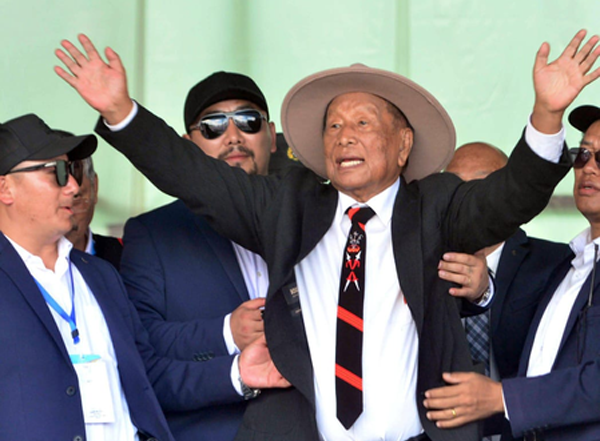
Chief Political Negotiator and General Secretary/Ato Kilonser (Prime Minister) of the National Socialist Council of Nagalim (NSCN/GPRN), Th Muivah on Wednesday reaffirmed that the Framework Agreement of August 3, 2015 and the Amsterdam Joint Communiqué of July 11, 2002 remain the foundation for any honorable and acceptable political settlement with the Government of India (GoI), while reiterating that the Naga national flag and Constitution are non-negotiable issues.
In a strongly worded message to the Naga people from Tahamzam (Senapati) in southern Nagalim, where he received a rousing welcome, Muivah expressed deep gratitude to the people of the Shepoumaramth, Wung Tangkhul, Komrem, Makuilongdi, Zeilad, Asalu, and Khurmi regions for their warm reception and for their “resolute commitment and supreme sacrifices” toward the Naga national cause. He also thanked God Almighty “for the politically significant and fruitful visit” to his birthplace Somdal in the Wung Tangkhul Region.
Recalling the early days of the Naga movement, Muivah paid tribute to leaders and patriots who, he said, “renounced servility and rose to defend the right of the Nagas to live as a nation.”
He referred to the 1930s struggle led by Haipou Jadonang against British imperial rule, whose martyrdom inspired the formation of the Jadonang Brigade under the NSCN/GPRN.
Muivah also traced the roots of Naga nationalism to the Naga National League (NNL), formed in 1946 under Athikho Daiho, Ng Thaiso and others, who organized the “No Tax Campaign” of 1948 and boycotted the Manipur elections in protest against arbitrary colonial boundaries.
He reminded that many young Nagas laid down their lives to defend their dignity, citing the names of those killed during the crackdown by the Assam Rifles and Manipur police forces.
He recounted the contributions of Naga leaders such as Capt Phungtha Horam, Rungsung Suisa, and Rev Ruichumhao Rungsung—pioneers of faith and politics who shaped the Naga narrative in the early decades of the 20th century. Muivah described Suisa’s efforts to convince Indian leaders including Nehru and Indira Gandhi on a “sovereign relationship” between India and Nagalim as a “historic step that continues to guide our struggle.”
Muivah declared that the signing of the Framework Agreement and the Amsterdam Joint Communiqué officially acknowledged Nagalim’s unique history and sovereignty. “With the official signing of the two agreements, the desperate distortion of Nagalim unique history by India and Myanmar, have been officially corrected and rectified by the GoI. Hence, among others, the August 14, 1947 Nagalim independence declaration and the May 16, 1951 plebiscite for sovereign Nagalim have been officially recognized by the GoI,” he asserted.
He emphasized that the Indo-Naga issue was not an internal problem of India or Myanmar but a political conflict between two entities.
The recognition and acknowledgement that “sovereignty lies with the people” officially recognized and acknowledged Nagalim sovereignty and affirmed that the Naga national flag and the Naga national constitution are integral in the letter and spirit of the Framework Agreement of August 3, 2015, he said, reiterating that these symbols are non-negotiable.
Muivah spoke at length about decades of violence and repression under what he termed “military occupation” by Indian and Burmese forces. He alleged that the Armed Forces (Special Powers) Act (AFSPA), imposed in Nagaland since 1958, has institutionalized human rights violations.
“Villages were burnt, daughters raped before their parents, men tortured and killed. Our land became a training ground and our people, targets,” he said, recalling documented cases of atrocities including the 2021 Oting killings in Mon district.
He cited publications such as Nagaland File: Question of Human Rights by Luingam Luithui and Nandita Haksar and The Judgment That Never Came by Nandita Haksar and Sebastian Hongray as records of the Naga people’s suffering. Despite these ordeals, Muivah noted that “not a single Indian or Burmese civilian has ever been harmed by the Nagas,” underscoring the defensive nature of their resistance.
The NSCN leader accused the Government of India of attempting to distort the Framework Agreement and sow division among Nagas.
He warned the Nagas of the Indian state strategy of “divide and conquer” through distortion and perversion of the letter and spirit of the Framework Agreement of August 3, 2015. He also regretted that some section of Nagas has become pawns in the hands of the GoI and its agencies.
He further mentioned that the NSCN/GPRN do not recognize any agreement signed within the Constitution of India- past, present and future. “Any Nagas and organizations who are promoting and advocating the corrupt version of the Indian state and its agencies, regarding the Amsterdam Joint Communiqué of July 11, 2002 and the Framework Agreement of August 3, 2015, shall be deemed as traitors to the Naga nation,” he reiterated.
Download Nagaland Tribune app on Google Play

He said the letter and spirit of the Framework Agreement officially recognized and acknowledged that the “sharing of Sovereign powers” is included in the political negotiation inclusive of the Naga national flag and Naga national constitution and not from the constitution of India and Myanmar.
“The only honorable negotiated political agreement shall be according to the letter and spirit of the Amsterdam Joint Communiqué and the Framework Agreement and the officially recognized Nagalim unique history, Nagalim sovereignty, Nagalim territory and the Naga national flag and the Naga national constitution,” Muivah stated.
Muivah appealed to all Naga tribes across artificial boundaries to remain united and steadfast in defending their political rights.
“As we journey forward, we must remember that it is Yahweh who fights our battles,” he said. “The NSCN/GPRN, Nagalim and the Naga people shall defend our unique history and sovereignty given by God Almighty — to the last, come what may.”
The United Naga Council (UNC), the apex body of Nagas in Manipur, had declared a ‘Genna’, a traditional day of respect and celebration, to honour NSCN-IM chief Muivah in a civic reception in Senapati on Wednesday.
“Genna”, in Naga culture and customs, refers to restrictions to ensure maximum participation when a national holiday or an important day for the community is observed. During this time, Naga community members customarily abstain from routine activities to observe rituals and celebrate collective identity. As a mark of respect for the occasion, the UNC has earlier directed that all educational institutions and shops across Naga-inhabited areas remain closed.
UNC President NG Lorho, declaring the ‘Genna’, in a statement, said that in reverence to their traditions and cultural practices, the Nagas in the present state of Manipur, hereby declare a Genna on the occasion of the historic Civic Reception in honour of the living legend Muivah at Tahamzam (Senapati) on October 29.
Muivah arrived in the Naga-inhabited Ukhrul district in Manipur on October 22 to visit his birthplace, Somdal village, for the first time in 50 years.
The NSCN-IM supremo stayed in Somdal village for eight days and came to Senapati district, where, according to organisers, over 30,000 people from across Naga-inhabited districts of Manipur gathered to honour the 91-year-old tribal leader.
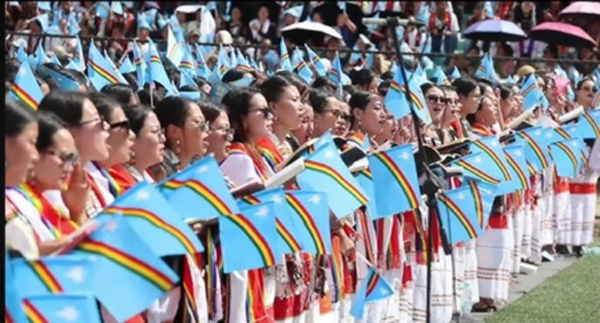
Thousands of Nagas from all walks of life, dressed in traditional attire and carrying NSCN-IM flags, greeted Muivah in the Naga majority hill district. A large number of Naga men, holding traditional spears and wearing customary headgears, turned up at the venue to welcome the NSCN-IM head.
As part of the reception ceremony, the All Naga Students’ Association, Manipur (ANSAM) unfurled the Naga flag at its office in Senapati, symbolising the student body’s continued commitment to the Framework Agreement and its core principles, including recognition of the Naga flag and constitution.
In his address to the gathering, ANSAM President Angteshang Maring hailed Muivah as “the living embodiment of the Naga political struggle”.