
The Clark Theological College Students’ Union (CTCSU) celebrated its Jubilee under the theme “For God’s Glory” with solemn thanksgiving, and a reflective message from the Speaker Rev. Temsü Jamir, Executive Secretary of the Ao Baptist Arogo Mungdang (ABAM).
Delivering the Jubilee Message, “Cut the Bottom of the Basket”, Rev. Temsü Jamir began by greeting the gathering on behalf of the All-Baptist Arogo Mungdang and the 1994 batch of Clark Theological College. Describing the day as “a momentous occasion,” he recalled the early 1990s when CTC was still in its formative years, with only four classrooms and one vocational classroom for driving lessons.
He narrated vivid memories of student life then, when all classes—from pre-theology to final year—took turns every Saturday to gather fresh cow dung from the farm to plaster the chapel floor.
“There was a pit in front of the chapel hall, and some of us had to mix cow dung and clay with kerosene and water. The roads were kutcha and muddy, and we wore rubber shoes instead of formals,” he recalled.
The speaker humorously noted that some students, connected with the Buddhist community, wore hunting boots and ammunition boots, remarking, “We were unsure of what we would become, but CTC has shaped us into who we are today.”
Reflecting on the college’s transformation over the decades, Rev. Jamir praised CTC as a premier theological institution and expressed his desire to see it evolve into a university with satellite campuses. Yet, he posed a challenging question: “CTC has changed, but have we changed? Are we still with the same old wineskin?”
Sharing a vision he received on the morning of October 27, he said, “God revealed to me a vision concerning CTC, and even now I shudder at the very thought of it. The picture was not pleasant. CTC exists for the glory of God, but if we make this blaze only a blaze of academic exercise, rather than fulfilling God’s greater plan, then we need to seriously retrospect.”
Download Nagaland Tribune app on Google Play
https://play.google.com/store/apps/details?id=com.news.nagalandtribune< Hyperlink >
Quoting Isaiah 43:18–19, he reminded, “Forget the former things. See, I am doing a new thing.” He said the question was not whether God wants to do something new, but whether believers are willing to change for God’s glory.
Drawing from an illustration of basketball’s invention by Dr. James Naismith in 1891, Rev. Jamir explained how initially, each scored point required stopping the game to retrieve the ball from the basket until someone suggested cutting open the bottom. Though initially resisted, the small change revolutionized the game.
“Brothers and sisters,” he said, “we all have certain kinds of baskets, and sometimes the biggest block we have is the basket we refuse to cut.”
He warned that holding on to old habits, pride, or traditions hinders spiritual progress: “God cannot fill hands that are still tightly holding the old. He cannot bring a new season if we are unwilling to leave behind the past seasons.”
Citing examples from Scripture, Rev. Jamir reminded that God’s new seasons demand sacrifice, surrender, obedience, and change: “Abraham left his country. Moses left the palace. Peter dropped his net. God is ready to do a new thing in your life, but maybe it’s time to cut the bottom of the basket.”
He identified “old baskets” as pride, fear, comfort zones, and habits that drain spiritual passion.
“Many of us cling to old ways, saying ‘we have always done it this way.’ We give importance to self rather than Christ. We work for recognition instead of serving God,” he said.
He urged the congregation to examine their lives: “Are we glorifying God through our works and lives? Or are we climbing ladders of our own making, getting exhausted and losing the spark of ministry?”
Rev. Jamir emphasized that theological education must lead to spiritual transformation: “God needs people who can bring transformation, not just those with information. Let our theology form our discipleship, not simply scholars who love arguments.”
He exhorted students to “be shepherds of souls rather than managers of religious programs,” and reminded that the Word of God, not theology alone, must be the authority.
Encouraging attentiveness in life’s journey, he said, “Every journey is important. I never close my eyes when I travel, because I may never travel that road again. So let me see, enjoy, and learn.”
Concluding, he posed a reflective question: “If Jesus rebuked the religious establishment in his time, what would he rebuke in ours?” He urged everyone to seek the answer and live lives that glorify God alone.
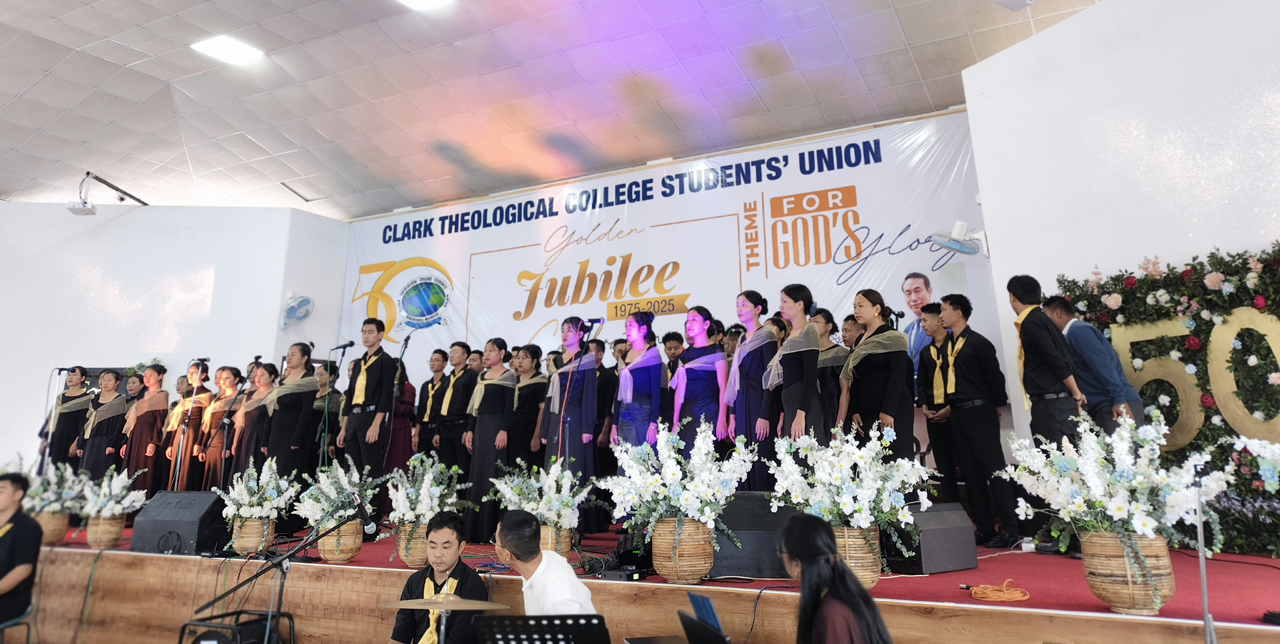
The event, held at the college chapel, was led by Matsunginla Jamir (M.Th II) as leader, with Jentiyanger Longkumer as cantor and Sentijungla Longchar on piano. The Jubilee opening was led by the CTCSU, followed by the hymn “To God Be the Glory.”
Imtilemla, Principal of Impur Bible Seminary, read the scripture and led in prayer, while Prof Rev Dr A Temjen Jamir, Principal of Clark Theological College (CTC), delivered the welcome and introduction. Nungshisangla, General Secretary of CTCSU, offered a tribute to the departed souls, and the group Pilgrims presented a special song.
Greetings were conveyed by Akangtemsu Yaden, President of CTCAA; Wati Imchen, Principal of FAC; and Dr A Niholi Sema, Associate Pastor (Women) of Atoizu Town Baptist Church. The “Down the Memory Lane” segment was presented by the Publicity and Media Committee, followed by a special prayer for CTCSU by Prof Rev Dr K Dhanbir Rai.
Dr Tsuknugrenla, Associate Professor, CTC, unveiled the Jubilee souvenir, after which the CTC Choir presented a song.
The celebration concluded with a vote of thanks by Akumsunep Jamir, President of CTCSU, followed by the closing hymn “To the Regions Beyond” and benediction pronounced by Khipenlo Apon, Academic Dean of Mt Terogvu Theological College, Tseminyu.
An extravaganza programme was scheduled for the evening.

