The Department of Genetics and Plant Breeding, School of Agricultural Sciences, Nagaland University. Medziphema Campus, in collaboration with ICAR-National Research Centre on Mithun (ICAR-NRCM), Medziphema, Chumoukedima District, Nagaland organized a National Conference on “Harnessing Genetic Resources for Food Security: Innovations in Conservation and Utilization for Sustainable Crop and Livestock Improvement in the Northeast Region” on November 17 and 18 in hybrid mode.
At the inaugural session on November 17, Vice Chancellor, Nagaland University, Prof Jagadish K Patnaik, speaking as the Chief Guest in online mode, emphasized the timeliness and relevance of the theme and noted that food insufficiency in the region is closely linked to changing lifestyles, fragile livelihoods, and limited support to the farm and food sectors.
Stressing the growing challenges of ensuring adequate and safe food for all, he underscored that food security must go hand in hand with food safety, and that any violation of food safety standards threatens both health and sustainability and highlighted the importance of the seminar theme and stated that research on genetic resources, conservation strategies, and innovative utilization of indigenous crops and livestock is crucial for strengthening the region’s resilience.
Dr Girish Patil S, Director of ICAR–NRC Mithun, highlighted that Nagaland holds 98% of the world’s Mithun population, entirely found in the Northeast, and stressed the need for collaborative efforts to conserve this valuable genetic resource as its numbers decline. He noted that the Northeast, part of four global biodiversity hotspots in India, is a mega-diverse region where traditional food practices—seen in events like the Hornbill Festival—reflect rich biological diversity that remains underutilized for food security.
He also pointed to rising temperatures and studies predicting further micro-climatic changes, emphasizing the urgency of strengthening in situ conservation. With about 180 participants, he expressed confidence that the discussions would help develop strategies to conserve genetic resources and promote sustainable crop and livestock improvement in the Northeast.
Prof Dipak Sinha, Pro Vice Chancellor, School of Agricultural Sciences, Nagaland University, emphasized that the conference was genuinely multidisciplinary, bringing together diverse fields to address the theme of harnessing genetic resources for food security.
He noted that such integrative discussions are essential for advancing innovative approaches in conservation and sustainable improvement of crops and livestock in the Northeast region.
During the inaugural session, Compere was carried out by PhD scholar, NU:SAS, Nzanthung Ezung; invocation by Dr Razouninuo, Professor, Department of LPM.
Download Nagaland Tribune app on Google Play

Convenor of the organizing committee Prof Malini B Sharma, Head, Department of GPB, NU:SAS, delivered the welcome address along with the brief about the conference.
The event aimed to bring together leading scientists, researchers, academicians, and policymakers to deliberate on innovative strategies for the conservation and utilization of genetic resources to enhance food and nutritional security in the region and had the support and guidance of local advisors from 11 departments of the School of Agricultural Sciences, Nagaland University, Medziphema Campus.
Honoured guests were also Dr A Pattanayak, former Director, IIAB Ranchi ; Dr Aditya Pratap, PC, AICRP on Kharif pulses IIOR, Kanpur, Dr H K Bora, chief scientist, AAU.
Vote of thanks was delivered by Dr Sanjeev Kumar Singh, senior scientist cum head, ICAR-KVK, Phek and the release of the conference e-book took place during the inaugural session.
Speaking at the valedictory program, chief guest, Dean of SAS:NU, Prof. Pauline Alila, highlighted that rural communities already possessed rich knowledge and time-tested techniques and noted that modern scientific knowledge should be integrated with this traditional wisdom to strengthen sustainable agriculture.
She stressed the need to conserve and utilize traditional seed and animal varieties, improve them, and support farmers in adapting to the challenges of climate change through close collaboration. According to her, farmers’ techniques, refined over generations, had proven effective and should be recognized as a foundation for future progress.
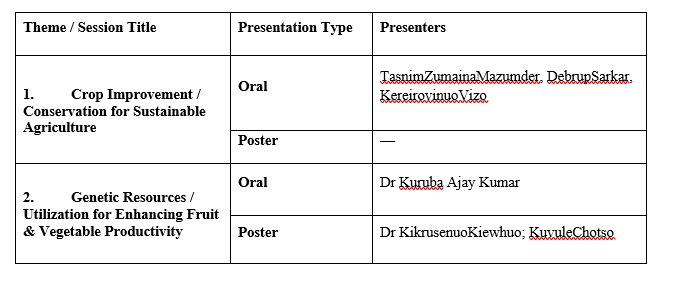
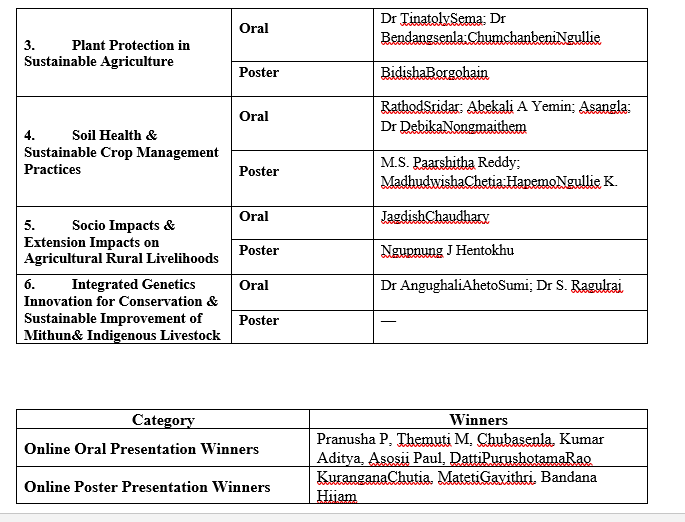
Over the last two days, a total of six different themes were covered, with in all of 185 registrations were recorded for the event; with oral and poster presentations delivered in both online and offline modes by participants from various parts of the country while the program featured 17 invited speakers, one plenary session, and the participation of 35 RAWEP students from ICAR–IARI, Assam, Dhemaji.
List of the winners