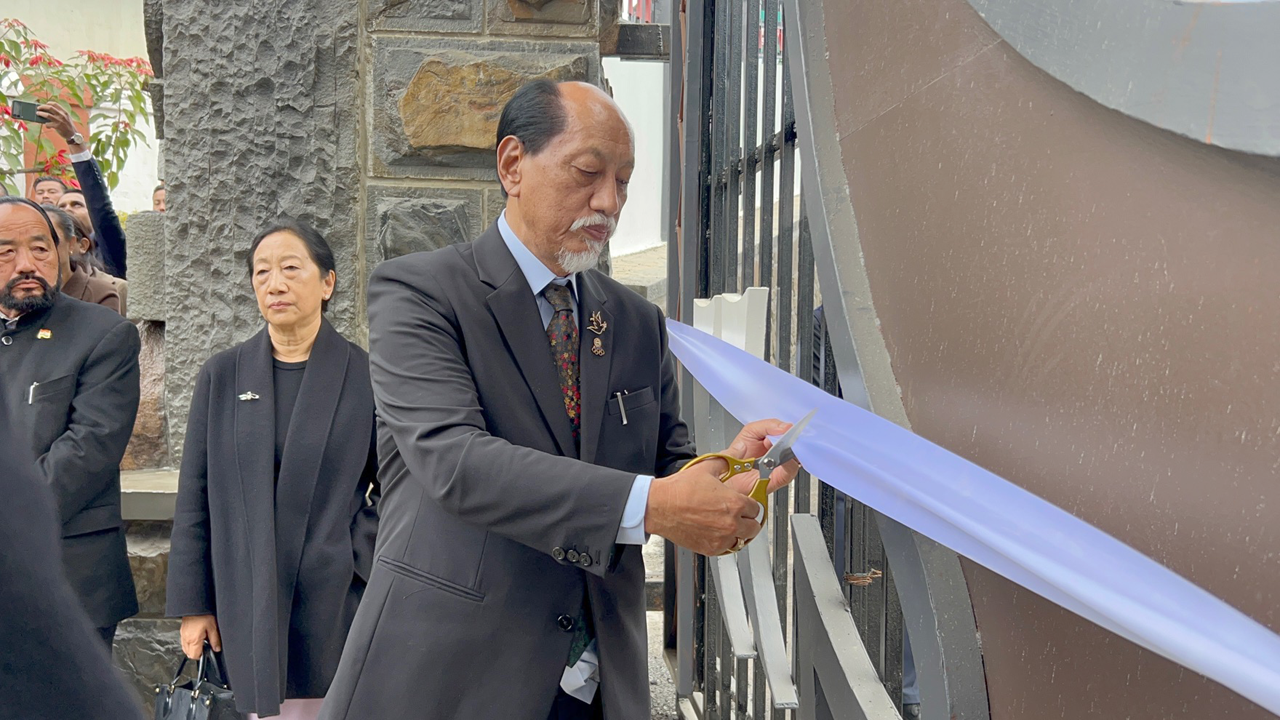
Nagaland Chief Minister Neiphiu Rio on November 29 inaugurated the Kohima Peace Memorial & Eco-Park at Kohima and emphasized that the site should stand as a lasting reminder of the sacrifices made during the Second World War and as a space for future generations to learn the value of peace.
Calling the project “historically significant,” Rio said it reflects a collective effort to honour the past while shaping a peaceful future. He noted that the Eco-Park, together with the Peace Memorial and elements symbolising Nagaland–Japan friendship, had transformed the area into a meaningful destination for both locals and tourists.
Although Nagas did not initiate the war, Rio reminded the gathering that local communities bore immense suffering—starvation, fear, and displacement—as global powers clashed on Naga soil.
Reflecting on his own family’s wartime history, Rio recalled that his father served in the British Indian Army as a training instructor in Shillong and was decorated with the King George V Medal and the Burma Star. He shared childhood memories of growing up under strict military discipline, noting that he and his brothers were sent to Sainik School in keeping with their father’s values.
Rio narrated wartime stories passed down through Naga communities , women carrying water for British troops, villagers remembering tins of food and chocolates, and accounts of Japanese soldiers tending to their wounded in improvised camps. He said these memories form an essential part of Naga history and are increasingly being recorded by local writers, including former colleague, Mogamo Kikko.
He added that Japanese nationals continue to visit the memorial, regularly laying flowers at commemorative stones.
Rio highlighted the heavy losses in the Battle of Kohima, citing the 1,420 graves at the Commonwealth War Cemetery and 914 Indian soldiers recorded separately, while acknowledging that civilian casualties remained undocumented.
Drawing parallels with his visit to Hiroshima’s Peace Park, Rio said the emotional impact on visitors there illustrates the horrors of war. He expressed hope that the Kohima site would similarly encourage reflection and peace education. He urged schools and colleges to bring students for guided tours to learn from artifacts, diaries, and soldier accounts preserved at the site.
The Chief Minister also highlighted Japan’s continued developmental engagement in the state. He said Japanese ambassador Suzuki Hiroshi is expected to visit next year, and credited JICA for supporting livelihood, conservation efforts, and a sanctioned 400-bed hospital to be jointly operated by Japanese and Naga staff.
Rio encouraged youth to learn Japanese—already taught at Nagaland University—to take advantage of training and employment opportunities with Japanese companies and institutions.
Expressing gratitude to landowners, the Environment and Forest Department, and architect Richard Belho, Rio said the memorial and park were realised through collective dedication. He urged shopkeepers to promote Naga products, maintain fair pricing, and uphold cleanliness and discipline, adding that Japanese work ethic should inspire Nagas to adapt to global competitiveness.
Download Nagaland Tribune app on Google Play

Advisor to the Chief Minister and NAGA People’s Front (NPF) Secretary General Abu Metha delivered a powerful message of peace and historical reflection during an event at the Kohima Peace Memorial, drawing parallels between the legendary Battle of Kohima and other pivotal Second World War sites across the world.
Metha opened his address by recalling visits to Hiroshima’s eternal flame, Pearl Harbor in Hawaii, and the River Kwai in Thailand—places that, he said, evoked photographic memories because of their profound wartime significance. He asserted that Kohima stands on equal footing with these global landmarks.
“Kohima is no lesser in its historical importance,” Metha said, noting that the Japanese advance through Asia culminated in one of the most decisive battles of modern history. He reiterated the widely acknowledged view that the Battle of Kohima changed the trajectory of the Second World War. According to him, had Japanese forces succeeded in capturing Dimapur and the railway head, “the history of the subcontinent and the spread of democracy in South Asia might have been very different.”
Metha also highlighted the broader impact of the Japanese campaign across Asia, saying it accelerated decolonisation and contributed to the emergence of new independent nations. Regardless of the war’s outcome, he said, “history changed course,” with democracy and freedom ultimately prevailing in Kohima.
Reflecting on the wartime experiences of the Naga people, Metha emphasised that local communities were unwilling participants caught in a conflict not of their making. “We were living peaceful lives when guns boomed, tanks arrived, and fighter jets flew overhead,” he said. “Great ideologies and superpowers clashed on our lands and in our fields.”
Standing at the memorial, he contrasted today’s peaceful landscape with the devastation of 80 years ago—“cries of pain, destruction, and the smell of death.”
Quoting the programme chairperson, Metha reminded the audience that they were walking on the very soil where soldiers fought and died during the battle. “This was the battlefield… the place where history changed,” he said. He described the Kohima Ridge as ground soaked with the blood of young men who made the ultimate sacrifice.
Metha praised the Naga people for transforming the painful memory of war into a message of peace for the world. “Today, Kohima and the Naga people are contributing again to the goodness of humanity,” he stated, calling for unity, oneness, and peace as the only way forward.
He further reflected on the legacy of the Kohima War Cemetery, describing each grave as a story and each patch of land as forever belonging to the countries and regions the soldiers came from—England, Scotland, Ireland, Punjab, and others. Many of the soldiers, he said, were teenagers or only children who travelled thousands of kilometres to fight in a land far from home.
“As we remember them, we must use their legacy to carry a message of peace to the world,” Metha urged. Concluding his speech, he delivered a simple but powerful appeal to humanity: “Never again.”
Earlier during the inaugural event, Environment and Forest minister CL John delivered the welcome address, PCCF & HoFF Vedpal Singh chaired the programme, pastor Visato Yhoshü offered the dedicatory prayer, and Cantabile Choir and Lidi Kro-u presented folk fusion performances.