Four years after the Oting massacre, the Konyak Morung in Kisama heritage village glowed under candlelight as the Eastern Naga Students’ Federation (ENSF) gathered to remember the 14 lives lost. What might have been a quiet evening of mourning turned Into a moment of collective reckoning, with ENSF president Nuheymong Yimkhiung retelling the events of that dark December night in 2021.
Speaking to the gathering, Yimkhiung said that confusion and misinformation had long clouded the tragedy. To counter that, he presented a report drawn from eyewitness accounts, the stories of people who had been present when the violence unfolded.
The president said that eight miners left Tiru at 4:05 p.m expecting to reach home within half an hour. A second group, still at the depot, heard distant gunshots but did not imagine they were connected. Only when they later started for Oting, and were redirected by a uniformed man to take the long Pioneer road.
The president highlighted that back at the village, concern grew when two hours passed with no sign of the first group. By 7:30 p.m young men formed a search team, and shortly after 8 p.m they found the miners’ Bolero, empty, blood-stained, and pierced by a bullet.
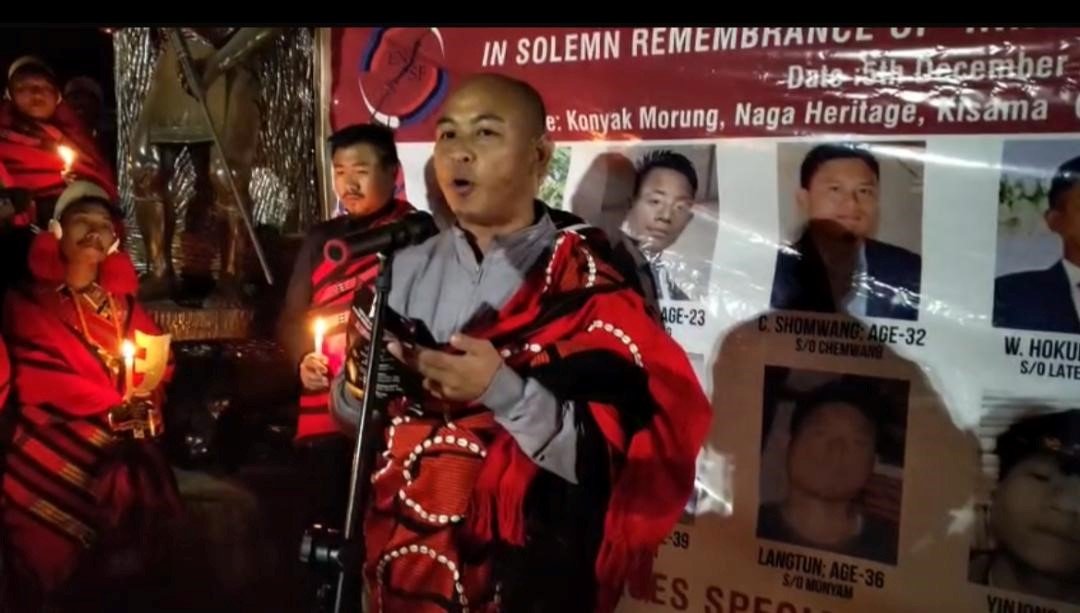
Yimkhiung recounted that the discovery at the site was a devastating revelation. The search party encountered a convoy of paramilitary vehicles. One attempted to drive away. When the villagers stopped them, the personnel claimed they knew nothing about the missing miners. But inside the vehicles, under a tarpaulin was six bodies and signs that someone had tried to disguise them in combat uniforms.
The discovery triggered confrontation, the President said and shots were fired. More villagers were hit. Yimkhiung said that armed personnel hidden around the area opened fired and that some fled using villagers’ motorcycles, firing as they escaped.
According to the report, three more civilians, Bipul Konwar, Ngampho Konyak, and Pongche Konyak were killed separately, though they had not been part of the clash. Their deaths, Yimkhiung said, challenged claims of “self-defence.” In another incident, a civilian Pongche Konyak of Jakphang Village was also killed in his hut.
He added that even the following day bore traces of confusion when two injured villagers taken to Dibrugarh Hospital were reportedly labelled as NSCN members by those who brought them in. This, he said, contrasted sharply with the government’s later description of the incident as a “mistaken identity” case.
Download Nagaland Tribune app on Google Play

Yimkhiung said that December 4, 2021 incident is a shameful day in the history of Indian intelligence. The ENSF president reaffirmed the federation’s demand for justice and for the repeal of AFSPA from Nagaland. “We cannot endure another tragedy like this,” he said.
ENPUK President Toshi Chang reminded the gathering that remembrance is not only about death but about honouring the lives lived. He spoke of how grief lingers in everyday moments and how Nagaland’s collective sorrow continues to bind its people together. “Memory has no expiry date,” he said.
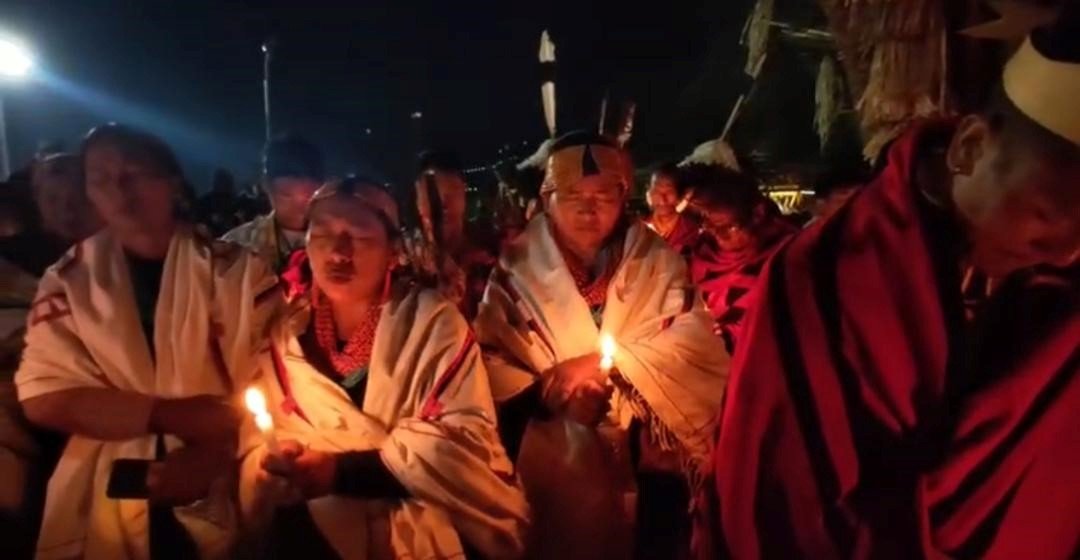
The vigil included prayers, traditional gunfire, and the deep, resonant beat of the log drum, a tribute that carried both mourning and resilience.
Representatives of various tribes and visitors joined in, standing together for the families who continue to carry the weight of that night.