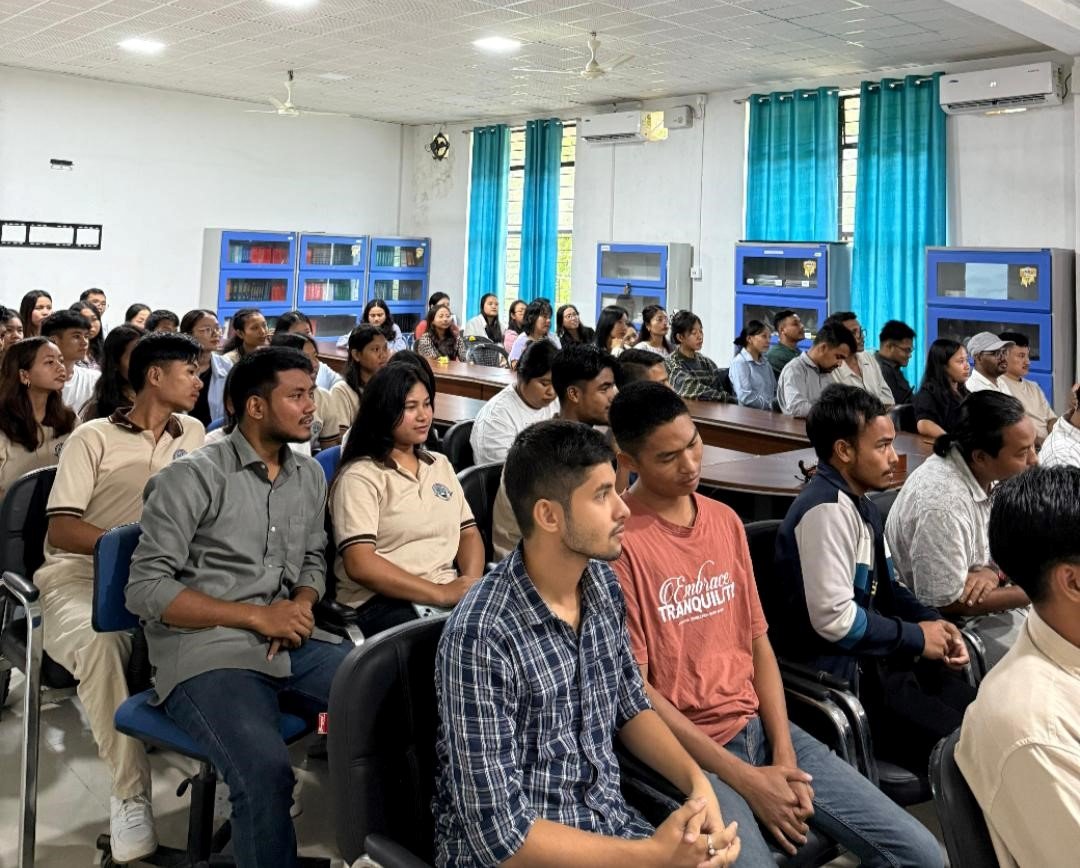
Nagaland University, the only Central University in the State, is continuing its effort to expand academic and research activity on Indian Knowledge Systems. The varsity has initiated teaching and research activities within the chemistry discipline, informed a press release from the University.
It stated that the initiative reflected the University’s commitment to incorporating the objectives of NEP 2020 into mainstream higher education while encouraging interdisciplinary participation across departments.
The Value-Added Course titled Chemistry in Indian Knowledge Systems, offered by the varsity’s Department of Chemistry, has the approval of the University Academic Council. Recognising that India’s chemical knowledge traditions have received comparatively limited academic attention despite their historical significance, the course seeks to address this gap.
Its objective is to introduce learners to foundational aspects of Indian Knowledge Systems, including modes of knowledge transmission and pedagogical traditions, while examining the relevance of these practices to contemporary discussions on sustainability and environmental responsibility.
It will familiarise learners with the historical development of chemical knowledge in India and its interconnections with medicine, metallurgy, materials science and environmental practices. The course is open to students from all disciplines, underscoring its interdisciplinary character and broad academic relevance.
Urging students of the university to avail this program, Prof. Jagadish K. Patnaik, Vice-Chancellor, Nagaland University, said, “Through this teaching initiative, Nagaland University is supporting advanced scholarly research in the area of Indian Knowledge Systems (IKS) in Chemistry. The Value-Added Course titled Chemistry in Indian Knowledge Systems, offered by the University’s Department of Chemistry, has the approval of the University Academic Council and the Academic Council.”
Prof. Jagadish K. Patnaik congratulated Prof. Upasana Bora Sinha and her team for their leadership and dedicated efforts in strengthening research and academic activity in IKS within the chemistry discipline, calling it a significant step toward realizing the vision of NEP 2020.
In addition to the teaching initiative, Nagaland University is supporting advanced scholarly research in the area of Indian Knowledge Systems in Chemistry. A Doctor of Science (D.Sc.) programme is currently being pursued by Prof. Upasana Bora Sinha of the Department of Chemistry on the research topic “A Chronological Study of Chemistry in India from 1500 BC to the 21st Century: Linking Ancient Chemistry Knowledge with Modern Day Research Through Computational Simulation.”
Download Nagaland Tribune app on Google Play

The research focuses on a systematic scientific examination of India’s chemical knowledge traditions using contemporary analytical and computational methods. The research also allows the documentation of the history of chemistry in India, a mammoth task which had been initiated by Acharya P. C. Ray and continued by scholars such as Prof. B. V. Subbarayappa and Prof. Priyadaranjan Ray.
Elaborating further, Course Coordinator Prof. Upasana Bora Sinha, Department of Chemistry, Nagaland University, said, “The teaching and research initiatives provide students with contextual learning, interdisciplinary exposure and research-informed perspectives, equipping them to engage critically with both India’s scientific heritage and contemporary global challenges. Through this initiative, Nagaland University continues to strengthen its commitment to inclusive, future-ready education rooted in indigenous knowledge traditions.”

About Nagaland University
Nagaland University, the 13th Central University and the only Central University in Nagaland was established based on the Act of Parliament of India and received the assent of the President of India on 20th October 1989 as The Nagaland University Act 1989. The University came into being on September 6, 1994 having jurisdiction over the entire state of Nagaland
At present the University has three campuses, viz. (i) Headquarters at Lumami in Zunheboto district (ii) Kohima Campus at Meriema in Kohima district (iii) Medziphema Campus (School of Agricultural Sciences) at Medziphema in Dimapur district.
There are 43 departments offering Undergraduate and Postgraduate and Ph.D. programmes in different disciplines of Arts, Commerce, Sciences, Agricultural Sciences, Engineering & Technology and Management streams. There are 76 colleges from all over the state of Nagaland currently affiliated to Nagaland University.