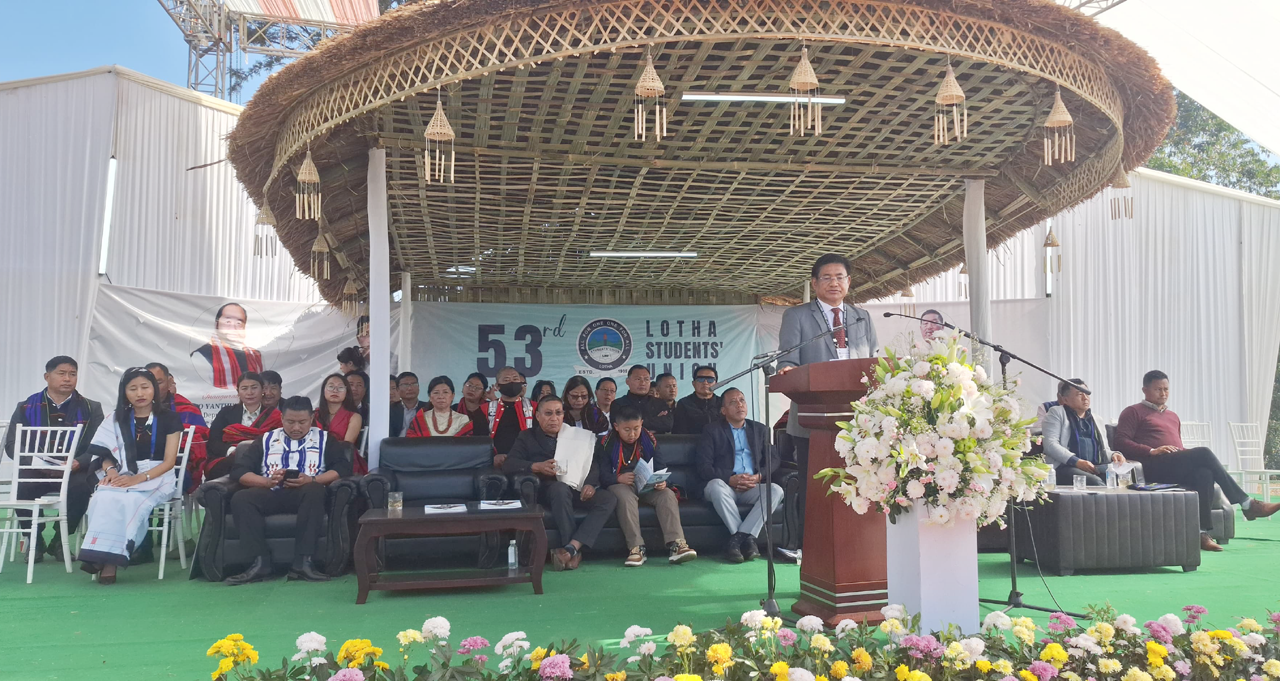
Cultural identity, unity and the evolving responsibilities of Naga youth formed the core messages at the Cultural Session of the 53rd General Conference of the Lotha Students’ Union (LSU), held at Old Changsu Village on Friday. The event brought together student leaders, elders and policymakers, with Mhathung Yanthan, MLA and Advisor for Agriculture, attending as the special guest, while the valedictory session in the evening was addressed by Achumbemo Kikon, MLA and Chairman, Bhandari SDPDB.
Throughout the session, speakers repeatedly underlined the urgency of safeguarding cultural heritage at a time of rapid social and technological change. Addressing the gathering, Yanthan acknowledged the LSU leadership for making culture and tradition a central focus of the conference and for their continued efforts in promoting Lotha heritage. He said such initiatives were essential in ensuring that traditional values remained relevant to younger generations.
Yanthan also welcomed the participation of cultural troupes from other states, stating that exposure to diverse traditions fosters mutual respect and strengthens inter-community understanding. He warned that cultural erosion was becoming increasingly visible among the youth, stressing that language, traditional attire, customs, folk songs and dances are not merely ceremonial practices but the foundations of identity.
While recognizing the inevitability of change, Yanthan cautioned against equating development with cultural neglect. He pointed to challenges such as technological advancement, climate change and changing lifestyles, noting their wide-ranging impact on agriculture, health and society at large. Encouraging students to engage constructively with modern tools, he called for responsible use of artificial intelligence, digital learning platforms and smart education systems.
On the issue of employment, Yanthan observed that many students continue to view government service as the only viable career option. Without dismissing such aspirations, he urged students to widen their perspective by embracing innovation, skill-based learning and entrepreneurship, and to take advantage of government-sponsored training and skill development programmes.
Linking leadership to accountability, Yanthan reminded students that their choices today would define the future direction of society. Describing young people as future leaders, he stressed that discipline, clarity of purpose and commitment were essential qualities for meaningful leadership. He concluded by urging the gathering to collectively commit themselves to preserving cultural values as a shared responsibility.
Download Nagaland Tribune app on Google Play

Think beyond village and tribe, Kikon tells youth at LSU conference
The valedictory address delivered by Achumbemo Kikon shifted focus to historical consciousness and collective vision. Kikon said conferences of this nature should leave participants enriched with wisdom and experience that extend beyond academic instruction, adding that intellectual gatherings must contribute meaningfully to both personal growth and societal advancement.
Reflecting on the conference theme, “Transcend Beyond Borders”, Kikon described the Lothas as pioneers in Naga history, crediting their elders for possessing a broad and inclusive outlook despite limited access to formal education. Tracing the evolution of Naga unity, he recalled key historical milestones such as the formation of the Naga Club in 1918 and the establishment of the Naga National Council in 1946 at Wokha, which he said exemplified visionary leadership that looked beyond narrow community interests.
Kikon challenged the present generation to introspect on whether their thinking matched the vision of their forefathers. He cautioned against being confined by village, range or tribal politics, stressing that unity was vital for the survival of Naga society. Warning that division could weaken the entire community, he called for reconciliation and collective responsibility, particularly among educated youth.
He also expressed concern over how social media and digital platforms are being used, urging young people to move away from negativity and instead promote constructive dialogue. Calling for a return to traditional Naga values of respect, accommodation and mutual care, Kikon stressed that these principles must be revived and practiced in everyday life.
Highlighting the demands of an increasingly competitive global environment, Kikon warned that basic academic qualifications alone were insufficient. He encouraged students to cultivate reading habits and pursue deeper learning, cautioning that dependence on superficial information could lead to intellectual stagnation.
The cultural session featured a range of traditional performances and competitions, including yodelling, folk songs, folk dances and tug-of-war events. Lolano Lotha of RASU emerged first in the debate competition, followed by Yanrowo Y. Ezung of WRSU, while Erenthung Ezung of KLSU and Sorenbeni T. Odyuo of DLSU shared third place.
James Ennie secured first position in the war cry competition, with Renchithung Kithan finishing second, and Mhademo Ovung and Chanbemo Ngullie jointly taking third. In folk dance, DLSU claimed the championship title, followed by LLRSU and LMRSU, while ERSU topped the folk song category ahead of NRSU and WCSU.
In tug-of-war events, DLSU secured first place in the women’s category, with ERSU finishing second, while ERSU emerged winners in the men’s category, followed by WCSU.
The programme concluded with prayers of blessing offered by Moyithung N Murry, Senior Pastor, New Riphyim Baptist Church.
