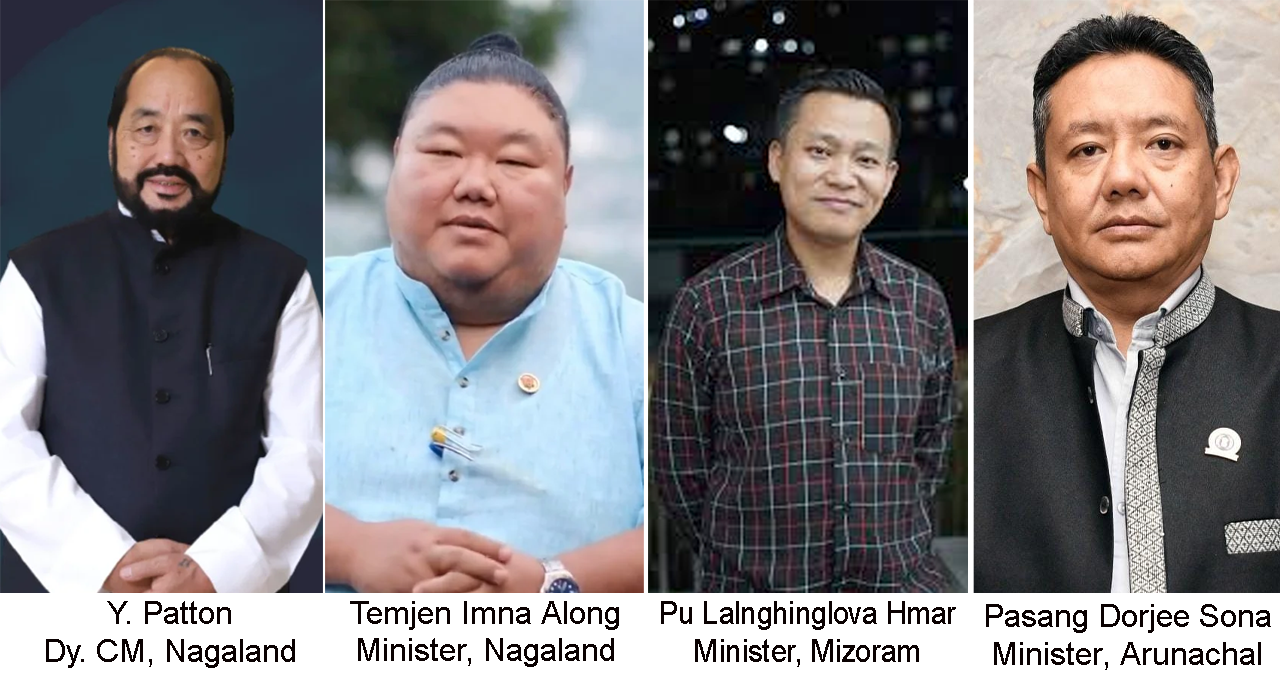
Leaders from Nagaland, Mizoram and Arunachal Pradesh have welcomed the Union Budget 2026–27, describing it as a visionary, inclusive and future-oriented blueprint that places the Northeastern region at the centre of India’s development journey. Applauding its strong focus on infrastructure, skilling, sustainable livelihoods, tourism, MSMEs and regional equity, the ministers said the Budget provides a stable and outcome-driven framework to empower hill and frontier states while advancing the national vision of a Viksit Bharat and a Viksit Nagaland.
Deputy Chief Minister of Nagaland, Y Patton on Sunday described the Union Budget for the year 2026-27 as highly visionary and in the right direction towards realizing the dream of a Viksit Bharat under the able leadership of Prime Minister, Narendra Modi.
Congratulating Union Finance Minister, Nirmala Sitharamaj for presenting her 9th consecutive Union Budget, Patton stated that the clear focus on the Northeastern Region reaffirms the national priority accorded to historically disadvantaged and geographically challenged states, including Nagaland.
The provisions supporting high-value agriculture, including agarwood cultivation in the Northeast, were noted as being well aligned with the region’s ecological and economic strengths and crucial for its long-term development, he stated
Patton further highlighted that the enhanced thrust on animal husbandry, fisheries, and rural entrepreneurship would directly support livelihood diversification in hill states like Nagaland. He welcomed the strengthened MSME framework, which demonstrates the intent to empower small enterprises and local entrepreneurs in remote regions.
He also emphasized that the increased public capital expenditure would sustain infrastructure momentum critical for improving connectivity and market access. The Budget’s emphasis on skilling, allied health, and the services sector was appreciated for expanding employment opportunities for youth and aligning with the State Government of Nagaland’s initiatives to skill its human capital, he said and acknowledged the support extended to handloom, handicrafts, and village industries, recognizing the cultural economy of indigenous communities.
He said that the Budget’s inclusive approach effectively integrates growth with social justice and regional equity, balances fiscal prudence with growth imperatives, prioritizes capital formation, and provides a stable, outcome-oriented framework for inclusive and sustainable development—crucial for achieving the vision of a Viksit Bharat and a Viksit Nagaland.
Nagaland’s Minister for Higher Education & Tourism, Temjen Imna Along said that the Union Budget 2025-27 sends a strong signal that services, education and tourism would be central to India’s next phase of growth, and this has direct relevance for Nagaland.
He said the proposal to establish University Townships along major corridors, coupled with the High-Powered ‘Education to Employment and Enterprise’ Standing Committee, reinforces the need to align higher education with employability and entrepreneurship, an area Nagaland has been actively reforming.
For the tourism sector, the Minister said, the upgradation of the National Council for Hotel Management into a National Institute of Hospitality, the pilot programme to train 10,000 certified guides, and the creation of a National Destination Digital Knowledge Grid would professionalize tourism while opening new opportunities for local youth. These measures are especially relevant for culturally rich states like Nagaland, where heritage, festivals and community tourism are key economic drivers, he added.
The Minister said the Budget’s focus on MSMEs, startups and creative industries, including AVGC and design education, provides pathways for youth to participate in the orange economy without migrating out of the region.
Importantly, the continued thrust on Purvodaya and targeted tourism development in eastern and Northeastern states acknowledges regional aspirations; he said adding this Budget offers Nagaland the policy tools to convert education into employment and tourism into sustainable livelihoods.
Mizoram Tourism Minister, Pu Lalnghinglova Hmar observed that the Union Budget placed tourism firmly at the intersection of employment generation, cultural preservation and sustainable regional development, a perspective that aligns closely with Mizoram’s priorities. The emphasis on eco-sensitive tourism, professional skilling, hospitality education and digital documentation reflects a shift from volume-driven tourism to value-based, experience-oriented models, he added.
Download Nagaland Tribune app on Google Play

He said that the National Destination Digital Knowledge Grid would enable systematic documentation and storytelling of lesser-known destinations, opening new avenues for local youth, researchers and creative professionals. Investments in guide certification and hospitality skilling would further strengthen service quality while generating dignified livelihoods across hill and rural districts.
Lalnghinglova further said the continued thrust on infrastructure, with public capital expenditure rising to ₹12.2 lakh crore, alongside incentives for last-mile connectivity, will improve access to interior tourism circuits. Support for MSMEs, women-led enterprises and community entrepreneurship further ensures that tourism growth remains inclusive and locally anchored. Overall, the Budget provides a balanced and future-ready roadmap for Mizoram’s tourism-led development, he added.
Minister for Tourism, Education, Rural Works, Parliamentary Affairs & Libraries, Government of Arunachal Pradesh, Pasang Dorjee Sona said that the Union Budget reflects a mature understanding of India’s diversity by addressing development through capacity-building, connectivity and cultural continuity.
For Arunachal Pradesh, he said the emphasis on Purvodaya, sustained capital expenditure of ₹12.2 lakh crore, and enhanced fiscal devolution under the 16th Finance Commission strengthens the foundation for long-term, decentralized growth.
“What stands out is the Budget’s clear pivot from welfare delivery to capability creation,” he said adding, the Education-to-Employment Standing Committee, University Townships, and girls’ hostels in every district directly address access and aspiration in remote and border regions.
Sona said the focus on digital documentation of heritage and knowledge through the National Destination Digital Knowledge Grid, complements Arunachal Pradesh’s efforts to preserve libraries, manuscripts and indigenous knowledge systems.
He further said the Budget also recognizes that rural infrastructure and livelihoods must move together. Increased support for high-value agriculture in the Northeast, including agarwood, combined with investments in last-mile connectivity, seaplane operations and rural infrastructure, would significantly improve market access in difficult terrain, he observed.
The expansion of SHE Marts under the Lakhpati Didi framework is particularly relevant for tribal and women-led enterprises, enabling a transition from subsistence activity to ownership-based rural entrepreneurship, Sona said.
He also said that the proposed Buddhist Circuit scheme reinforces Arunachal Pradesh’s role as a civilizational bridge between India and Asia, adding overall, the Budget provides a balanced roadmap—linking education, rural works, cultural preservation and economic opportunity—to empower frontier states as active contributors to Viksit Bharat.