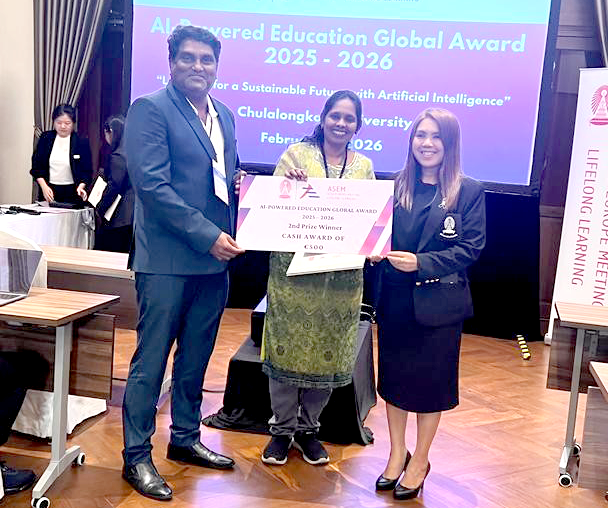
A multidisciplinary research team has been awarded 2nd Prize at the AI-Powered Education Global Award 2025–2026 Contest, organized by the ASEM Lifelong Learning Hub, Chulalongkorn University, Thailand, for their innovative project titled “Preserving Heritage through Technology: A Scalable NLP Solution for Nagamese Language (NagaLangue.ai)”.
The award-winning project addresses a critical gap in artificial intelligence by enhancing machine translation for low-resource and underrepresented languages, with a special focus on Nagamese, a widely spoken creole of Northeast India. Using a token-augmented adaptation of the mBART-50 multilingual model, the research introduces language-specific tokens to significantly improve translation accuracy without requiring costly architectural changes or large-scale retraining.
Experimental results demonstrated substantial performance gains, with Nagamese–English translation achieving a BLEU score improvement from 81.25 to 85.42, alongside up to 40% reduction in accent-induced translation errors when compared to leading multilingual models such as Transformer, M2M-100, and NLLB-200. The solution shows strong potential for scalable deployment in education, digital governance, immigration workflows, and multilingual platforms, while contributing to linguistic equity and cultural preservation.
Download Nagaland Tribune app on Google Play

The study, led by Dr R Vasanthan, Associate Professor, and co-authored by researchers from Nagaland University, SRM Institute of Science and Technology, National College (Autonomous) Tiruchirappalli, Central University of Haryana, and Central University of Tamil Nadu, highlights how lightweight, fairness-aware AI interventions can deliver high impact for marginalized language communities.
By combining advanced NLP techniques with cultural sensitivity, NagaLangue.ai sets a global benchmark for how AI can be leveraged to preserve linguistic heritage while advancing inclusive and equitable education technologies.