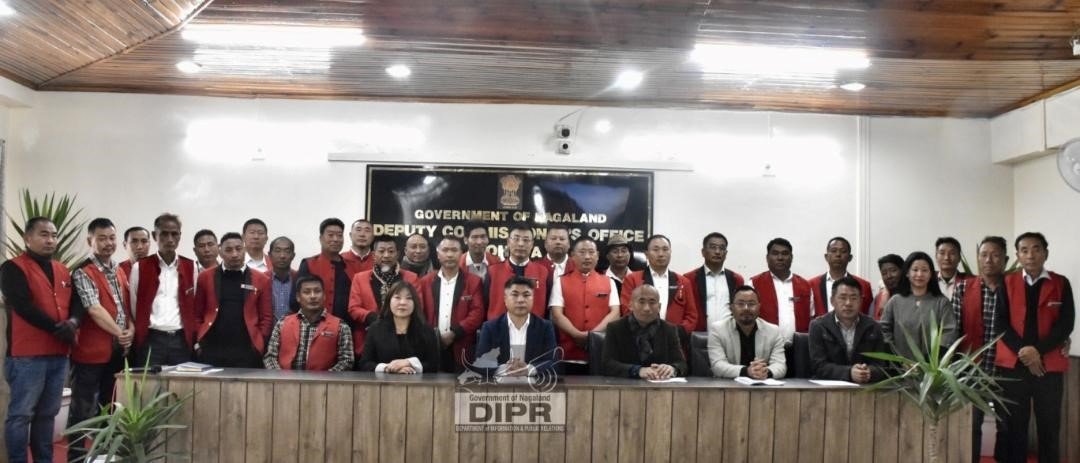
A one-day orientation programme for the Dobashis (DBs) of Kohima District was held on February 3, 2026 at the DC’s Conference Hall, Kohima, to strengthen their understanding of their roles in administration, customary justice and governance.
Addressing the inaugural session, B. Henok Buchem, NCS, Deputy Commissioner, Kohima, highlighted the historical significance of the Dobashi institution in Naga society. Referring to the formation of the Naga Club in 1918, the DC stated that Dobashis played a pivotal role in the early Naga political movement, noting that nine of the signatories to the memorandum submitted to the Simon Commission were Dobashis. The DC described Dobashis as a respected institution vested with both executive and judicial authority and stressed that with changing times and evolving social conditions, Dobashis must also adapt while upholding the principles of equality before law. The DC urged them to deliver judgments without fear or favour, remain neutral from village and tribal politics, maintain discipline and integrity, and discharge their responsibilities sincerely as peacemakers and representatives of the administration.
Speaking on behalf of the Dobashis, Notho, DB-I, thanked the district administration and officers for organising the orientation programme. He stated that the Dobashis are presently functioning in a period of transition and uncertainty due to changing social and administrative contexts, and expressed hope that the orientation would provide clarity and guidance. He reaffirmed the commitment of Dobashis to uphold Naga customary law, preserve Naga culture and identity, and contribute towards maintaining law and order.
Download Nagaland Tribune app on Google Play

James Renbi Kikon, SDO (C) Sadar, delivered a session on the origin of the Dobashi institution, tracing its evolution during the British period. He explained the role of Dobashis as “men of two languages” who served as interpreters and cultural mediators between colonial administrators and Naga communities, facilitating administration, governance and judicial processes, and bridging linguistic and cultural gaps.
Ketoulhoutuo U. Rame, Senior Legal Assistant, DC Office Kohima, spoke on the Village Council Act, 1978 and the Bengal Frontier Regulation Act, 1873. She explained that the Village Council Act provides statutory recognition to village councils and empowers them to administer village affairs and resolve disputes based on customary practices. She further stated that the Bengal Frontier Regulation Act continues to safeguard Naga customary law and traditional institutions, forming the legal foundation for the administration of justice in Nagaland.
Imtiyenla K., EAC Kohima, delivered a session on the present role of Dobashis in district administration. She explained that the institution originated in 1842 during the British era as interpreters between administrators and Naga tribes and later evolved into key functionaries blending traditional authority with administrative roles. She highlighted that Dobashis, as government-appointed functionaries, assist administrative officers in daily operations, village-level coordination, dispute mediation, inspections, surveys, law and order duties, and in supporting police and magistrates.
Dr. Riku, EAC (Sadar), spoke on the Rules for the Administration of Justice and Police in Nagaland, emphasising the role of Dobashis in customary judiciary, DB Courts, recording of statements, and ensuring that legal proceedings are properly understood by all parties.
The programme highlighted the challenges faced by the Dobashis in balancing tradition with modern governance and reaffirmed their continued importance as custodians of local customs, traditions and dialects, and as vital links between customary practices and the modern administrative system.