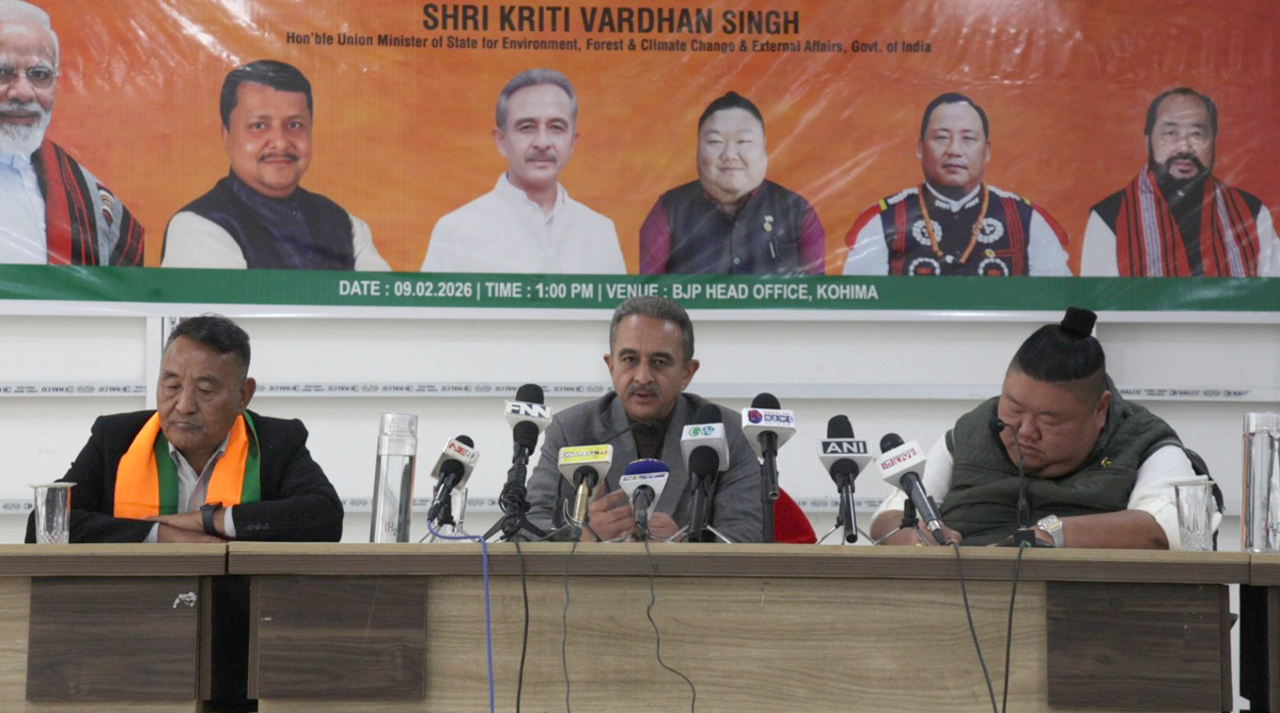
Union Minister of State for Environment, Forest and Climate Change and External Affairs, Kriti Vardhan Singh on Monday said the Union Budget 2026–27 reaffirmed the Modi Government’s focus on reform-led growth, fiscal prudence and people-centric development, guided by the principle of Aatmanirbharta.
Speaking at a press conference at the BJP headquarters in Kohima, Singh said the budget, presented from Kartavya Bhavan for the first time, was a youth-driven initiative inspired by the Viksit Bharat Young Leaders Dialogue 2026. He said it was anchored on accelerating economic growth, fulfilling public aspirations and leveraging advanced technologies, including artificial intelligence, for better governance.
Singh said the government would continue its reform momentum under the “Reform Express” roadmap towards Viksit Bharat@2047, citing proposals such as regulatory simplification, a high-level committee for non-financial sector reforms, and Jan Vishwas Act 2.0 to reduce criminal provisions and improve ease of living.
On fiscal indicators, Singh said the fiscal deficit had been brought down to 4.3% of GDP in BE 2026–27, while the debt-to-GDP ratio was estimated at 55.6%. He said gross market borrowings of ₹17.2 lakh crore and net borrowings of ₹11.7 lakh crore would support growth without crowding out private investment. He added that ₹1.4 lakh crore had been provided to states following acceptance of the 16th Finance Commission’s recommendations.
He said the budget continued to provide relief to the middle class through simplified tax compliance, reduced litigation, lower TCS rates for education and medical remittances, and duty exemptions on essential medicines. Measures to attract foreign investment by PROIs were also announced.
On employment and education, Singh said the budget proposed new institutional mechanisms to link education with employment, expand skilling in services, healthcare and creative sectors, and establish new national-level institutions in hospitality and design.
Download Nagaland Tribune app on Google Play

MSMEs, he said, would benefit from enhanced equity and liquidity support, mandatory use of TReDS by CPSEs and creation of a secondary market for MSME receivables. Manufacturing expansion across strategic sectors and revival of industrial clusters were also highlighted.
Singh said capital expenditure would increase to ₹12.2 lakh crore, with emphasis on transport infrastructure, waterways, logistics and regional connectivity. Export growth would be supported through a dedicated Export Promotion Mission and digital trade platforms.
Addressing a query on Dimapur Airport, Tourism and Higher Education Minister, Temjen Imna Along said the issue of expansion, affected by land occupied by the Assam Rifles, had been discussed in the state cabinet. He said the matter involved the AAI and Ministry of Home Affairs, while the state government was also addressing civilian encroachment.
Singh said he would assist at the Centre if needed. He further said Dimapur Railway Station had been upgraded and Krishi Udan facilities introduced to help farmers transport produce quickly and economically.
He said Nagaland’s eco-forests and strong community institutions offered significant potential, but stressed the need for training, NGO involvement and development of eco-tourism initiatives to generate livelihoods, particularly for youth and women.