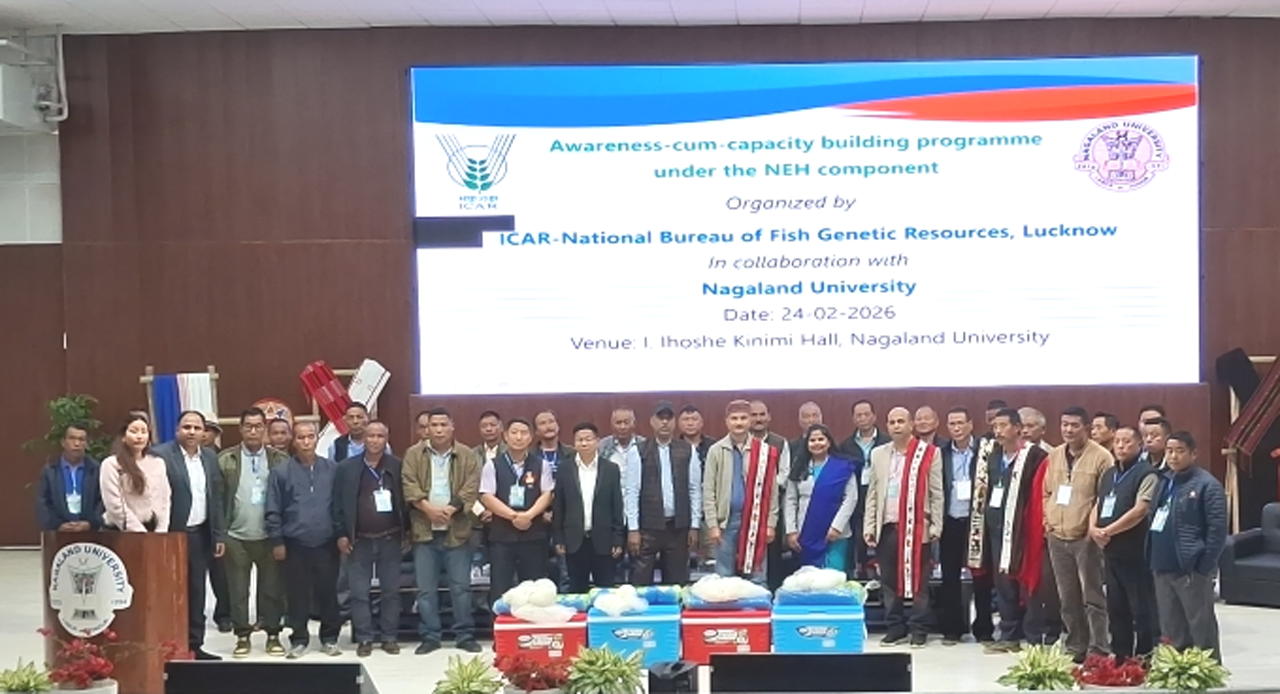
An Awareness-cum-Capacity Building Programme under the NEH Component was organized on February 24 at I Ihoshe Kinimi Hall, Nagaland University, Lumami. The programme was organized by ICAR-National Bureau of Fish Genetic Resources, Lucknow, in collaboration with Nagaland University, with the objective of strengthening sustainable aquaculture practices and promoting scientific fisheries development in the North Eastern Hill (NEH) region.
The programme was convened by Dr Kajal Chakraborty, Director, ICAR–NBFGR, Lucknow, who addressed the gathering virtually and presented an overview of the Bureau’s initiatives in the NEH region. He highlighted fish germplasm conservation, brood bank development, biosecurity measures, and farmer-oriented capacity-building interventions aimed at enhancing regional fisheries productivity.
The inaugural session included the release of Farmers’ Extension Booklets in Nagamese and Ao languages to support scientific fish farming practices at the grassroots level. Senior functionaries of the University emphasized the importance of integrating indigenous ecological knowledge with modern aquaculture technologies to improve productivity and sustainability.
Chief Guest, Prof B Kilangla Jamir, Vice-Chancellor (In-Charge), underscored the vast fisheries potential of Nagaland, noting the state’s abundant streams, ponds, springs, and terrace-based water systems. She observed that despite these natural resources, dependence on imported fish remains high, reflecting a production gap as well as a significant opportunity for achieving self-reliance through scientific pond management, quality seed use, balanced feeding, and systematic water-quality monitoring.
Dr Abemo, Registrar of Nagaland University, emphasized the University’s commitment to providing strong administrative support for community-oriented research and extension initiatives. Prof Bendang Ao, Director of the Research & Development Cell, highlighted the importance of translating academic research into measurable field-level outcomes that directly benefit rural communities.
Dr Pranay Punj Pankaj, Associate Professor, Department of Zoology, Nagaland University, coordinated the programme at the University level, facilitating institutional arrangements, academic coordination, participant mobilization, and liaison with ICAR–NBFGR officials to ensure the smooth conduct of the event.
Er T Imlisunep Ao, Principal of Government ITI Mokokchung, who represented the farmers of Mangmetong Village, expressed sincere gratitude for the scientific guidance and fisheries input support provided under the NEH initiative.
Dr Rejani Chandran, Senior Scientist of ICAR-National Bureau of Fish Genetic Resources, underscored the importance of sustainable pond management and region-specific advisory services tailored to local conditions.
Download Nagaland Tribune app on Google Play

Dr LK Tyagi, Principal Scientist, emphasized scientific broodstock management and feed optimization as critical components for enhancing fish productivity.
Amit Singh Bisht, ACTO, highlighted the significance of field-level technical assistance and continuous follow-up support to ensure effective adoption of improved aquaculture practices.
Prof Ranjit Kumar, Head of the Department of Zoology, appreciated the active interdisciplinary involvement of faculty members and students in community-based extension programmes.
The programme witnessed participation of nearly 250 attendees, including progressive Ao tribal fish farmers, Village Council members from Mangmetong Village, faculty members, University Staffs, research scholars, students, and media representatives. Technical sessions covered scientific pond preparation, optimal stocking density, feed and health management, water-quality assessment, and post-harvest handling practices. An interactive scientist–farmer session enabled participants to discuss field-level constraints and identify locally adaptable solutions.
The programme highlighted the shared commitment of ICAR–NBFGR and Nagaland University in advancing sustainable aquaculture, strengthening livelihood security, and enhancing community-oriented extension initiatives in Nagaland. The session was chaired by Senepsola Ozukum.
