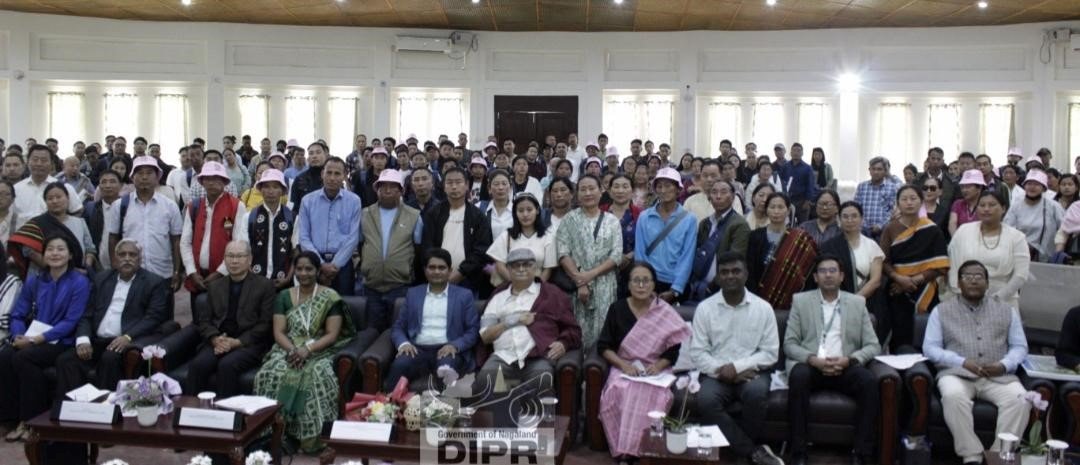
A three-day Plant Genetic Resources (PGR) Conservation Awareness Program cum Training on Organic Farming commenced at Agri Expo, Chümoukedima, on February 19. The programme is being organised by the ICAR–National Bureau of Plant Genetic Resources (NBPGR), New Delhi, in collaboration with SAS, Nagaland University, Medziphema Campus and the Department of Agriculture, Government of Nagaland.
The inaugural program was graced by Sidramappa M. Chalkapure, IFS, CCF (D&P) and Member Secretary, State Biodiversity Board, GoN as Special Guest, while Prof. Akali Sema, Professor In-charge, Research Cell, SAS, Nagaland University, chaired the session.
Sidramappa M. Chalkapure, IFS in his address, stated that the program is significant as it brings together scientists, scholars, community leaders and farmers on a common platform to exchange knowledge, research findings and practical insights. He said that such interaction enables participants to learn from one another, bridging the gap between scientific expertise and traditional wisdom to foster sustainable practices. He expressed appreciation for the large number of farmers participating in the program, representing all districts of the State.
He explained that there are two primary types of conservation—in-situ conservation, which protects species in their natural habitats, and ex-situ conservation, which involves preservation outside natural environments such as botanical gardens or seed banks. He said that this program exemplifies a powerful combination of these approaches—scientists contributing through ex-situ methods, while government departments and officials focus on in-situ strategies, supported by formal policies and on-ground implementation.
Highlighting Nagaland’s ecological importance, he stated that the State forms part of the Indo-Himalayan Biodiversity Hotspot, one of the 36 recognized hotspots worldwide, and the need to preserve and safeguard the natural resources for future generations. He urged participants to utilize the platform to enhance their understanding of preservation and conservation techniques, particularly for endemic plants and animals native to the State.
He noted that every tribe in Nagaland possesses invaluable traditional knowledge related to the conservation of indigenous plants and crops, and stressed the need to document these practices while integrating modern scientific methods to improve their effectiveness.
Speaking on protected areas, he said that Nagaland is home to one National Park and three Wildlife Sanctuaries, which are managed by the Forest Department and are dedicated to the preservation and conservation of wild biodiversity. He emphasized that conservation is not the responsibility of the government alone and called upon farmers and village communities to actively participate in protecting land and natural resources.
He recalled that villages in Nagaland have traditionally preserved forests to protect water sources, plants and animals, and stressed that such practices must continue while adapting to contemporary challenges.
Download Nagaland Tribune app on Google Play

He stated that community conservation has been practiced in Nagaland since time immemorial and urged farmers and community leaders to sustain these traditions and share the knowledge widely. Citing Khonoma village as an example, he referred to the alder-based agriculture system as a nature-based solution demonstrating how traditional practices can address modern environmental challenges.
In conclusion, he called upon scientists, communities and policymakers to work collectively to protect and preserve Nagaland’s rich biodiversity.
Dr. Sushil Pandey, Principal Scientist, ICAR-NBPGR, New Delhi, briefed the participants on the objectives of the programme and highlighted its key components. He informed that India hosts the second-largest gene bank in the world, with reference to the National Gene Bank at National Bureau of Plant Genetic Resources (NBPGR). He further stated that the Government of India is committed to supporting the programme, reaffirming its dedication to national biodiversity conservation efforts, and informed that a second gene bank is proposed to be established in Himachal Pradesh.
The inaugural session concluded with a vote of thanks by Prof. A.K. Singh, Centre In-charge, AICRN on Potential Crops, Department of Soil Science, SAS, Nagaland University. The program saw participation from farmers, scientists, students and officials from various departments.
