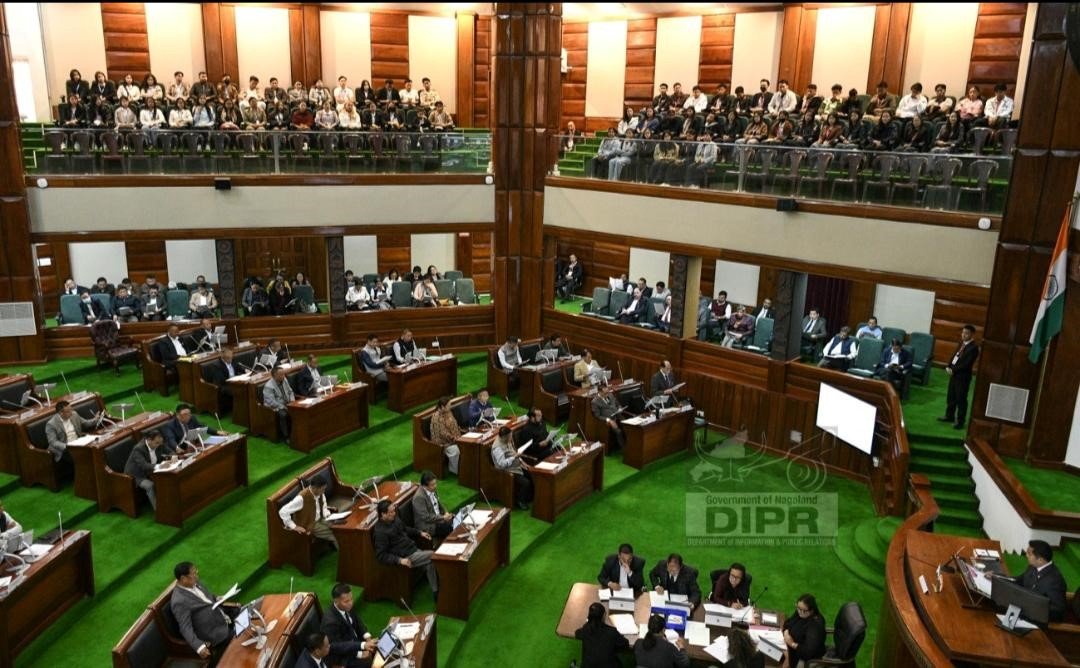
Advisor for School Education, Dr. Kekhrielhoulie Yhome, in his speech, stated that ever since the 5th Finance Commission denied Nagaland its fiscal rights in 1989, the State has faced significant financial constraints and persistent fiscal deficits. He said that Nagaland, as a political State, was created with the firm belief that Delhi would take care of all administrative expenditure through the Consolidated Fund of India, but ever since that support was discontinued, the State has been under financial strain.
Drawing a comparison over the last five years, he said that between 2020–21, the total receipts stood at Rs. 20,826 crore, while in the current year it has increased to Rs. 22,507 crore, reflecting an increase of around Rs. 1,681 crore over the past six years. On the expenditure side, he noted a marginal improvement, with an increase of Rs. 1,078 crore over the past five years.
At the sectoral level, he pointed out that the State’s own revenue has shown substantial improvement. In 2021, State taxes stood at Rs. 1,283 crore, whereas last year it increased to Rs. 2,714 crore, which he described as nearly a double increase, amounting to around 47 per cent growth.
On the issue of debt, he said that in 2021, nearly 29.8 per cent of the State’s budgetary allocation was being used for debt servicing and interest payments. However, in the current year’s budget, this has come down to 11.6 per cent, which reflects a significant improvement in fiscal management.
Yhome further noted that in 2021, the State had a negative opening balance of Rs. 2,234 crore, whereas this year it began with a negative opening balance of Rs. 411 crore, and is projected to end with a negative balance of Rs. 337 crore. He said these figures clearly show substantial improvement in fiscal management and budgetary discipline.
While acknowledging the State’s limitations as a small State with limited revenue and heavy dependence on Delhi, he congratulated the Chief Minister and the Finance Minister for their prudence in financial management. He said that as far as the burden of debt on future generations is concerned, there has been remarkable improvement over the past five years.
Download Nagaland Tribune app on Google Play

Speaking specifically on the Department of School Education, for which the Chief Minister is also the Minister in-charge, Yhome said that between 2020 and 2025, the State spent Rs. 7,891.36 crore on school education alone, while receiving Rs. 1,535.57 crore from the Centre. Altogether, school education has consumed Rs. 9,426.93 crore over the past five years, which is only Rs. 573 crore short of Rs. 10,000 crore.
He said that successive Central Finance Commissions have repeatedly flagged Nagaland’s high revenue expenditure, particularly on salaries, and this year’s budget also reflects those concerns. He pointed out that the Minister has allocated Rs. 12.89 crore for civil works this year, but except for the SDO Office, the remaining works are already ongoing.
The Advisor observed that capital infrastructure investment under the State Plan for the Education Department stands at only 0.48 per cent, and said that while around Rs. 70 crore has been spent on State school infrastructure over the past five years, the amount received from Delhi for capital infrastructure investment stands at 14.26 per cent.
He acknowledged that the current Budget, especially the non-CSS allocations, is largely infrastructure-oriented and therefore justified. At the same time, he congratulated the Finance Minister for introducing new elements into the Budget.
Yhome said that the Budget team now appears to be working with system thinking and a deeper understanding of social innovations that can be scaled up. He noted that the Budget reflects a growing degree of fiscal prudence, as well as an awareness of how global practices can be adapted and integrated into the State’s financial planning.
He cited the inclusion of SDG-related initiatives as one such example, saying this reflects the State’s movement towards a new financial regime. He further stated that the Government of India has also introduced several management reforms, and that Nagaland is increasingly aligning its financial practices with international best practices.
