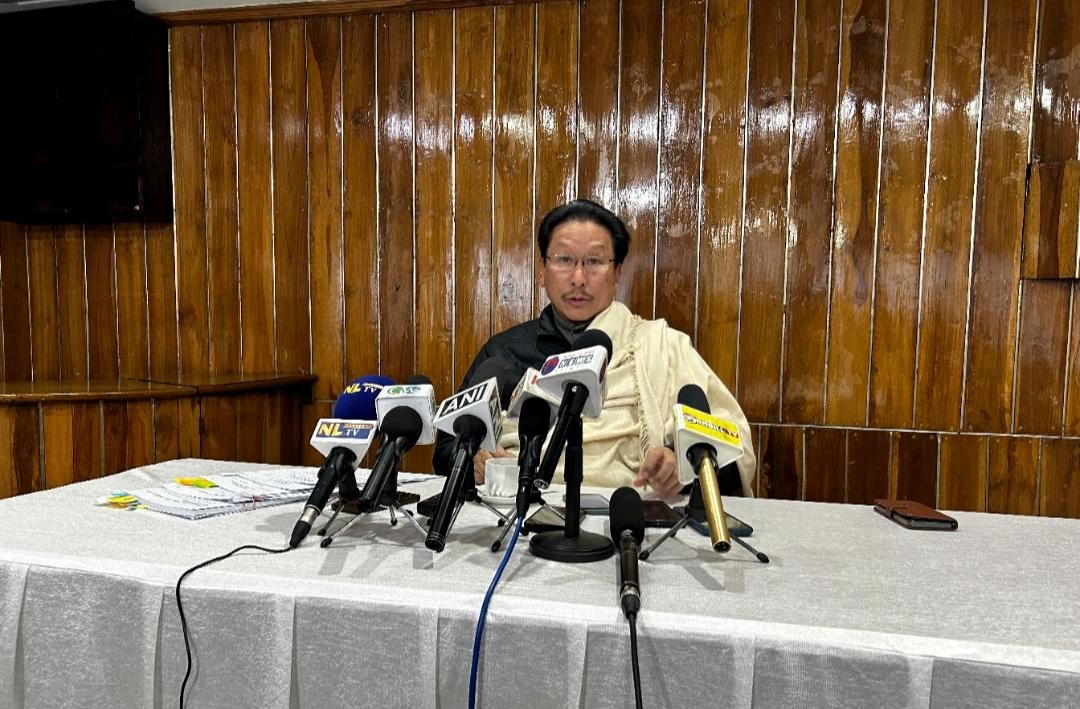
Minister of Parliamentary Affairs and Power, K.G. Kenye, on February 4 held a press conference at Hotel Japfu, Kohima, briefing the media on key decisions taken at the recent Cabinet sitting held Chümoukedima Rhododendron Hall on February 3.
Addressing the media, Kenye said the Cabinet reviewed several important political and administrative issues and called the press conference to share developments and decisions taken by the state government.
He informed that discussions are currently underway between Eastern Nagaland People’s Organisation (ENPO), the Frontier Nagaland Territorial Authority (FNTA), and the Government of India. Expressing optimism, Kenye said that talks were expected to be held in New Delhi on February 4 and that the state government is hopeful of a positive announcement from the Centre on February 5 regarding the long-pending demand for the creation of a new administrative entity under FNTA.
“We are keeping our fingers crossed and hope for the best,” Kenye said, adding that the issue has endured for years and remains a matter of deep public interest.
Kenye highlighted that to effectively address ongoing political matters, the Cabinet has decided to constitute a subcommittee under the Political Affairs Committee (PAC). Kenye explained that since the PAC is a large body, it is often difficult for all members to convene frequently. The newly formed subcommittee will be convened by Chief Minister Dr. Neiphiu Rio and will include two Members of Parliament, two Deputy Chief Ministers, and Cabinet ministers.
He further informed that members who were able to travel have already left for Delhi and will take up key issues with the Centre, including the Free Movement Regime (FMR) and the reimposition of the Protected Area Permit (PAP).
The Political Affairs Subcommittee will also press the Centre to review the PAP, which Kenye said has been affecting Nagaland in several ways. He expressed hope that after sustained persuasion for nearly one and a half decades, the issue would finally be resolved in accordance with the wishes and aspirations of the people.
“The desire of our people is clear, and we sincerely hope this matter can now be put to rest,” Kenye added.
On the issue of oil and gas exploration , Kenye highlighted that it is a long-standing issue and had become contentious after being taken to court. He mentioned that while the state government had hoped for clarity following court hearings on matters related to Article 371(A) and ownership of resources, the final verdict is yet to be pronounced. In view of this delay, the Cabinet resolved to move forward based on constitutional provisions.
It was clarified that oil and gas exploration in Nagaland would not go against the Centre’s interests or any standing orders. Article 371(A) clearly states that land and its resources belong to the people of Nagaland, a provision unique to the state. Unlike other states, all natural resources on, above, and below the surface belong to private landowners and the people.
Kenye added that the elected state government, with the consent of landowners, has the authority to take decisions regarding the exploration of natural resources. He highlighted that dispute arose due to differing interpretations of central laws on petroleum and natural gas, which are central subjects elsewhere in the country. The matter was taken to court following objections by certain organisations, but the case has since become infructuous after the withdrawal of the petition.
Kenye also reiterated that its position is firmly grounded in the constitutional safeguards provided to Nagaland.
Download Nagaland Tribune app on Google Play

On land holding system, Kenye said that the Cabinet has taken major decisions to bring greater clarity and regulation to the state’s landholding system, which has remained largely unsettled over the years.
Addressing the issue, he said that despite the promulgation of various laws and directives such as the SARFAESI Act and several Office Memorandums over time, the Land Revenue department and the state government had not taken a firm and decisive stand on regulating land ownership. As a result, ambiguities in the landholding system have persisted.
He said that the Cabinet during its recent sitting examined proposals submitted by the Land Revenue department and reviewed them in the context of existing legal frameworks, including the Inner Line Permit (ILP), the Bengal Eastern Frontier Regulation, and provisions for the registration of indigenous inhabitants of Nagaland. Taking these factors into account, the government emphasized the need for concrete, long-term decisions.
Kenye informed that one of the key decisions taken was to introduce new directives requiring non cadastral areas and government occupied lands where individual land pattas were previously not issued to be brought under proper registration. Under the new measures, such lands held by organisations and individuals will be required to obtain land pattas and pay land revenue to the government, similar to other private landowners .
Kenye described these steps as significant moves towards streamlining land administration and ensuring accountability in land ownership and revenue collection across the state.