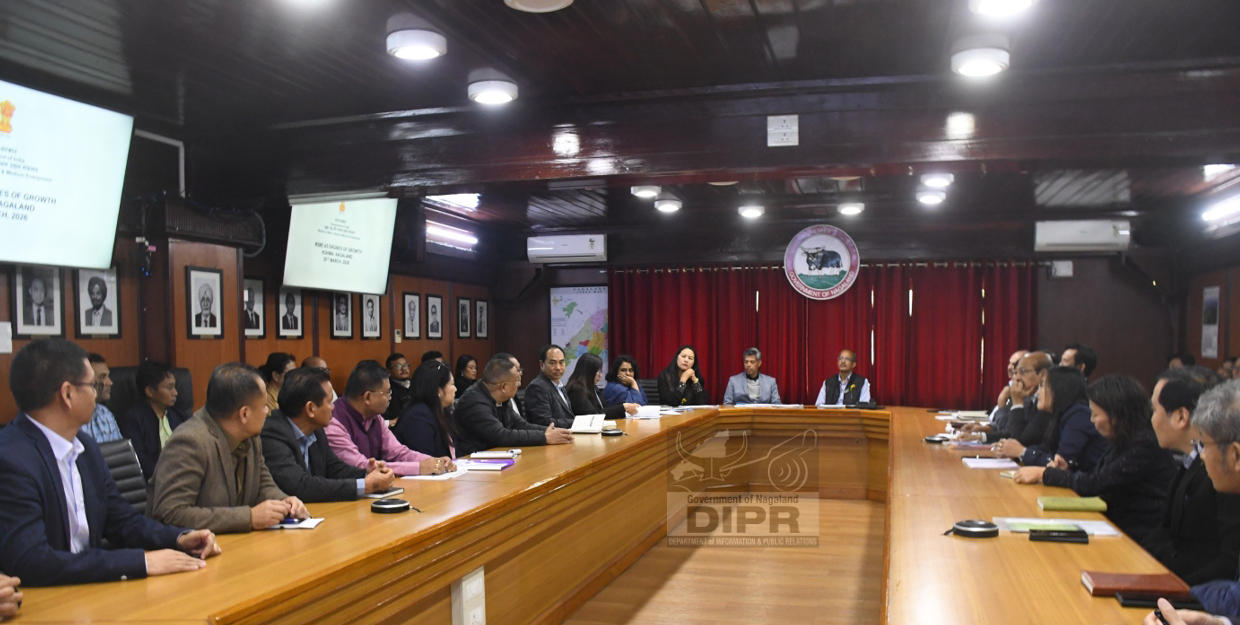
A high-level coordination meeting on “MSMEs as Engines of Growth” held at the Chief Secretary’s Conference Hall, Nagaland Civil Secretariat, Kohima, on Monday underscored the critical need for stronger convergence, coordination and collaboration between the Centre and the State to accelerate the growth of the Micro, Small and Medium Enterprises (MSME) sector in Nagaland.
The meeting, chaired by Additional Chief Secretary and Agriculture Production Commissioner V. Shashank Shekhar (IAS), brought together senior officials from the Ministry of Micro, Small and Medium Enterprises, Government of India, along with representatives from various agri and allied departments of the State government.
In his opening remarks, Shekhar stated that the primary objective of the meeting was to bring all concerned departments onto a common platform, enabling better synergy between central and state agencies to maximise benefits for the people. He emphasised that convergence and collective efforts are essential for effective implementation of developmental programmes, particularly in a sector as diverse and cross-cutting as MSMEs.

Secretary, Ministry of MSME, SCL Das, while addressing the gathering, stressed that the MSME sector cannot be viewed through the lens of a single department. He pointed out that MSMEs span across a wide spectrum of industries, including textiles, food processing, steel, electronics and several other sectors, making it imperative to break departmental silos and adopt a more integrated approach.
Clarifying the intent of the meeting, Das said that it was not a review exercise but rather a platform for dialogue, partnership and mutual understanding. He noted that the Government of India is committed to supporting Nagaland’s growth as part of the country’s broader development trajectory and emphasised that such engagements are crucial for aligning central schemes with the specific needs and priorities of the State.
Highlighting the importance of convergence, he remarked that multiple ministries and departments at both the Centre and State levels are implementing schemes that benefit MSMEs. However, without proper coordination, the full impact of these initiatives cannot be realised. He underscored that enhanced collaboration would ensure that benefits reach the intended stakeholders more effectively and translate into tangible outcomes on the ground.
Describing the meeting as an “initiation” of a more structured engagement process, Das expressed optimism that such interactions would continue through regular and institutionalised follow-up meetings. He also appreciated the State government for facilitating the interaction, terming it a valuable learning experience for both sides.
Download Nagaland Tribune app on Google Play

A detailed presentation was delivered by Joint Secretary Mercy Epao, who outlined the Ministry’s vision of fostering sustainable and globally competitive MSMEs as a central pillar of India’s economic growth. She elaborated that the Ministry’s mission is not only to promote enterprise creation but also to strengthen the manufacturing base, generate employment opportunities, and support traditional sectors such as Khadi, Village and Coir industries.
Epao emphasised that the growth of MSMEs depends on a combination of key enablers, including formalisation and financial inclusion, improved access to credit, adoption of modern technologies, digitalisation, infrastructure support and industry-relevant skill development. She highlighted that these elements must work together in a coordinated manner to build a resilient and competitive MSME ecosystem.
She further provided an overview of several flagship schemes of the Ministry, including PM Vishwakarma, the Prime Minister’s Employment Generation Programme (PMEGP), the Micro and Small Enterprises Cluster Development Programme (MSE-CDP), the Self Reliant India Fund (SRI Fund), Micro and Small Enterprises Cluster Development Programme (MSE-CDP), Prime Minister’s Employment Generation Programme (PMEGP), National SC-ST Hub Scheme (NSSH), International Cooperation Scheme (IC), and Assistance to Training Institutions (ATI).
These initiatives, she said, are designed to support MSMEs at different stages of growth, from enterprise creation to scaling and market expansion.
Focusing on women entrepreneurship, Epao highlighted the Yashasvini Initiative, which aims to empower women-led enterprises. The initiative envisions achieving the mandated 3% public procurement from women owned MSEs, promoting gender parity in formalization, and supporting women entrepreneurs at every stage from informal to formal enterprises, she said, adding it also seeks to enhance the contribution of women-led enterprises to GDP, exports, and employment generation through partnerships with key stakeholders.

Outlining the long-term roadmap under the vision of Viksit Bharat 2047, she stated that the goal is to develop a modern, vibrant and globally competitive MSME sector at the core of India’s development. She noted that this vision includes expanding MSME participation in exports and services, promoting sustainable and modern technologies, strengthening rural industries, and enhancing digitalisation and skill ecosystems and strengthening rural industries including Khadi and Coir through policy reforms and improved market access.
During the interaction session, various State departments, including Industries & Commerce, Tourism, Horticulture, Fisheries, Rural Development, Finance, IT & Communication, Land Resources, Women Development, Forest, Nagaland Bamboo Mission, Employment & Skill Development, Youth Resources & Sports, Sericulture and Agriculture, presented updates on their ongoing activities. They also highlighted key challenges, particularly in areas such as market access, value addition and export linkages, and sought greater support from the Centre to scale up their products and initiatives.
In his concluding remarks, Das assured that the concerns and grievances raised by the departments would be taken into consideration. He emphasised that such meetings provide an important opportunity to identify gaps, strengthen coordination and move forward collectively. He further stated that decisions which are immediately actionable would be implemented without delay, while identified bottlenecks would be addressed promptly through coordinated efforts.
Reiterating the importance of sustained engagement, he called for regular follow-up meetings to review progress and ensure that the momentum generated through such interactions is maintained.
The meeting concluded with a shared understanding that stronger Centre–State convergence, backed by continuous dialogue and coordinated action, will be crucial in unlocking the full potential of the MSME sector and driving inclusive economic growth in Nagaland.
Development Commissioner, Departments including Industries & commerce, Tourism, Horticulture, Fisheries, RD, Finance, IT & C, Land Resources, Women Development, Forest, Nagaland Bamboo Mission, Employment & Skill Development, Youth Resource & Sports, Seri culture, Agri department attended the meeting.