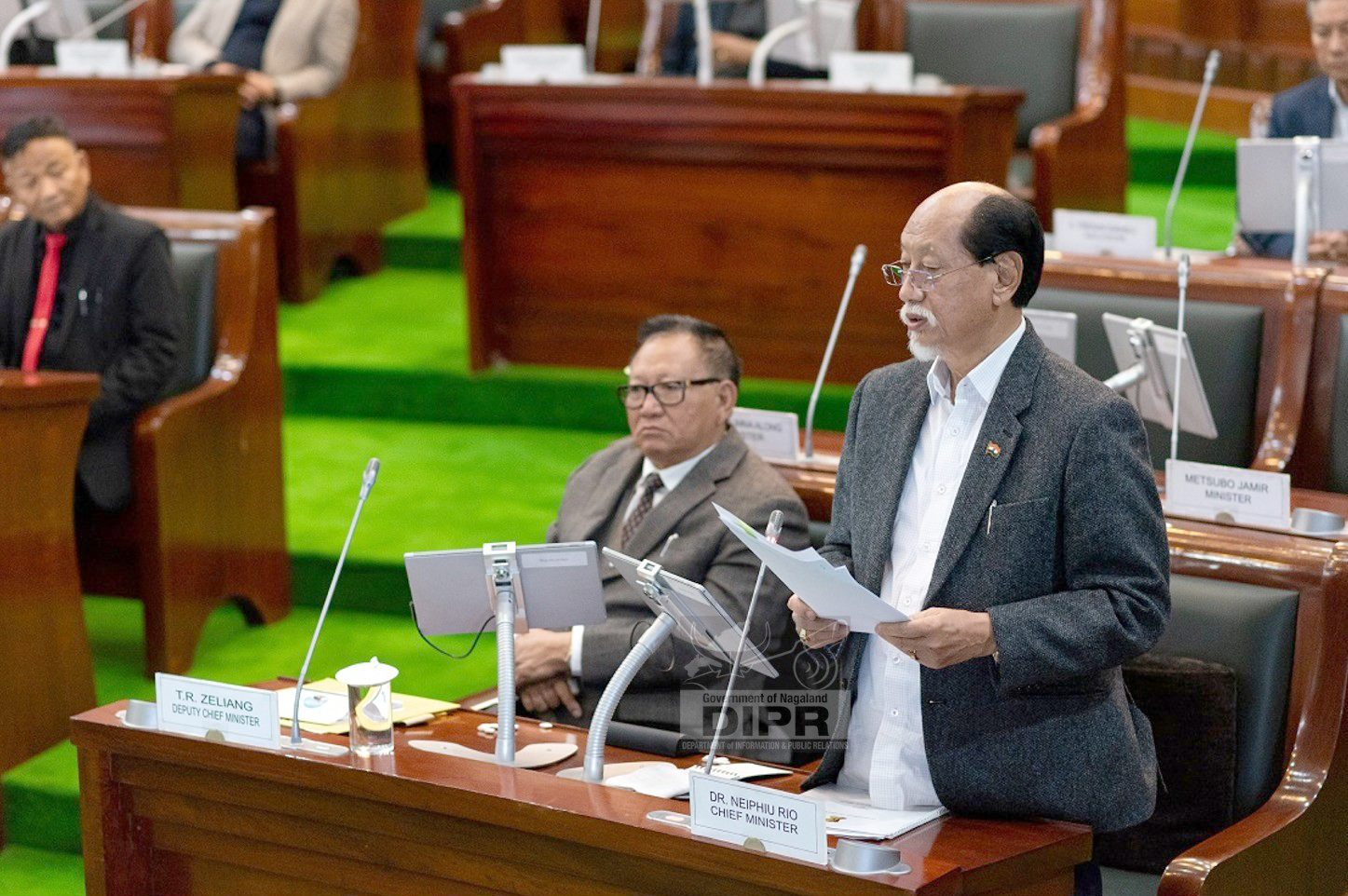
Nagaland Chief Minister, Neiphiu Rio today clarified that the term “Sadar” refers to urban areas with a high concentration of population and economic activities.
He was replying to a query raised regarding Sadar areas in Nagaland during the Question Hour on the second day of the 8th session of the 14th Nagaland Legislative Assembly.
He further explained that when an area is designated as a Sadar, the administrative authority should be responsible for issuing land pattas. In the context of Nagaland, due to the protections under Article 371(A), the state is exempt from the 73rd amendment of the Panchayati Raj Act because land and its resources belong to the people. As a result, the administrative framework for urban areas is developed separately from that of village areas.
The Chief Minister was answering a starred question raised by NPP MLA Nuklutoshi, who also highlighted that since the creation of the Mokokchung district headquarters, there has been no Sadar administrative area jurisdiction. He asked whether the government would introduce Sadar administrative area jurisdiction in Mokokchung district headquarters and in other district headquarters where such jurisdiction is currently absent.
Rio also noted that concerns have been raised, including by the Home Department, regarding customary laws, traditions, and the role of Gaonburas in villages. Currently, there is no provision for Gaonburas to function in towns. Therefore, the laws governing urban areas, development agencies, and funding for village development are all different. If any area wishes to come under the Sadar framework and undergo a cadastral survey for the issuance of pattas, the Chief Minister stated that this would be permissible. He added that the necessary administrative and legal terms could be discussed to facilitate this process.
Otherwise, complications may arise. He also mentioned that progress is being made to pass the SARFAESI Act, 2002, to support business purposes and allow land to be used as collateral. While these matters are in progress, banks have not been fully cooperating because land cannot be mortgaged to outsiders. This remains a sensitive issue. However, if an area falls under Sadar or district jurisdiction—specifically urban areas—and the village communities agree, there is no problem. But such a transition cannot be forced. The Chief Minister concluded that this issue requires further study, acknowledging that the question raised is highly relevant and that more clarity will be sought.
Deputy Chief Minister and Minister in-charge of Home, Yanthungo Patton, informed the House that there are 15 Sadar areas in Nagaland. He explained that the purpose of defining a Sadar area is to demarcate the main central headquarters of a district. Most important offices are typically located within the Sadar area to ensure coordinated and effective monitoring by the Deputy Commissioner and the District Administration.
He further stated that the criteria for defining a Sadar area are based on administrative necessity. These areas generally encompass populated and commercially active zones that require closer supervision for governance and law and order maintenance. He pointed out that in Mokokchung district, all peripheral villages fall under the jurisdiction of EACs. Among the 17 districts, both Chumoukedima and Mokokchung have not yet submitted any proposal for the creation of a Sadar area. Unlike newer districts such as Niuland, Shamator, Noklak, Tseminyu, and Meluri, Chumoukedima currently does not have a Sadar as it was previously under the Sethekema Sadar area.
He informed the House that a proposal has already been sent, and the government will take up the matter. He appealed to the administration of Mokokchung to send a proposal for the formation of a Sadar area in Mokokchung. Once the proposal is received, he assured that it would be examined and acted upon.
Non-allocation of administrative officer in Changtongya sub-division
NPP MLA Nuklutoshi, while raising a starred question regarding the non-allocation of an administrative officer in Changtongya Sub-Division, highlighted that the sub-division has been functioning without an administrative officer (SDO Civil) for the past eight months, despite several requests made to the concerned department. He expressed concern that young officers are not staying in their place of posting, and remarked that it is not fair for any officers to remain only in Kohima and Dimapur and not attend to their duties. He emphasized that officers should travel around the district they are posted in to gain experience of both the district and the area they are assigned to. He further questioned why the government is not taking action on this issue.
In response, Deputy Chief Minister and Minister-in-Charge of Home, Yanthungo Patton, informed the MLA that an SDO Civil was posted on 30th September 2025 and was serving in Angjangyang, Mon district. However, the officer who was supposed to report to Angjangyang could not join, which meant the officer posted there could not be relieved. He assured the House that the Personnel and Administrative Reforms (P&AR) department is looking into the matter and affirmed that he would ensure the issue is resolved.
Status of road construction from KM 101-125 (Doyang-Izheto) on NH-2
NPF MLA Tongpang Ozukum, while raising his starred question regarding the status of road construction from KM 101–125 (Doyang–Izheto) on NH-2, highlighted the inconveniences faced by the public traveling on that stretch. He emphasized that the suffering of the people must be addressed and appealed to the government to instruct the contractor to at least take care of the area before the onset of the monsoon season.
Deputy Chief Minister and Minister in-charge of PWD (National Highways), TR Zeliang replied that the physical progress of the project is 42.47% and the financial progress is 41.38%. He also stated that NH-2, which starts from Kohima, has been completed up to Wokha (Doyang River). He further highlighted the challenges causing delays, noting that people have constructed houses along the roadside and above the drainage, and informed that the administration is looking into the matter.
He said the total project length is 24 kilometres, with a designed length of 19.315 kilometres. The contractor, Kaushal Sharma of Tinsukia, Assam, was appointed on June 18, 2024. The project completion period is 24 months and is expected to be completed by June 2026. Although the appointment date was declared in June 2024, work was halted by landowners and could only resume in November, making the contractor eligible for an extension.
Due to land compensation issues, approximately 1.2 kilometres near Tsungkiki village, 200 metres near the Doyang bridge in Sastami village, and around 100 metres in Pisumi village remain obstructed—totalling about 1.5 kilometres. The department is pursuing these matters with the district administration to resolve them, and the contractor cannot be blamed for the delay. Efforts are ongoing in coordination with the district administration to settle the pending land issues, and it is hoped that with the cooperation of all stakeholders, the matter will be resolved very soon.