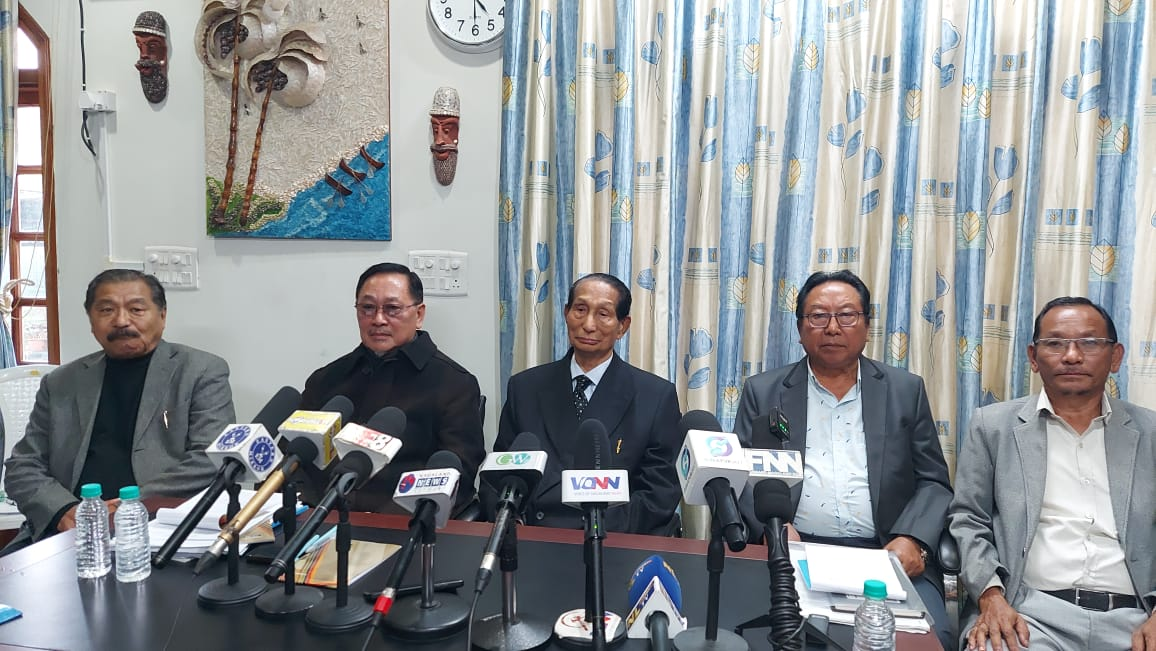
Former Nagaland Chief Minister and Governor of Goa, Maharasthra, Gujarat & Odisha, Dr S C Jamir on Thursday said that the continued delay in implementing the Framework Agreement and the Agreed Position has left Nagaland in a state of deep suffering, stressing that the Naga people are yearning for peace, stability and normalcy in their own land.
Addressing media persons after an informal consultative meeting of “Like-minded leaders of Nagaland”, Jamir said Nagaland today resembles “fatally wounded person groaning in pain” without anyone to care for them.
He said the meeting was convened by concerned citizens who are not attached to any organization or political interest, to deliberate on various issues as to why Nagas should suffer in this land.
Jamir said that among the many issues discussed, the most pressing problem affecting peace in Nagaland remains the unresolved Naga political issue. He pointed out that negotiations have been ongoing for more than two to three decades, during which all major political subjects such as sovereignty, constitution, flag and integration were discussed in detail.
Agreements already signed, foundation already laid
He recalled that after years of deliberation and study, two political agreements were finally signed: the Framework Agreement on August 3, 2015, by the NSCN-IM, and the Agreed Position on November 17, 2017, by the Naga National Political Groups (NNPGs). According to Jamir, these two agreements now form the legitimate political foundation upon which the peace of Nagaland must be built.
Jamir said that when the agreements were signed, the leaders of both groups were fully aware of the contents and implications of what they had agreed to. “And while signing these, I think they had full knowledge of the contents of their own agreements—both groups—and they were fully alive to the kind of subjects they had already included,” he said.
He recalled that the signing took place in the presence of the Prime Minister, the Home Minister and the National Security Advisor. “I think they shook hands, laughed, and on that day, not a single dissenting voice was raised. All of them were jubilant,” he said. He added that the Prime Minister had publicly stated that for the first time underground leaders had agreed to join the mainstream of Indian nationalism.
Stating that the political conclusion reached at that time in the presence of the Prime Minister and Home Minister, Jamir said a similar agreement was made between the NNPGs as well as the Government of India, called “Agreed Position”.
“So now, a legitimate political framework is there,” he stressed.
Questioning the delay in implementing these agreements, Jamir said, “Since after so long a negotiation they have already arrived at it, the sooner they implement it, the better, because Naga people want to live in peace and harmony and want to carry on their normal vocations without any disturbances whatsoever from any quarter.” This, he said, can only happen when the political roadblocks are removed.
‘Why keep it in cold storage?’
Highlighting the urgency of the matter, Jamir said senior citizens felt compelled to speak out as the issue cannot be kept in cold storage any longer while people continue to suffer.
“We have only deliberated on the pros and cons on how best and how soon can we ask the Government of India and the concerned authorities to implement these agreements,” he said adding, “Because you cannot keep it in cold storage, as people are really suffering because of the non-implementation of this issue. He lamented that there are always “black sheep” in a society.
He noted that although underground groups had entered into political agreements with the Government of India, there are still elements who benefit from the “status quo” and do not want peace in the land. These groups, he said, are creating obstacles to a logical conclusion of the peace process.
Jamir stressed that as senior citizens, concerned citizens, they have to speak out loudly, honestly and tell the people that “we have to live in peace and it depends upon the Naga people, we have to raise our voice.”
Stating that the issue cannot be solved by outsiders, Jamir said, “It is our own problem and therefore, it has to be solved by our own effort and from our own angle.”
No sovereignty, no integration
Responding to a question on the nature of the final solution, whether it would be Nagaland-centric or pan-Naga solution, Jamir said the Framework Agreement and Agreed Position clearly state that there will be no integration and no sovereignty. He clarified that Nagas of Manipur will remain in Manipur, Nagas of Arunachal Pradesh in Arunachal, and Nagas of Nagaland in Nagaland, adding that there is no ambiguity on this matter.
Download Nagaland Tribune app on Google Play

On the discussion surrounding a “Common Draft,” Jamir said that when Government of India has already signed Framework Agreement as well as the Agreed Position, it is not necessary for all clauses to be incorporated into the Constitution of India through the Indian Parliament. He explained that only relevant portions are incorporated through Parliament, citing Article 371A as an example from the 16-Point Memorandum, where only Article 371 (A) was constitutionally included.
‘NSCN (IM) responsible for delay’
When asked who is responsible for the delay in arriving at a final solution, Jamir said that, according to his understanding, there is no problem from the Government of India or the NNPGs, but that the delay is being caused by the NSCN-IM. “To be frank, it is the IM who is delaying,” he said.
Responding to a question on the recent initiatives by the Forum for Naga Reconciliation (FNR) and other organisations over the claims that deliberations had reached a position “beyond the Framework Agreement and the Agreed Position”, Jamir said that only the signatories to the political agreements have the authority to decide the course of the Naga peace process.
“What I can tell you, very frankly, is that whether it is the FNR or any other group, they are not party to the agreement. The parties to the agreement are the NSCN(IM) and the WC-NNPGs [Working Committee of Naga National Political Groups],” he clarified.
“Whether a solution is ‘beyond’ or ‘below’ those agreements is none of the business of the FNR,” he said and asserted that it is for the Government of India and the signatories alone to decide since they have already signed.
“I don’t think there is any scope for anything ‘beyond’ what has already been signed. I don’t know from where they will get this ‘beyond.’ Not ‘beyond,’ but ‘within’,” he asserted