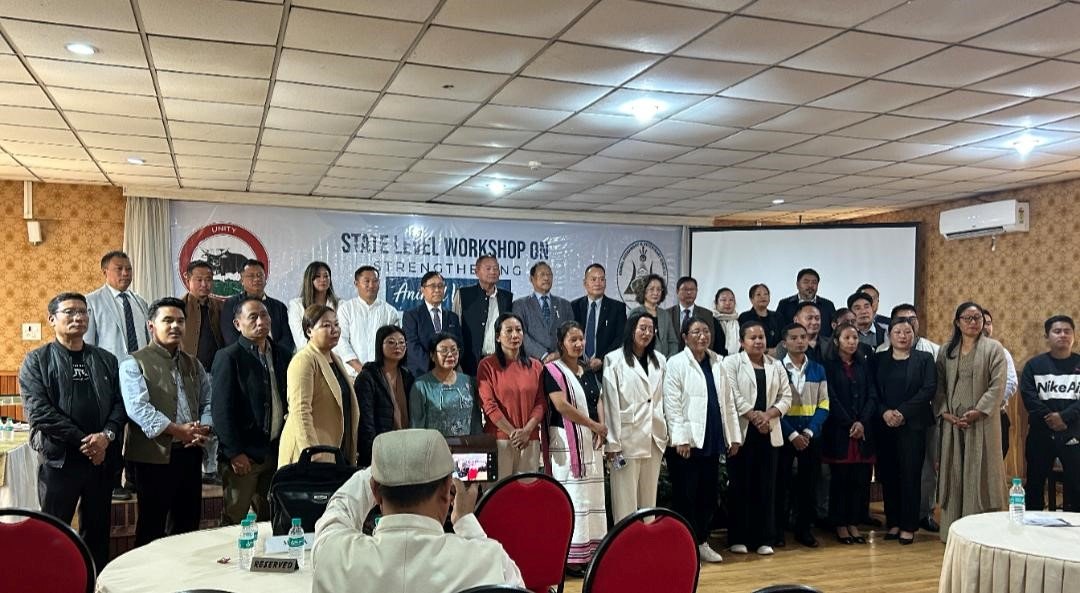
A state-level workshop on Strengthening Animal Welfare was held at the Conference Hall of de Oriental Grand, Kohima on March 19. The three-day workshop was organized by the Department of Animal Husbandry and Veterinary Services.
Addressing the workshop, Zhaleo Rio, IAS (Retd.), Advisor for Urban Development & Municipal Affairs, congratulated the department for organizing what he described as a “very important and timely workshop”. Rio lauded the initiative for bringing together various sister departments, Urban Local Bodies (ULBs), civil society organizations, SPCA representatives, legal experts, and professionals from environmental, health, and livestock sectors.
“When we talk about animal welfare, it is not only about animals but also about human welfare,” Zhaleo stated. He highlighted that issues such as environmental health, hygiene, livestock economy, and public health are deeply connected to how animals are treated and managed.
The Advisor expressed satisfaction that representatives from ULBs across districts and sub-divisions are participating in the workshop. He noted that while his department has conducted several workshops on urban administration, governance, and the provision of civic amenities, serious discussions on animal welfare with municipal and town councils had been limited.
Rio urged ULB representatives to take the learnings from the workshop back to their respective towns and implement practical measures. “In addition to your regular responsibilities, you must also regulate the slaughtering of animals and the sale of meat in an organized and identified manner,” he said.
He stressed the need for designated slaughterhouses in all ULBs, pointing out that open slaughtering and unhygienic practices must be addressed. “Nobody seems to be bothered about hygiene. We must start selling dressed meat clean and hygienic even if it costs slightly more,” he remarked.
Referring to urban sanitation and organized markets, Rio said that while some municipalities such as Mokokchung and Dimapur Municipal Council are performing well in maintaining organized shopping areas, services, and revenue generation, one or two good performers among the 39 ULBs in the state are not enough.
“We have to think seriously about urban sanitation and quality meat production,” he added, calling for better coordination between ULBs and the Veterinary Department.
Rio also touched upon the humane treatment of animals, noting that Nagas traditionally rear and love animals, though recent incidents such as dog thefts in Kohima and Dimapur are concerning. “We have moved far beyond the head-hunting period. We must inculcate the habit of loving and caring for animals. Animals are good companions and deserve proper treatment,” he said.
He further emphasized the need for ULBs to work closely with veterinary departments and other stakeholders at the district level to ensure the welfare of both animals and citizens. He also encouraged the formation of strong district-level coordination committees and assured that more such programmes would be organized in the future.
Advising participants to make full use of the three-day training, Rio urged them to return to their respective districts equipped with knowledge and a clear plan of action. He called upon ULB members and councillors to study the Nagaland Municipal Act thoroughly, set priorities, and work collectively to improve civic services.
On public health, Rio suggested that Nagas should consider reducing excessive meat consumption and adopt a more balanced diet for better health outcomes.
He concluded by reiterating that all stakeholders must work together to provide the best services to citizens, ensure hygienic meat production, improve urban sanitation, and promote humane treatment of animals across the state.
Download Nagaland Tribune app on Google Play

Kazheto Kinimi , Advisor of A.H & Veterinary Services and Chairman SAWAB-N also in his speech said that animals play a vital role in our society—not only as companions but also as a source of livelihood and food security for many families across the state.
Kinimo highlighted that In Nagaland, livestock farming and animal husbandry have long been an integral part of our culture and economy. He emphasized that many rural households depend on livestock such as pigs, poultry, cattle, and goats for income, nutrition, and employment. Therefore, ensuring proper care and welfare of animals is not only a moral responsibility but also an economic necessity for the development of our state , he noted .
Highlighting on the Government of Nagaland’s initiatives to strengthen veterinary and animal welfare services , Kinimi said that one of the key priorities is improving veterinary infrastructure across the state.
“New veterinary hospitals and offices are being constructed in different districts to provide better medical care for livestock and pets. These facilities will help farmers receive timely treatment, vaccination, and health services for their animals” , he cited .
Another important initiative of strengthening Animal Welfare, Kinimi said, is through the introduction of Mobile Veterinary Units, which bring veterinary services directly to farmers in remote and rural areas.
These units, he said, are equipped to provide diagnosis, treatment, vaccination, minor surgeries, and artificial insemination services at the doorstep of livestock owners. Kinimi expressed that this initiative ensures that even animals in the farthest villages receive proper healthcare.
Kinimi also added that the department is focusing on strengthening of animal welfare through the State Animal Welfare Advisory Board, Nagaland (SAWAB-N) which is a statutory body of the Government of India established as per the direction of the Supreme Court of India that it is mandatory for all the States to constitute State Animal Welfare Advisory Board and the District Societies for Prevention of Cruelty to Animals (SPCA). Accordingly, he said that the Government of Nagaland had constituted the SAWAB-N which is under the Animal Welfare Board of India (AWBI) for promoting animal welfare and for the protection of animal rights from being subjected to unnecessary pain and suffering. These institutions promote humane treatment of animals and encourage citizens to build a compassionate society where humans and animals coexist peacefully.
Kinimi also encouraged farmers and youth to participate in livestock and dairy farming. With improved veterinary care, better breeding programmes, and modern technology, livestock farming can provide sustainable employment and boost the production of meat, milk, and eggs in Nagaland.
“However, the success of these initiatives depends not only on the government but also on the cooperation of the people. Every citizen must understand that animal welfare is a shared responsibility,” Kinimi noted.
He further stated that proper feeding, shelter, vaccination, and humane treatment of animals must become a part of our daily practice.
Lanuakum, Deputy Chairperson of Mokokchung Municipal Council also spoke on the responsibilities of ULBs in promoting animal welfare. He said that animal welfare is not only a legal obligation but a reflection of a humane and progressive society.
“The way we treat animals is closely linked to public health, environmental sustainability, and the overall quality of life in our towns and cities. The Urban Local Bodies must act with clear purpose and direction while stating that the role encompasses the promotion of public health, sanitation, and safety, while also ensuring responsible animal ownership and humane care,” he said.
Sharing the experience of Mokokchung Municipal Council, the Deputy Chairperson mentioned that In 2017, the Council enacted the MMC Dog Registration and Proper Control of Dogs Rules and Regulations, formulated in close coordination with local ward authorities and the Department of Animal Husbandry & Veterinary Services, and approved by the Deputy Commissioner in 2017. He maintained that one of the key factors behind the success has been strong coordination between the Municipal Council, local ward authorities, veterinary department and the community.
Earlier during the event, Dr. Imomanen Tuzdir, Director of the Department of AH&VS, Nagaland, delivered his welcome address. An introductory remark was given by Dr. ILang where he highlighted the objectives of the three-day programme. He stated that the workshop aims to build awareness on legal provisions, address challenges in implementation, and foster better coordination among stakeholders involved in animal welfare and urban governance.
The formal session concluded with a vote of thanks proposed by Dr. Kuokehebi Gwirie, Additional Director, Directorate of AH&VS.
The first technical session featured a presentation on The Prevention of Cruelty to Animals Act, 1960by Advocate Sapu Jamir.
The second session focused on the roles and challenges in promoting animal welfare in Nagaland. The session was moderated by Dr. I. Pihoto Khala, Retired Director of AH&VS, Nagaland.
Panelists included Dr. C. Ithika Swu, Senior Consultant at Wagging Tales, Dimapur; Eunice Lotha, member of the Society for Prevention of Cruelty to Animals (SPCA), Dimapur; and Imleesen representing Noah’s Ark.