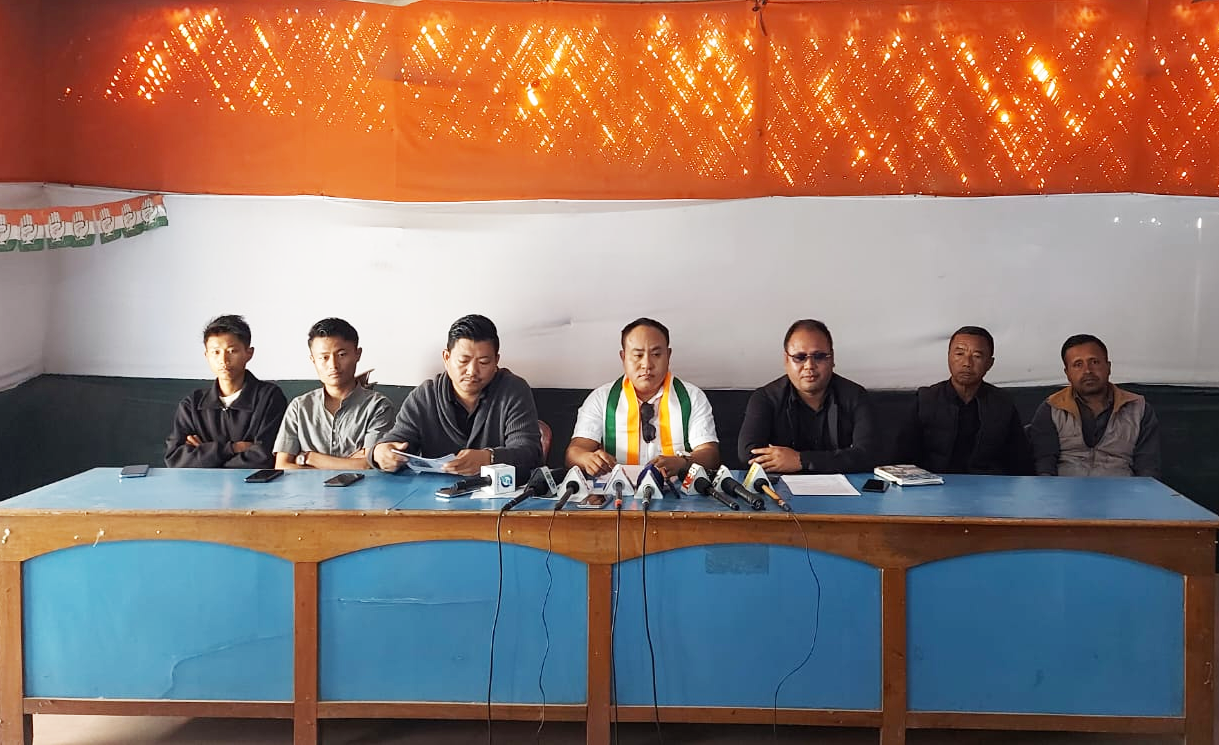
The Dimapur District Congress Committee (DDCC) on Saturday formally launched its “MGNREGA Bachao Sangram” campaign, raising serious concerns over the proposed VB-GRAM-G Bill, which it said threatens to dilute the core guarantees of the Mahatma Gandhi National Rural Employment Guarantee Act (MGNREGA).
Addressing a press conference, DDCC President, Kutoho Chishi described MGNREGA as a lifeline for millions of rural households across India, including Nagaland. He said the Act, which guarantees 100 days of wage employment to rural households willing to undertake unskilled manual work, has played a transformative role in reducing poverty, empowering rural workers, and strengthening rural infrastructure.
Chishi cautioned that the newly proposed VB-GRAM-G Bill could dismantle the foundational principles of MGNREGA by potentially restricting job guarantees, reducing funding, and altering implementation mechanisms in ways that may exclude the most vulnerable sections of society. Such changes, he warned, would severely endanger rural livelihoods and undermine income security at a time when employment uncertainty remains high.
He said the MGNREGA Bachao Sangram campaign aims to expose the adverse impact of the VB-GRAM-G Bill on rural employment, socio-economic stability, and income security in Dimapur, across Nagaland, and in other parts of the country. The campaign also seeks to mobilize public opinion and sensitize the media on the importance of preserving MGNREGA in its original form, which he described as a constitutional expression of the Right to Work.
Calling for the withdrawal of the VB-GRAM-G Bill, Chishi stressed the need to restore MGNREGA’s original provisions to ensure uninterrupted employment opportunities for rural workers. He reiterated that the Congress party remains committed to peaceful, non-violent, and constitutional forms of protest to demand accountability from policymakers.
Appealing to the Central government, Chishi urged it to reconsider the implications of the proposed bill and engage in meaningful dialogue with all stakeholders to safeguard the interests of rural workers. He also called upon the people of Dimapur, civil society organizations, and concerned citizens to actively participate in the upcoming phase of the movement.
As part of the campaign, the Congress plans to conduct panchayat-level outreach programmes, ward-level sit-ins on Martyrs’ Day, and district-level dharnas from January 31 to February 6, aimed at building collective resistance against any dilution of MGNREGA.
“Our commitment is to ensure that no rural worker loses the fundamental right to employment and livelihood security guaranteed under MGNREGA,” Chishi asserted, adding that a strong and intact MGNREGA is essential for inclusive growth, poverty alleviation, and sustainable rural development in Dimapur and across the nation.
He called to unite in the struggle to “Bachao MGNREGA—Save MGNREGA,” and amplify the voices of rural workers whose livelihoods depend on the scheme.
General Secretary of the Dimapur District Congress Committee (DDCC), Kumjimong criticized the proposed VB-GRAM-G Bill, alleging that it undermines the very spirit of the Mahatma Gandhi National Rural Employment Guarantee Act (MGNREGA) and reflects what he described as the BJP’s “deep hostility” towards the legacy of Mahatma Gandhi.
Download Nagaland Tribune app on Google Play

Kumjimong expressed shock over the removal of Mahatma Gandhi’s name from the proposed legislation. “They have even removed the name of Mahatma Gandhi, the Father of the Nation, from the bill itself. I wonder why the BJP hates Mahatma Gandhi ji so much,” he said, questioning the intent behind renaming through the acronym VB-GRAM-G.
While acknowledging that the bill may appear attractive on paper, Kumjimong warned that it contains serious loopholes with far-reaching consequences for rural workers. He asserted that the most dangerous aspect of the new bill is its attempt to weaken the legal Right to Work, which MGNREGA had guaranteed for the socio-economic upliftment of the rural poor and weaker sections.
Kumjimong further alleged that the bill marks a complete departure from decentralised governance, stating that earlier planning and implementation were driven by village councils and local institutions. Under the new system, he said, decision-making would be centralised, with the Central government determining what works are to be executed and where, thereby sidelining village councils and grassroots participation.
Raising serious concerns over the financial burden on states, Kumjimong pointed out that under the existing MGNREGA, wages for 100 days of work were fully borne by the Central government. However, the VB-GRAM-G Bill introduces a 90:10 funding pattern, placing an additional burden on states like Nagaland, which are already struggling financially.
“In Nagaland, many villages do not even receive 100 days of work. In some places, people don’t get even 10 days. Now the state is expected to contribute 10 percent of wages. How will our state government manage this?” he questioned, recalling past failures of similar funding models in various centrally sponsored schemes implemented in the state.
He also raised concerns over the impact on women workers, stating that the new bill prioritizes asset creation over employment generation. According to him, the focus has shifted from providing work to vulnerable sections, including women, to creating assets in selected locations decided by the Centre.
“The focus is no longer on providing employment to the poorest of the poor. It is about building assets in targeted areas as decided by the Central government,” he said, warning that such an approach would marginalise rural workers and defeat the original purpose of MGNREGA.
Kumjimong reiterated the Congress party’s opposition to the VB-GRAM-G Bill and called upon the Central government to withdraw the proposed legislation. He urged the public, civil society organisations, and rural communities to remain vigilant and united in defending MGNREGA as a cornerstone of rural livelihood security.