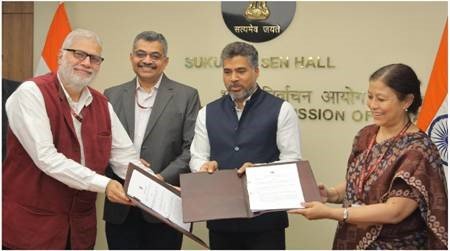
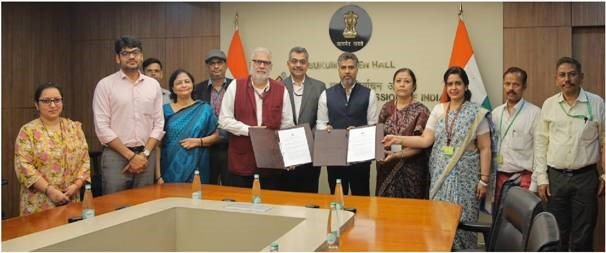
School and College students will soon learn about their future role and duties as voters in the election process, as part of the curricular and extra-curricular interventions in educational institutions. A Memorandum of Understanding (MoU) on electoral literacy was signed on November 2 between the Election Commission of India (ECI) and the Ministry of Education, informed the Press Information Bureau (PIB)
The MoU underscores the development of an institutional framework that seeks to incorporate electoral literacy formally into the school and college education system. This includes structured curricular, co-curricular, and extracurricular activities, all of which will help in preparing future and new voters for greater electoral participation and in effect strengthening democracy.
The salient features of the MoU includes: Systematically integrating voter education and electoral literacy into the curriculum, starting from classes 6 to 12 in all schools. The integration will also extend to the curricular framework for all colleges and universities, tailored to suit different disciplines and credited accordingly. NCERT will introduce and update textbooks to include content on electoral literacy and will advise State Education Boards and other Boards to follow suit. It also emphasises the orientation and training of teachers in effectively imparting electoral literacy in classrooms. The MoU will also foster a sense of responsibility within State Education Departments for establishing Electoral Literacy Clubs (ELCs) in schools and colleges. It will also encourage various activities to promote voter awareness among students, ensuring they are well-versed with the country’s electoral system and encouraging them to register as voters and participate enthusiastically, with a well-informed and ethical approach, in every election.
According to the PIB, the MoU seeks to evolve a robust mechanism to fulfill the aspirational goal of ECI to handover the voter ID card to every student immediately after their attaining the age of 18 years: an institutional framework to be created for online registration of eligible and prospective students who have attained 17+ years of age (after every qualifying date (1st January, 1st April, 1st July and 1st October of every calendar year) and during the annual summary revision of electoral rolls.
This will also include electoral literacy in the curriculum for adult literacy and basic education, creating educational content focused on electoral processes for lifelong learning.
Another important feature is the designation of one of the rooms in every senior secondary school as the ‘Democracy Room’ for the regular display of voter education materials and the conduct of Continuous Electoral and Democracy Education (CEDE) activities throughout the year. A dedicated ‘Democracy Room’ will offer a platform for students to learn, discuss, and participate in various aspects of our democratic processes throughout the year.
The new initiative also hopes to enable critical thinking, communication, and leadership skills amongst university students to actively participate in university-level politics, including engaging in informed debates and discussions.
It will also devise a system of credits for students taking part in CEDE to pursue higher studies; provide standard ramps, accessible toilets, proper lighting and electricity on a permanent basis.
Download Nagaland Tribune app on Google Play

Background
The MoU is aimed at extending the ECI’s flagship Systematic Voters’ Education and Electoral Participation (SVEEP) in schools and colleges. The objective is to encourage universal and enlightened participation of future voters in elections. The MoU also aims to address the issues like apathy among urban and young voters, as a crucial aspect of Continuous Electoral and Democracy Education. This integration seeks to motivate future voters to participate more actively in elections, fostering responsible citizenship, and reinforcing our democratic system with informed and dutiful citizens.
Despite successfully managing and conducting of elections by the Election Commission over the years in a fair and peaceful way along with a high jump in participation of the electors, there is also a concern that there were almost 297 million electors (out of 910 million) who did not cast their votes in General Election to Lok Sabha – 2019. The voting percentage was 67.4%. The Commission has taken this as a challenge to improve upon.
This significant collaboration aims to empower young people by bridging the knowledge gap among the youth and first-time voters. India boasts one of the world’s youngest populations, and the indifference of the youth towards the electoral process could potentially result in a future generation that is hesitant to engage in voting as adults. Such apathy could have substantial consequences for the functionality of a thriving democracy. Therefore, this MoU is signed with the long-term vision of instilling electoral literacy in the young people through the educational institutions. This initiative is expected to help in the Election Commission’s endeavour to address the urban and youth apathy, leading to better electoral participation in next general elections.