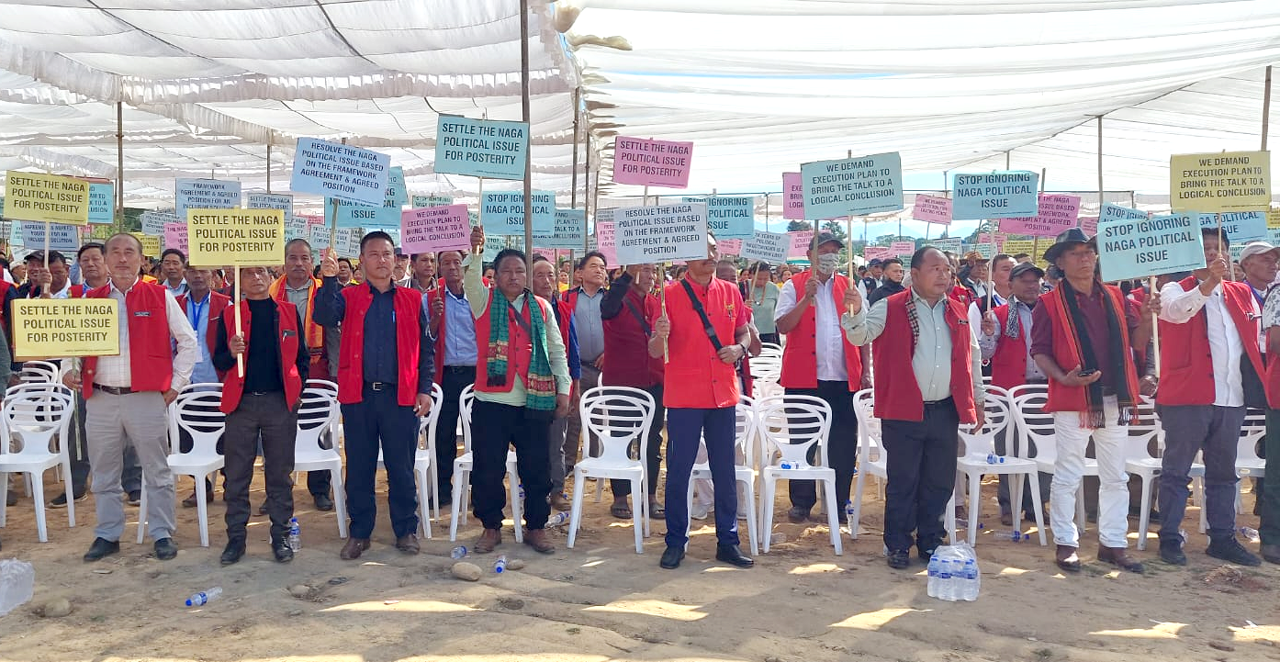
With a unified and resounding voice, thousands of people from across Naga society converged on Tuesday under the platform of the Naga Common Platform (NCP) for Political Solution, delivering an unequivocal message to the Government of India and Naga political negotiators–the time for waiting is over.
The massive gathering unanimously threw its weight behind the long-pending Framework Agreement and Agreed Position, demanding an immediate and permanent solution to a political struggle that has burdened generations.
Organized by the Nagaland GBs Federation Peace Committee in collaboration with Nagaland apex civil society organization, the Naga Common Platform held at Agri Expo, Chumoukedima unanimously resolved to support the landmark agreements signed between the Government of India, NSCN (IM) and the Working Committee of NNPGs.
The NCP unambiguously resolved to urge the Government of India to deliver a political solution based on the Framework Agreement and Agreed Position for the lasting peace in the Naga areas.
Stating that a century of political struggle of 28 years of political negotiation is a huge burden to the peace-loving people, the NCP urged the Naga negotiators and the Government of India to listen to the cry of the stakeholders and collectively bring the talks to their logical conclusion with a comprehensive agreement.
Addressing the stakeholders’ rally, Convenor of the Organizing Committee for the Common Platform for Naga Solution, Shikuto Zalipu, appealed for unity and urgency, declaring that the core question confronting every Naga today is simple yet profound: “Do the Naga people want peace or not? Do we want a solution?”
Zalipu said the demand for peace has echoed “from place to place, big and small,” driven by the collective longing of the people.
He recalled that Naga national freedom fighters had negotiated with the Government of India and reached an agreement a decade ago, yet it remains unimplemented.
“Why has this agreement, made ten years ago, still not been delivered to the Naga people?” he asked, questioning whether the delay stems from the Government of India, from within the Naga national movement, or from the Nagaland government itself. “Whatever the reason, a decade-long agreement should not be kept pending. It must be implemented swiftly.”
Zalipu said the people’s desire for lasting peace, development, and a secure future for their children has brought them together, irrespective of distance or background.
“We are here because we want peace. We are here because we want a solution,” he emphasized.
He acknowledged the Nagaland GB Federation for providing the platform that enabled Naga civil society to bring together people from all walks of life. “Through this platform, we say clearly: yes, we want peace; yes, we want a solution,” he said.

Calling for an end to what he described as “decades of unbearable suffering” for ordinary Nagas, Khekiya K Sema, Spokesperson of the Nagaland Senior Citizens Forum (NSCF), urged both the Government of India and all Naga political groups to bring the long-pending Indo-Naga issue to a logical conclusion without further delay.
Addressing thousands gathered at the rally, Sema said the platform was not formed to challenge any tribal hoho, faction, or government body, but to convey a collective cry for peace and stability. “Whatever happens today, this Indo-Naga political issue cannot be allowed to drag on for years and years,” he said.
Highlighting the daily struggles of ordinary citizens, Sema spoke strongly against the burden of multiple “national taxes” imposed by various factions.
“National tax on this side, national tax on that side—this is completely destroying the lives of our common people,” he said. Even small businesses and youths attempting to support their families, he added, “cannot move forward because every path is blocked by tax collectors.”
He said the rally was born out of desperation caused by the economic and psychological burden on people who have suffered for decades, including today’s youth who “should be able to compete with children from other states.”
Sema directly criticized certain tribal apex bodies for discouraging their members from attending the rally. He said the apex tribal bodies have also said solution should be brought at the earliest, but now they are asking people not to attend the rally.
He saluted the people in the rally for their courage and said, “Let the apex hohos say anything. As far as I am concerned, they have no authority to destroy the voice of the people.”
He alleged that some apex leaders are influenced by political powers: “Some are in the pockets of ministers and advisors… acting on their whims, saying ‘don’t go’ or ‘don’t participate.’ This is the game being played.”
Download Nagaland Tribune app on Google Play

Sema also targeted the State Government, stating that the Chief Minister should have convened all stakeholders to discuss the aspirations of the Naga people. “When he is with the public, he says the solution must come soon, but when the people finally speak in one voice, he controls the apex bodies and stops them from joining,” he charged.
Without naming individuals, Sema denounced the behavior of armed groups who continue collecting taxes from traders, markets, and even daily wage earners.
“How many kinds of sovereignty are they seeking?” he asked. “If they were striving for one sovereignty, that would be one thing. But now 30–40 factions have formed, and each one collects their own taxes.”
He warned that a time will come when the public will question underground leaders on how they amassed wealth, “Some who joined with nothing—not even a torn half-pant—now have palaces and foreign cars. The public will ask where this money came from.”
“Time has come to say—enough is enough,” he said.
Turning to the Framework Agreement, Sema said the demand for a separate Naga flag and constitution has become a major roadblock.
He asserted that while NSCN(IM) claims these are non-negotiable, the Government of India has categorically refused. Sema warned that rebranding Nagaland as “Naga Nation” would also open the door for Nagas from other states to claim a share of Nagaland’s resources: “What is ours is ours. No one can touch it. But they say those from outside can come and share our portion too. Do you agree with that?”
The crowd responded loudly: “No!”
He also criticized NSCN(IM) for not being transparent about the details of the Framework Agreement.
“This is not IM’s personal matter. This is our future, our children’s future. Why are they deciding everything without telling the stakeholders?” he asked.
Sema emphasized that Nagas have suffered for too long—from multiple taxation, factional splits, fear of violence, and economic stagnation. He said the Gaonburas (village elders), who historically supported the movement and suffered the consequences, understand the issue better than anyone.
He urged the Government of India to finalize the Naga solution quickly, and called on all factions and leaders to be honest with the people.
“NSCN (IM) must speak the truth to the Naga people. They cannot secretly decide our future.”
The crowd repeatedly responded with resounding chants of “Yes! Yes!” as Sema declared that the people’s voice must now be heard clearly and without fear.
He said that the NSCN (IM) also know that the Government of India has already refused the demand for sovereignty. “Flag and constitution is the right of a sovereign country, but here we are asking,” he commented.
Sema further said that both Framework Agreement and Agreed Position should be made into one to bring out a final solution. “This is what we want. We want a solution. We want our voice to be heard by Government of India,” he stressed.
In his closing remarks, member of the NGBF Peace Committee, Z Lohe delivered a stark diagnosis of the ailments plaguing Naga society, attributing them to the prolonged and indefinite nature of the Naga political negotiations.
He asserted that the only “medicine” to cure these societal “diseases” is a swift and final solution to the long-standing issue.
Commending the significant turnout of the Nagas from various walks of life, Lohe said they came of their own volition and expense, signifying their deep-seated desire for peace and a resolution. He also commended the people for their sacrifice, highlighting that their presence was not for “cheap popularity” but a genuine expression of their concerns.

Lohe metaphorically described the Naga people as being afflicted by numerous “diseases,” including disunity, disrespect, mutual blame, and extortion, which he termed the “disease of taxation.” He also pointed to the fragmentation of Naga political groups, which he said are now heading towards 30 factions, as a major ailment.
However, Lohe identified the “biggest disease of all” as the indefinite political negotiations under a ceasefire. “Political negotiation without a solution, not looking for answers but just continuing to ask questions—that disease has taken hold,” he declared.
The former Speaker of Nagaland Legislative Assembly was unequivocal in prescribing the “medicine” for these societal ills. “The medicine that is needed for this is the Solution,” he said and argued that true peace has remained elusive despite the cessation of fighting, and will only be realized once a political settlement is reached.
“Real peace will only come after the solution. Otherwise, there will be no peace. It will just continue like this,” he stressed.
Lohe also took a critical aim at those who, he suggested, benefit from the status quo. “Some people don’t want a solution to come,” he stated, implying that a resolution would cut off illicit financial gains and power enjoyed by some in the name of the Naga cause.
Expressing the collective impatience of the Naga people, Lohe emphasized that the time for a solution is “overdue,” noting that years have passed since the signing of the Framework Agreement in 2015 and the Agreed Position in 2017.
He drew a parallel with the Indian government’s approach to the Naxalite movement, the Maoist, the communist movement, and said the Indian Government’s target is to finish them by March. He suggested that after March 2026, New Delhi’s focus might shift, potentially altering its stance on the Naga issue.
“The Government of India has recognized our national movement. From that came the ceasefire. From that, the Agreed Position and the Framework were created. But if the Naga people, at this time, at the right time, do not demand that a solution be delivered quickly, then after March, the Government of India might change its mind. It’s not a dream, we are not visionaries, we don’t know. No one has told us anything,” he cautioned.
Others who spoke on the occasion include Vikuto Zhimomi, Advisor, NGBF; C John, vice president, Ex-Parliamentarian Association of Nagaland; Y Konyak, former vice president, ENPO; Chuba Konyak, president, ENPO GB Federation; Sulanthung Lotha, president, Naga Hoho; Chuba Jamir, social activist; and T Solo.