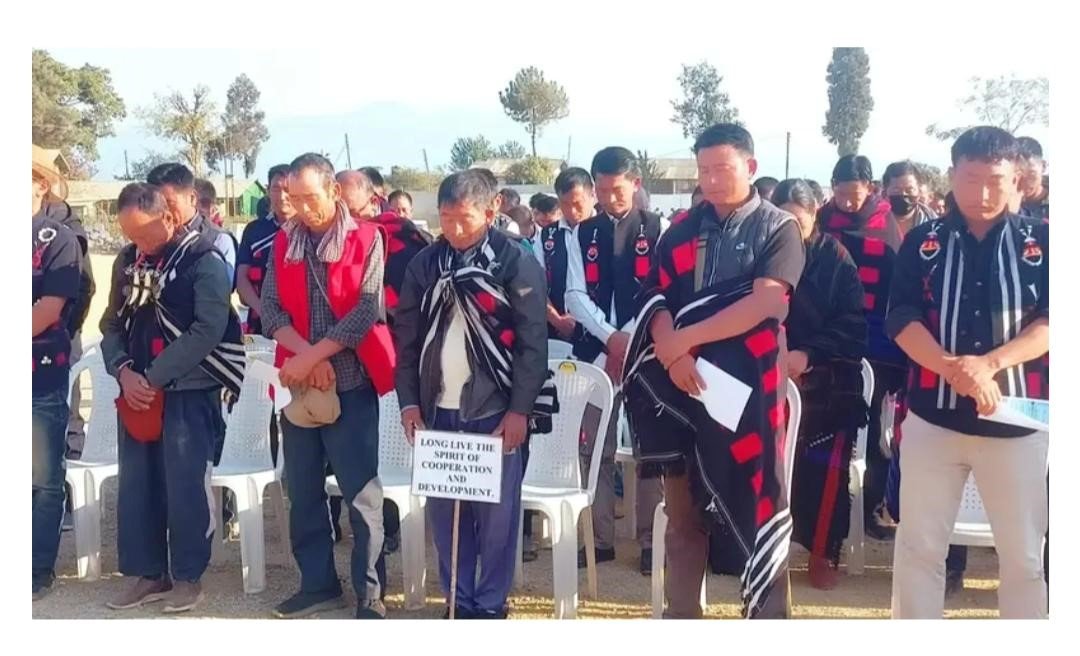
At a moment when Eastern Nagaland stands on the threshold of a new administrative arrangement, a seemingly technical decision has assumed wider significance. The introduction of an age criterion for membership in the Frontier Nagaland Territorial Authority’s Interim Council raises an immediate question: on what basis should participation in such a formative institution be determined, and by whom?
The authority itself emerges from a tripartite agreement signed on Feb. 5, 2026, between the Government of India, the Government of Nagaland and the Eastern Nagaland Peoples’ Organisation, or ENPO. The agreement envisions a governance structure for six eastern districts, with powers to be exercised across multiple sectors. The framework, however, continues to operate in an evolving space, with enabling legislation yet to be enacted and the Interim Council functioning as a transitional mechanism. In such a setting, what ensures legitimacy if not transparency, consistency and shared confidence among stakeholders?
ENPO occupies a central position within this arrangement. For years, it has served as a principal platform representing the eastern Naga tribes and has played a significant role in articulating regional aspirations. Its involvement in the FNTA process reflects that history. At the same time, its role within the present framework is consultative in nature, with the constitution of the Interim Council forming part of a broader institutional process involving the State and other stakeholders. Can a consultative body assume the power to impose binding conditions of exclusion without a clearly identifiable legal foundation?
It is against this backdrop that the age criterion becomes difficult to sustain. There is absolutely no public clarity on how the criterion was formulated, what inspired ENPO to formulate this weird critaria, whether it was uniformly communicated, or on what statutory authority it rests. Its application at the stage of disqualification, without prior notice or opportunity for clarification, raises further questions. Can a condition that is neither clearly articulated nor consistently applied form a fair basis for exclusion?
The issue extends beyond individual candidates. The Interim Council is intended to reflect the voices of diverse communities across Eastern Nagaland, many of whom have long sought greater representation in governance structures. Nominations forwarded by recognised tribal bodies carry an element of community endorsement. When such nominations are set aside on the basis of unclear criteria, what signal does that send to the communities whose participation the process seeks to ensure?
There is also an institutional dimension that warrants attention. ENPO is not a statutory authority created by law; it is a representative body whose influence rests on its ability to bring together different tribal groups (from Eastern Nagaland) and articulate their shared concerns. That influence derives its strength from consensus and trust. Decisions that appear exclusionary, particularly in the absence of clear agreement or transparent standards, raise an important concern: can trust be sustained where the basis of exclusion remains uncertain?
The question of authority becomes even clearer when viewed in the broader constitutional framework. Article 371(A) of the Indian Constitution protects Naga customary practices and local governance within defined spheres. The FNTA, however, operates as a governance-linked institutional mechanism dealing with administrative and developmental functions across multiple sectors. In India, eligibility for public office is governed by clearly defined constitutional and statutory provisions, which prescribe minimum age thresholds but do not impose upper age limits or discretionary age-based exclusions once those thresholds are met.
We learn in high school that, a person may contest elections to the Lok Sabha or a State Legislative Assembly upon attaining the age of twenty-five, while higher offices such as the President require a minimum age of thirty-five. Does the authority to prescribe additional disqualifying criteria in such a setting arise automatically, or must it rest on a clearly identifiable legal basis?
Download Nagaland Tribune app on Google Play

In this constitutional and institutional context, the continued application of the age criterion carries consequences that extend beyond administrative discretion. In the absence of a clearly identifiable legal basis, a decision that results in exclusion from a governance-linked institutional process becomes open to challenge on grounds of arbitrariness, lack of authority and procedural unfairness. If such a challenge arises, would it remain confined to individual cases, or could it call into question the integrity of the entire selection process?
The implications extend beyond the immediate controversy. The Interim Council represents the first visible layer of what is expected to evolve into a more structured governance arrangement. The practices established at this stage will shape institutional norms and public expectations. At such a juncture, can the process afford uncertainty where clarity is required?
A course correction at this stage would serve the process well. Withdrawing the age criterion, at least in its present form, would restore clarity, reinforce confidence and align the selection process with the participatory intent of the FNTA framework. Would such a step not strengthen both the process and the institution it seeks to build?
Ultimately, the success of Eastern Nagaland’s governance experiment will depend not only on the structures that are created but on the fairness and credibility of the processes that shape them. Ensuring that those processes remain transparent, consistent and inclusive is essential to securing the legitimacy upon which the entire initiative rests. In the end, the question is straightforward: can an institution built on participation and trust afford to proceed without ensuring that its foundations are beyond doubt?
- Litsala Anar, Student, B.A. Political Science, Dimapur
- Joseph Chang, Student, M.A., Political Science, Hyderabad,
- Limitsung Sangtam, PhD Scholar, New Delhi