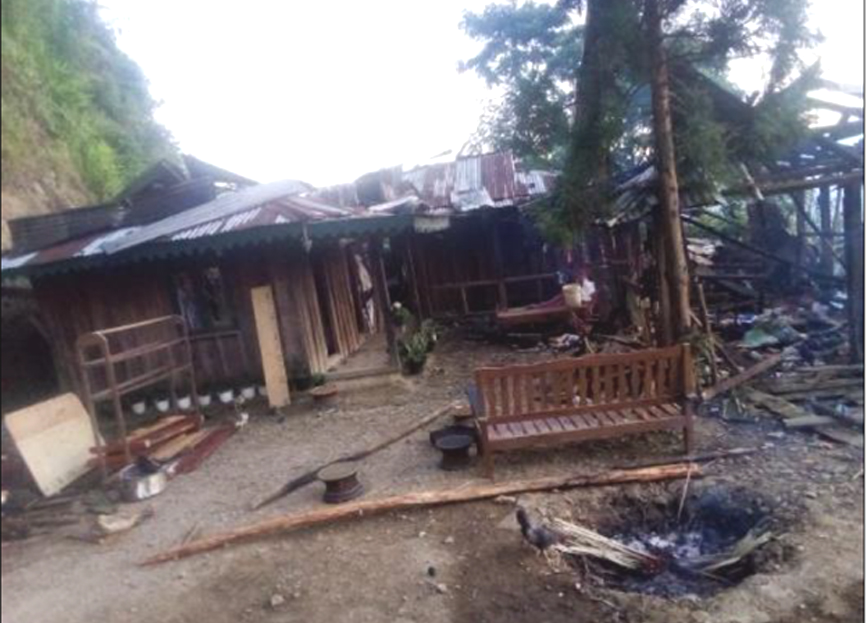
The Global Naga Forum (GNF) has submitted an independent fact-finding report to three United Nations Special Rapporteurs concerning an alleged drone strike on civilians in Khammoi village under the Naga Self-Administered Zone (NSAZ) in Myanmar on October 20, 2025.
The communication has been addressed to Morris Tidball-Binz, Special Rapporteur on Extrajudicial, Summary or Arbitrary Executions; Albert Kwokwo Barume, Special Rapporteur on the Rights of Indigenous Peoples; and Thomas H. Andrews, Special Rapporteur on the situation of human rights in Myanmar.
In its submission, GNF stated that the report was prepared following a fact-finding mission undertaken by a five-member independent team deputed by the Forum. The team visited Mon district in Nagaland to meet survivors and district authorities after the reported drone bombings at Khammoi village, allegedly carried out by the Indian Army.
According to the report, the drone strike took place at around 6:40 p.m. on October 20, 2025 at the residence of Major General Piyong of the NSCN-K while family members had gathered to celebrate a post-harvest festival and commemorate the birthday of his late granddaughter. Eyewitnesses stated that four bombs were dropped by drones, two of which reportedly exploded. One bomb struck the kitchen while others hit the bedroom area of the house.
Two civilians were killed in the incident. Seven-year-old Phiphot Wangsu succumbed to severe injuries while being transported towards Longwa for medical care. Khampei Wangsa, 27, eldest son of General Piyong and Joint Secretary of the Khammoi Village Students’ Union, was reportedly killed on the spot. Three others sustained serious injuries, including General Piyong’s wife, who suffered severe burns; a ten-year-old boy who sustained a leg injury and hearing impairment; and another individual who suffered an eye injury.
The report stated that Khammoi village lies about 10–15 kilometres from Longwa and falls under the traditional Anghship of the Longwa Angh. It is also located approximately 10 kilometres from the Arunachal Pradesh border.
It also stated that it was not clear whether the drones were deployed from the Arunachal Pradesh side or from Nagaland. However, eyewitness accounts confirmed that the drones hovered over the village for several hours even after the strikes.
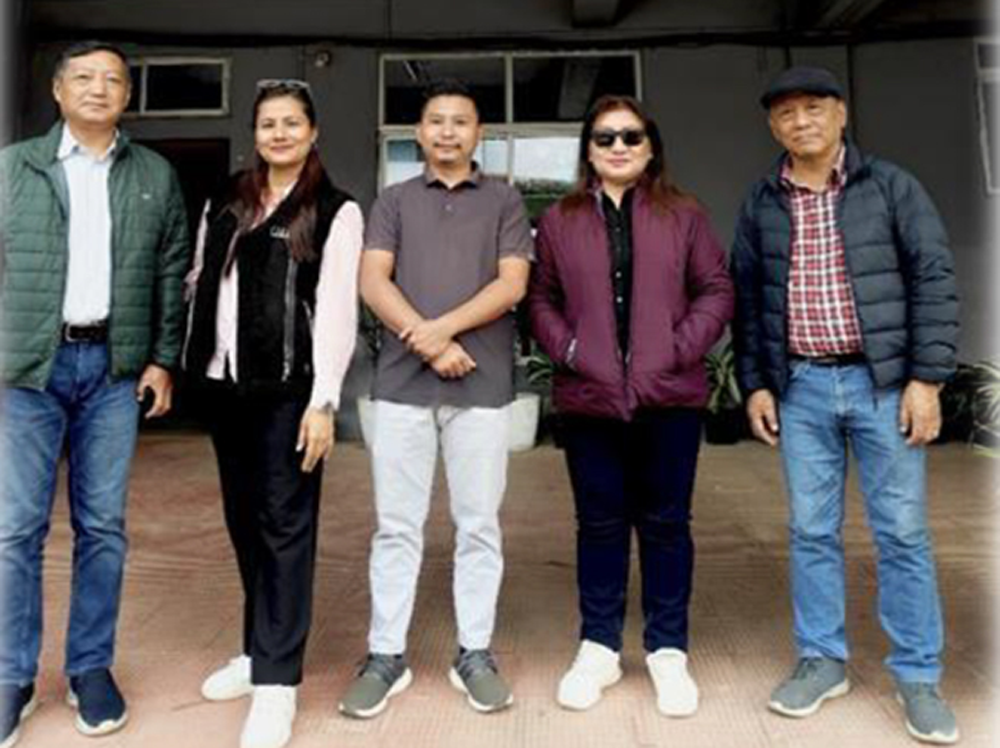
Fact-finding team members
The GNF team first met the Deputy Commissioner of Mon, who informed them that since the incident occurred across the international border in Myanmar, Indian Army personnel stationed at the border did not permit the Chairman of the Mon District Indian Red Cross Society to send emergency medicines or medical assistance to the affected village on the day of the incident. The team reported that the Red Cross was not allowed to cross the Longwa border despite reports of civilian casualties, including children.
The fact-finding team later visited the injured victims at Mon District Hospital and recorded testimonies through an interpreter. It also travelled to Longwa village to meet the Angh, who informed them that Khammoi falls under his traditional jurisdiction and that he attended the funeral rites the following day despite restrictions.
Download Nagaland Tribune app on Google Play

The report further noted that the team was stopped and questioned four times by Indian Army personnel en route to Longwa and observed a heavy security presence near the border gate and the Angh’s residence. Villagers showed the team the long flight of steps leading down to the road connecting to Khammoi. Witnesses testified that injured victims were carried on makeshift bamboo stretchers from Khammoi to Longwa, from where the Mon Red Cross transported them to Mon Hospital.
At the Tamphai checkpoint, soldiers insisted on verifying identities and even attempted to photograph individual team members, the report stated.
Due to restrictions imposed at the Longwa gate, no one was reportedly allowed to cross over to the Myanmar side following the incident.
Upon return to Mon, the GNF team sought an appointment with the Commanding Officer of the Indian Army but was informed that he was out of station.
GNF stated that the report has been prepared with particular care to ensure factual accuracy, internal consistency and neutrality of tone, based on eyewitness testimonies, engagement with district-level authorities and direct field observations.
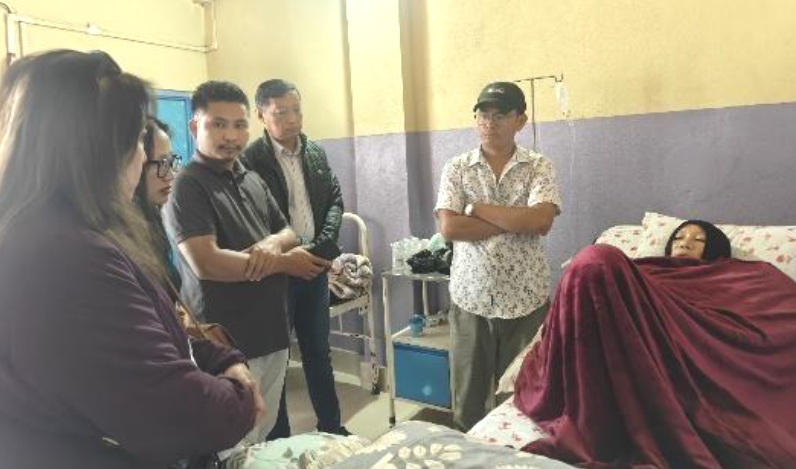
Fact-finding team with the critically injured wife of General Piyong and her son-in-law at Mon District Hospital
The Forum submitted the findings for consideration under applicable international human rights and humanitarian law standards, citing concerns over civilian protection, accountability for use of force, denial of humanitarian access and the rights of Indigenous peoples in border contexts.
Among its key recommendations, GNF has called for a high-level independent judicial inquiry into the Khammoi drone bombing to determine responsibility, command authorization, and the origin of the drone deployment; legal accountability and prosecution of all personnel found responsible for the killing and injury of civilians, in accordance with national and international law; adequate compensation and long-term medical and psychological support to the injured survivors and ex gratia relief to the families of the deceased, including the child victim and the young student; guaranteed humanitarian access protocols during emergencies to allow Red Cross and medical teams to cross the border for life-saving assistance; restoration of the Free Movement Regime (FMR) to ensure access to healthcare, education, relief, and essential services for Nagas living in the Naga Self- Administered Zone; review and reform of operational rules of engagement in border areas to ensure protection of civilian populations and prevent the use of disproportionate force; reconsideration of the Armed Forces Special Powers Act (AFSPA) in Naga areas in light of repeated human rights violations and concerns regarding its draconian provisions; and recognition and involvement of traditional authorities, such as the Angh, in cross-border humanitarian coordination and crisis response.
The five-member GNF Fact-Finding Team was led by Prof. Rosemary Dzuvichu and included Vichutuolie Mere, Kilentula Jamir, Atimiu and Nyamto Konyak.