“If I could, I would return to Nagaland as early as next month,” says a visibly elated
Eleni Michael, drawing a warm Naga shawl around herself as the Kisama evening dipped into a crisp, mountain chill.
“But I don’t think I would want to revisit the Hornbill Festival,” she added, her tone firm despite the smile lingering on her face.
Eleni is a food anthropologist and fermentation educator whose international career spans
hospitality operations, hands-on fermentation practice, and academic instruction. Originally from Cyprus, she is currently engrossed in a study of India’s vast and varied fermentation and preservation traditions — a quest that brought her to Nagaland, the delightful land of rice beer, millet beer, axone, vibrant culture and hospitality. A seasoned traveller who has explored 30 countries, she was also drawn to the state after encountering fellow anthropologist Dolly Kikon’s evocative writings on fermented bamboo.
Download Nagaland Tribune app on Google Play

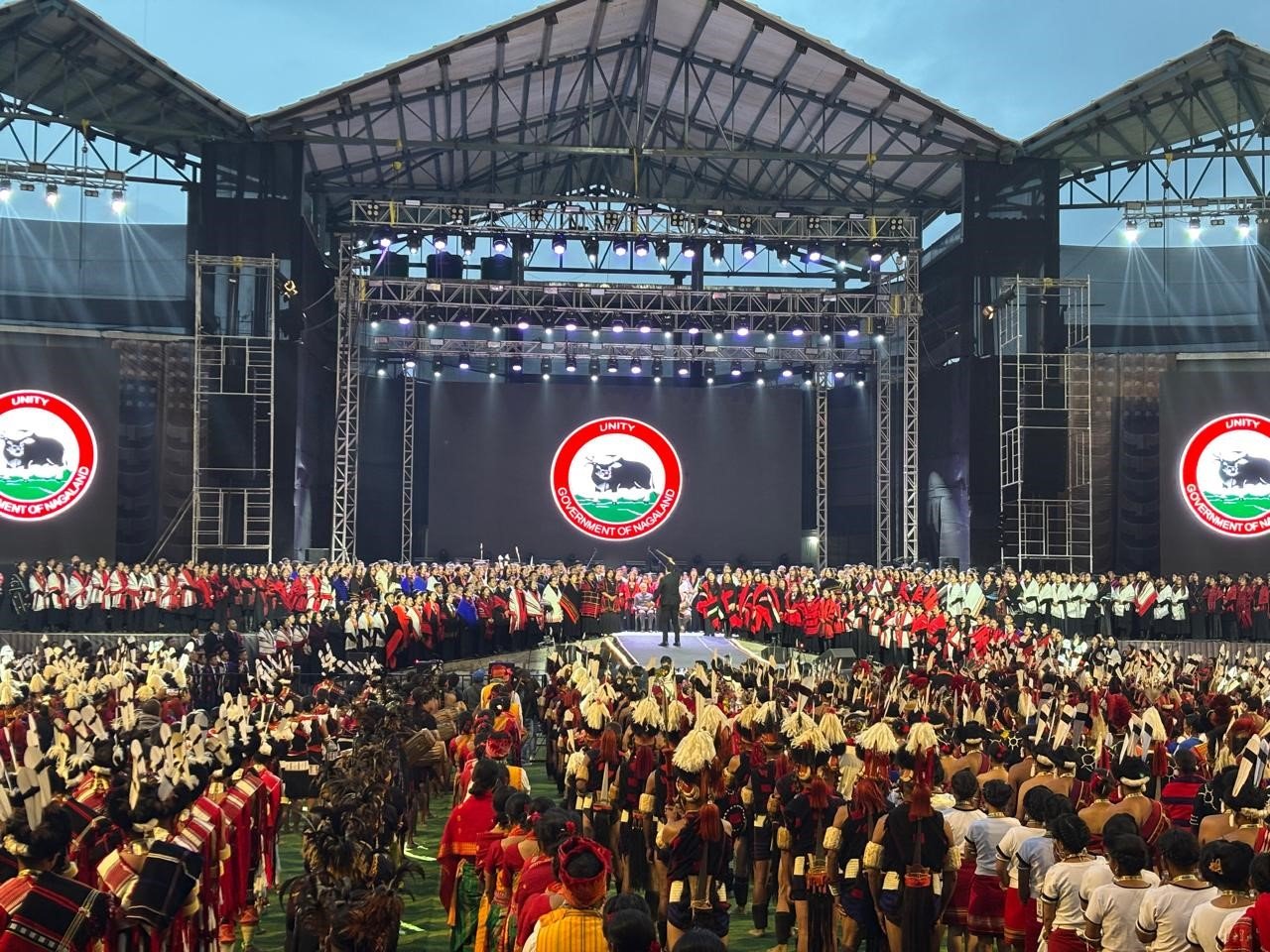
Her encounter with the festival’s opening ceremony was almost transcendent. Enveloped in
Nagaland’s effervescent culture, distinctive cuisine, and the disarming warmth of its people,
Eleni confessed that the traditional performance left her unexpectedly overwhelmed.
“It was so beautiful, so powerful, that it moved me to tears,” she recalled. But the enchantment soon dissipated. “I didn’t come all this way to listen to speeches by Europeans or to church choirs and gospel songs. I wanted to hear more Nagas speak on stage — to hear their voices, their stories, their perspectives.”
She was referring to the speeches delivered by representatives of the Hornbill Festival’s partner countries and the performances by the NBCC choir during the opening ceremony of Nagaland’s famed annual tourism event, held at Kisama, about 12 kilometres from the state capital, Kohima.
Her deepest disappointment, however, surfaced during the evening concerts at the main arena.
“It’s a shame. I don’t think people travel from the West to hear western music in Nagaland,” she said, shaking her head in disbelief. “I expected folk music, or even contemporary interpretations of traditional sounds — not young musicians belting out Coldplay numbers. And instead of church choirs, I had hoped for indigenous choirs, voices rooted in the land itself.”
Eleni was particularly critical of what she described as an incongruous Christian presence at an event meant to showcase indigenous Naga culture and tradition. “I found the Christian element in this festival a little forced. The Biblical quotes outside some morungs and in the coffee shops felt out of place,” she said, adding that she would have preferred to learn about the prayers of Naga ancestors instead of hearing gospel renditions.
“I find it difficult to believe that the grand old Konyak man in the Konyak morung believes in
Jesus; I would rather have known what his forefathers believed in,” she stated emphatically.
She clarified that she holds no bias against any religion — she herself comes from an Orthodox Christian family — but felt that the very essence of the Hornbill Festival was compromised by overt religious elements woven into a celebration intended to honour and preserve ethnic Naga culture. “Religion is personal, and it needn’t be projected so prominently in a cultural showcase,” she added.
Her critique extended to some of the architectural choices at the venue, which she felt did not
reflect the spirit of Naga culture.
“There were many aspects that felt out of place in the Kisama setup,” she says. The one exception, she noted, was the morungs. “Visiting the morungs was a delight — the food delectable, the cultural presentations enchanting. I especially loved the Ao Morung — organized, warm, and wonderfully managed.” She also spoke highly of Nagaland Coffee, praising its flavour and craftsmanship.
Eleni first heard of the Hornbill Festival a decade ago from her husband, Grammy-nominated
music producer and composer Raghav Mehta. Much like her, another foreign visitor, Lavrenty Repin — an artist by profession — also discovered the festival around the same time and finally made his way to Kisama this year.
Accompanied by his mother, Repin said the experience was “better than expected,” praising the “authentic Naga culture it showcases, and the calm and charm of the people.” He expressed delight at being able to the whole of Nagaland in one beautifully set venue.
At the same time, Repin cautioned that external and foreign entities should not be given space to use the festival as a platform for their own agendas. He warned that the event could lose its
essence if multinational sponsors were allowed to dominate a celebration meant to foreground ethnic Naga heritage.
As the clamour of Kisama fade and the festival grounds prepare for another day of spectacle,
voices like Eleni Michael and Lavrenty Repin remind us that the Hornbill Festival’s greatest
strength — and its greatest responsibility — lies in authenticity. The world is already saturated with borrowed sounds, imported agendas, and generic global culture. What visitors to Nagaland come seeking is the heartbeat of a land steeped in ancestral memory, carried in its songs, its oral traditions, its rituals, and its resilient people.
As the Hornbill Festival grows in ambition and scale, its challenge is not merely to entertain but to remain unmistakably, unapologetically Naga. Anything less risks dimming the very flame that draws the world here in the first place.
-Kallol Dey is a senior journalist based in Dimapur. With over two-decades into journalism, he has written for national, regional and local publications. He has widely reported on the Hornbill Festival since its initial years.