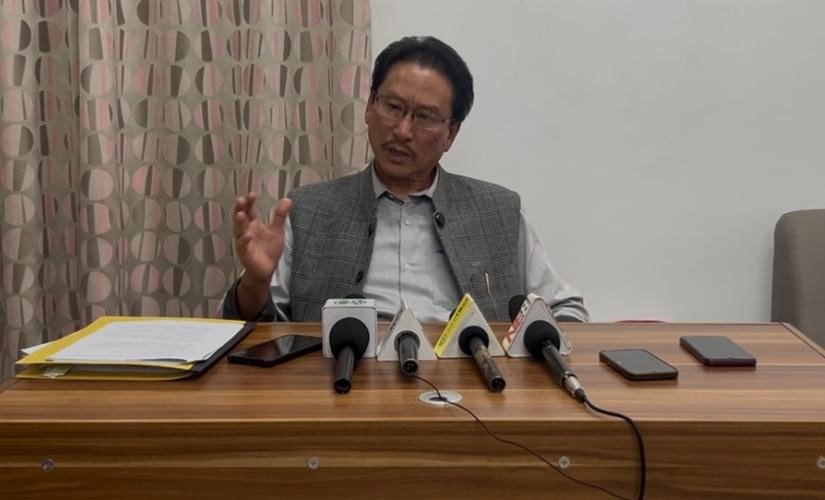
Minister of Power and Parliamentary Affairs, K. G Kenye, on October 16, reiterated the government’s position on indigenous status in Nagaland.
Addressing a press conference at his Thizama residence, Kenye said the issue, though not discussed in the Cabinet this week due to time constraints, has been a continuing concern. He explained that the government has sought to define indigenous status based on historical settlement and natural occupation, rather than merely permanent citizenship.
Highlighting the distinction, Kenye said certain non-Naga communities, including Garos, Kacharis, Mikirs, and Kukis, who settled in Nagaland before December 1, 1963, were granted permanent citizenship, but this does not confer indigenous status. “Granting permanent citizenship does not make a community indigenous. Indigenous status cannot be transferred or awarded—it is rooted in historical settlement and ownership,” he emphasized.
On whether the Nagaland Legislative Assembly can revoke the status already granted, Kenye clarified that the government has the authority to confer or withdraw status under existing administrative rules. He cautioned the communities concerned to cooperate with government directives, noting that policies may evolve to maintain administrative clarity and fairness.
Kenye also addressed the legal status of ongoing proceedings, noting that a court stay currently prevents the government from conducting enumeration of the four tribes. “As long as the stay is in place, we cannot proceed with enumeration or related benefits. This may necessitate reviewing other entitlements linked to their status,” he said.
He provided historical context to counter claims of indigenous status based on ancient kingdoms. Dimapur and surrounding areas, he noted, were once under the Kachari kingdom, followed by Ahom conquest, Burmese occupation, and later British administration. While some descendants may have settled in Nagaland centuries later, historical occupation alone does not determine indigenous status. “Time changes, authority changes, and power shifts. Historical claims cannot be the sole basis for indigenous recognition,” he said.
The Minister underscored the government’s plan to implement a register of indigenous inhabitants to provide clarity on Inner Line Permits, permanent resident certificates, and indigenous certificates. He said some communities have resisted the enumeration despite opportunities provided, leading to inconsistencies in administrative records.
Kenye stressed the importance of consulting customary authorities under Article 371(A) and reaffirmed the government’s commitment to ensuring that policies respect tribal customs. “We are a people’s government, and we value the opinion of our tribal leaders in every decision affecting land, resources, and citizenship,” he said.
He concluded by urging all communities, particularly the four tribes involved in current disputes, to cooperate with government directives, noting that the administration has the authority to confer, review, or revoke status as required. The aim, he said, is not discrimination but administrative clarity, fairness, and long-term governance efficiency.
Download Nagaland Tribune app on Google Play

On Frontier Nagaland Territory Agreement (FNTA)
During the press conference, Kenye briefed on the ongoing discussions over the proposed Frontier Nagaland Territory Agreement (FNTA) which he claimed have witnessed positive movement, with both the Centre and the Eastern Nagaland People’s Organisation (ENPO) continuing dialogue in recent months.
Kenye informed that talks between the Centre and the ENPO were held in August and again in September, with the last meeting likely taking place in Dimapur during the early part of September. He said the State government had already furnished its recommendations to the Centre after being asked to provide its opinion on a number of key points related to the proposed administrative arrangement.
While there was broad agreement on most of the issues raised, Kenye said, a few points required further reconsideration. To address these specific matters in detail, the Department of Personnel and Administrative Reforms (PN&AR) has set up a subcommittee in coordination with ENPO officials. This, he described, was a “new development” that could help unlock the issues that have so far slowed down the process.
While the details of the deliberations are confined to the ENPO and the PN&AR department, Kenye said it appeared that the current focus of discussion concerned the possible dissolution of the FNTA Executive Council.
The minister also indicated that the discussions included issues relating to the funding pattern and the appointment of different cadres within the proposed administrative structure. These, he observed, were “minor issues” that could be ironed out with further deliberation.
Maintaining that the process was progressing steadily, Kenye expressed optimism that the Centre would act with sincerity and move swiftly towards resolving the remaining issues.
Kenye informed that the matter of constitutional provisions under Article 371(A) had been discussed in detail during the recent Cabinet deliberations.
He said members of the state delegation that visited Delhi, led by the Chief Minister and accompanied by the two Deputy Chief Ministers and representatives from the ENPO region, confirmed that the Centre did not intend to amend Article 371(A). Instead, the proposed arrangement would be introduced through a separate chapter—either by way of an ordinance or a state legislation—to deal with matters beyond the scope of the Article.
Kenye clarified that the Centre’s position rules out any parliamentary amendment, as the changes would be effected at the state level through an act of the Nagaland Legislative Assembly.