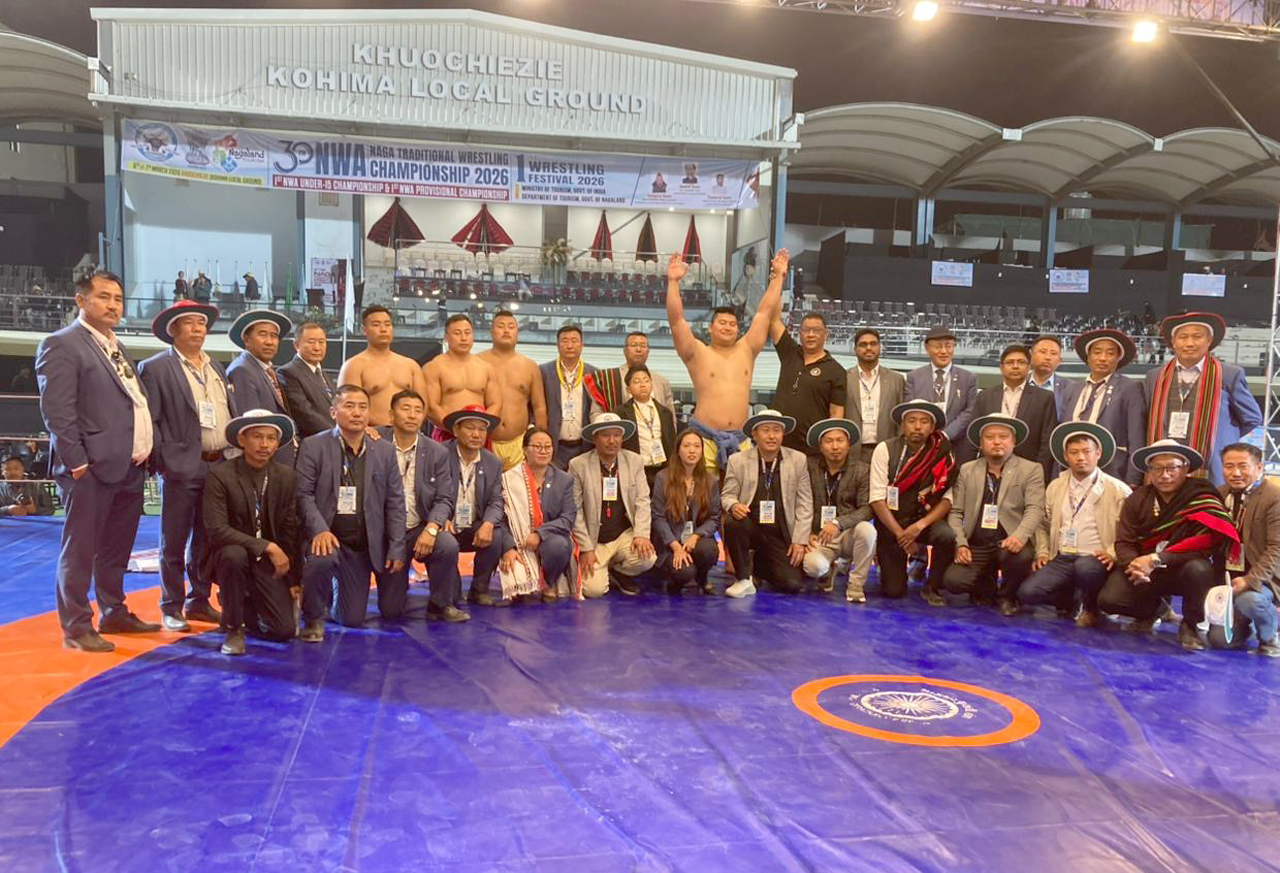
Kezhaseluo-o Pienyü was crowned champion of the 30th NWA Naga Traditional Wrestling Championship, winning a 100 ft × 100 ft plot of land at Chümoukedima donated by Puleho Pusa, along with a cash prize of Rs. 6 lakh, a medal, and a citation.
Runner-up Menuosetuo Yiese received Rs. 3 lakh, while third-place winner Venuzo Dawhuo was awarded Rs. 2 lakh. Venu Vadeo, who finished fourth, received Rs. 1.5 lakh.
The two-day 30th Naga Traditional Wrestling Championship 2026, along with the 1st NWA Under-15 Championship and 1st NWA Provisional Championship-cum-First Wrestling Festival 2026 was organised by the Naga Wrestling Association and powered by the Ministry of Tourism and the Department of Tourism, Government of Nagaland at Khuochiezie (Kohima Local Ground).
Championship is a celebration of identity: Rio
Nagaland Chief Minister, Neiphiu Rio, who graced the second day as chief guest, said it gave him immense pleasure to attend the 30th NWA Naga Traditional Wrestling Championship. He remarked that the annual championship is not merely a sporting event but a celebration of the identity, heritage, and indomitable spirit of the Naga people.
He stated that indigenous wrestling, known as Kene, is far more than a sport, describing it as a living heritage passed down from the forefathers. For generations, it has symbolized strength, discipline, courage, and respect. According to him, the forefathers regarded wrestling not just as a contest of physical power but as a test of character and integrity. The arena was a place where young men demonstrated resilience, brought honor to their villages, and upheld values of fairness and sportsmanship.
Rio said the 30th edition of the prestigious championship serves as a reminder of how far the sport has progressed—from village grounds to organized state-level competitions under the guidance of the Nagaland Wrestling Association. He commended the association for its tireless efforts in preserving, promoting, and modernizing the indigenous sport while safeguarding its traditional essence.
He also expressed happiness that wrestling has now expanded beyond the Tenyimi area and is spreading to other communities across the state, including the Sumi, Lotha, Rengma, Pochury, Sangtam, and Chang. This expansion, he said, reflects the unifying power of the traditional sport, adding that wrestling is no longer confined to one region but is becoming a shared pride of all Nagas.
Rio further stated that Nagaland is a small state without major industries or large enterprises that make it widely known to the outside world. However, he emphasized that the state is richly blessed with culture, courage, and sporting talent. Since wrestling is a defining part of Naga identity, he urged that every effort should be made to excel in the sport and showcase Nagaland’s tradition, discipline, and sporting excellence to the nation and the world.
Addressing the wrestlers, he said they are not only athletes but also ambassadors of culture. Their dedication, discipline, and months of preparation reflect their commitment to excellence. While victory is honorable, he said true greatness lies in humility, respect for opponents, and adherence to the spirit of the game.
He also highlighted that sports play a crucial role in building a healthy and progressive society by fostering unity, channeling youthful energy positively, and promoting physical and mental well-being. At a time when youth face many distractions and challenges, he said traditional sports like wrestling provide a platform to build confidence, resilience, and a sense of belonging.
Download Nagaland Tribune app on Google Play

To the wrestlers who competed, Rio said they had shown immense courage and dedication. While not everyone can emerge as a winner, he encouraged participants to strive for improvement, push beyond personal limits, and return stronger with every experience. Victory is important, he said, but the true measure of a sportsperson lies in commitment to self-improvement, discipline, and perseverance.
Congratulating the champions, he urged them to carry their titles with humility and inspire the younger generation. To those who did not win, he quoted, “Success is not final, failure is not fatal: it is the courage to continue that counts,” encouraging them to continue training and remain disciplined.
He added that the championship also serves as an occasion that brings communities together. The cheers of the crowd, the vibrant traditional attire, and the shared pride in the wrestlers strengthen the bonds that unite the Nagas. In the arena, he said, people witness unity through culture, sports, and shared identity.
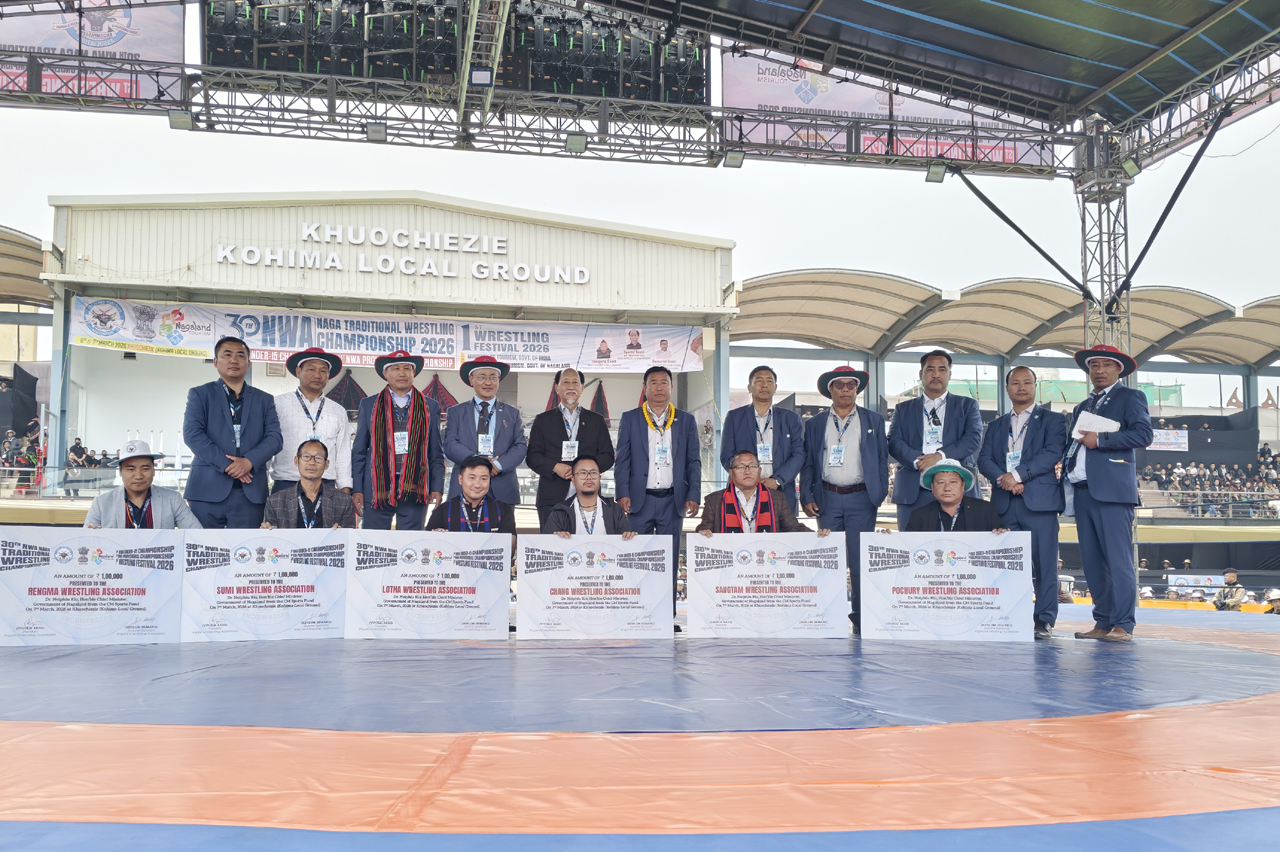
Rio also reaffirmed that the Government of Nagaland remains committed to promoting sports infrastructure and supporting indigenous games alongside modern sports disciplines. Preserving traditional sports, he said, is essential to safeguarding cultural heritage while creating opportunities for young sportspersons to compete at regional, national, and international levels.
As the 30th championship concluded, he expressed hope that people would renew their commitment to preserving traditions while embracing progress. He encouraged the younger generation to take pride in their identity, value discipline and hard work, and carry forward the legacy entrusted to them. Quoting, “The harder the battle, the sweeter the victory,” he said the spirit of wrestling should guide youth not only in sports but also in education, service, and leadership.
He also congratulated the organizers for successfully conducting the event, the referees and officials for ensuring fairness, and the spectators for their enthusiastic support. He wished all wrestlers the best and expressed hope that the championship would further elevate the glory of Naga tradition.
Sanjay Kumar Singh, President of the Wrestling Federation of India, said that the relationship between his federation and the Nagaland Wrestling Association (NWA) has strengthened, leading to several achievements. With the efforts of the Chief Minister and the Nagaland Olympic Association, wrestling was included in the Northeast Games, and he expressed hope that the progress would continue.
He further highlighted that Naga wrestling has been incorporated into the national championship of India, enabling participation from all states. Singh assured that the All India Traditional Wrestling and Pankration Federation (AITWPF) is committed to promoting Naga wrestling not only across India but globally.
Informing that AITWPF will represent India at the 2026 World Nomad Games, he proposed including Naga wrestling as a demonstration sport at the event to provide an international platform for the indigenous sport. He expressed hope that the Government of Nagaland would support the state’s participation, describing it as an opportunity to showcase Naga culture to the world. With government support, he added, international events could also be hosted in Kohima.
Singh also presented awards to two referees from Nagaland who were recognized as international referees under the Alysh Wrestling Federation—Seyielhoukho Sechü and Sürhoneyi Soho.
The oldest player of the day was Zasevikho Meyatsu, aged 39, from the Angami tribe, while the youngest participant was Khrethoveyi Veswuh, aged 17, from the Chakhesang tribe.
All quarterfinalists were awarded Rs. 20,000 each, while every participant received Rs. 10,000. The Chakhesang group also received Rs. 60,000 for winning the group championship.
Earlier, the program began with an invocation by Fr. Mathew Mhabemo, Parish Priest. Kuzhovesa Soho, Joint Secretary of NWA, chaired the program, while Vivolie Kezo, President of NWA, delivered the presidential address.