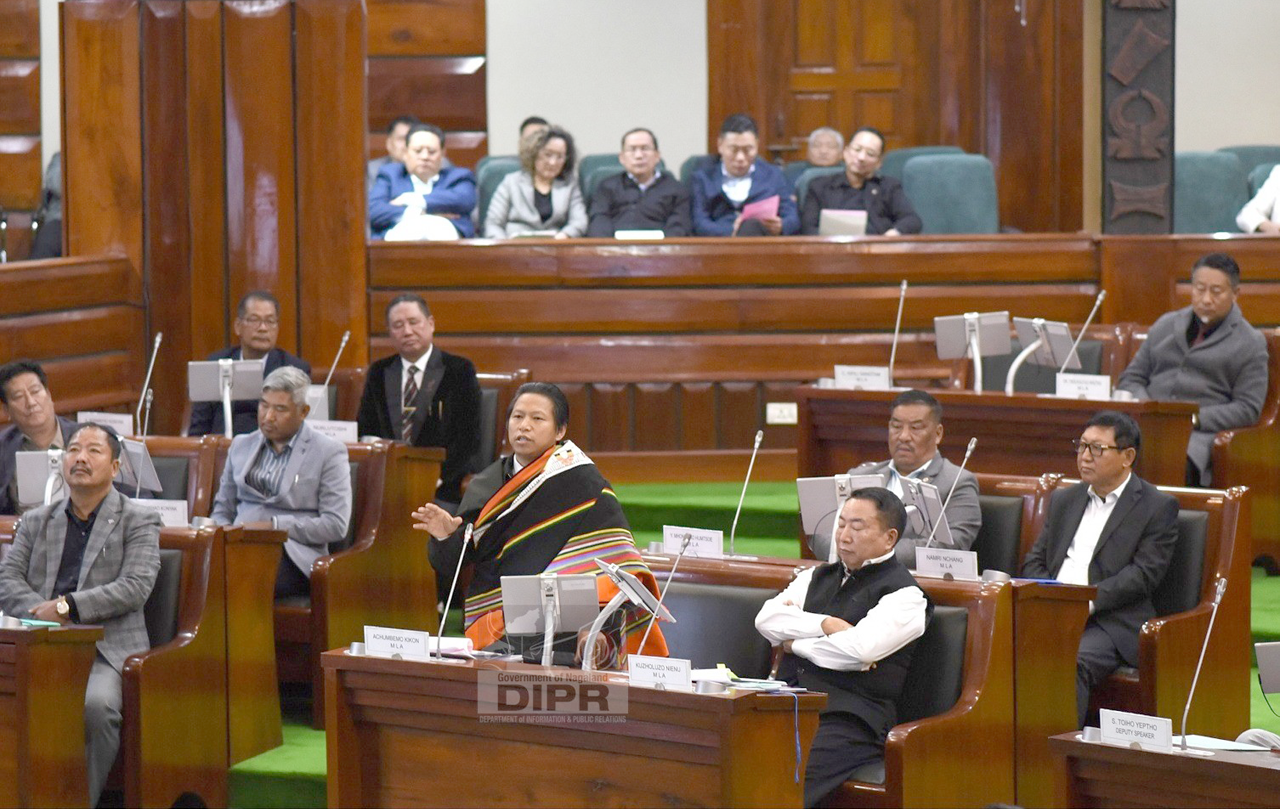
During the ongoing session of the Nagaland Legislative Assembly, MLA Achumbemo Kikon highlighted the plantation of Jatropha as a dual solution to promote green energy and mitigate human-elephant conflict, particularly in his constituency, 40–Bhandari A/C.
Kikon said he has consistently raised the issue of human-elephant conflict in almost every session of the 14th House, as Bhandari remains one of the worst-affected areas. He expressed anguish that many farmers in his constituency have been forced to abandon their paddy fields and farms due to repeated intrusion and destruction by wild elephants.
“As a representative of my people, I have explored several options to reduce the rampaging of fields and farms belonging to poor villagers, but there has been no concrete solution,” he stated, adding that he had sought answers both inside and outside the House, including from the Environment, Forest & Climate Change Department, without satisfactory outcomes.
In search of an alternative, Kikon said he engaged with an organisation called TERRATROTH, which is conducting systematic research on Jatropha cultivation as a sustainable bioenergy crop. Through its technical partner JATROPOWER, the organisation is working to address key challenges such as low-performing genetic material, lack of standardised agronomic practices, absence of assured market linkages, and weak value-chain integration.
He explained that sustained research, varietal improvement, scientifically optimised cultivation protocols, and market-aligned business models have helped build a more reliable and commercially viable Jatropha ecosystem. The goal, he said, is to transform Jatropha from an experimental plantation crop into a structured bioenergy feedstock supported by improved genetics and defined market pathways.
Kikon said he was convinced that Jatropha cultivation could serve as an alternative solution to reduce human-elephant conflict, as the plant and its seeds are not favoured by wild elephants. Cultivating Jatropha on abandoned lands could thus both deter elephant intrusion and provide economic benefits to affected farmers.
Under the proposed model, TERRATROTH will supply hybrid saplings to willing villagers for large-scale cultivation through mono-cropping and mixed-cropping systems. The organisation will also enter into written agreements with farmers to buy back Jatropha seeds at pre-fixed prices, ensuring assured market access and maximum benefits to cultivators.
Download Nagaland Tribune app on Google Play

He further informed the House that the organisation intends to establish a refinery or factory in the foothill areas of Nagaland to process Jatropha seeds into biofuel. Plans are also underway to set up a research centre and academic programmes focused on green energy and medicinal plants.
The Bhandari Sub-Divisional Planning & Development Board (SDPDB), in its meeting on February 13, 2026, resolved to engage with TERRATROTH for the supply of hybrid Jatropha saplings for extensive cultivation. Similarly, the District Planning & Development Board (DPDB), Wokha, adopted a resolution on February 24, 2026, encouraging Jatropha plantation in wild elephant-affected areas of the district.
Kikon said Nagaland stands at the threshold of a new opportunity — one that combines ecological protection, farmer empowerment and renewable energy into an inclusive development model. “Our vision is simple yet powerful: plantations that protect wildlife, enrich communities, and produce clean bio-diesel,” he stated.
He noted that the initiative aligns with global and national commitments to sustainable energy. The United Nations General Assembly, through Resolution A/RES/79/211, has extended the Decade of Sustainable Energy for All until 2030, urging member states to accelerate renewable energy adoption and expand clean energy access under Sustainable Development Goal 7.
India, under its National Policy on Biofuels (2018, amended in 2022), has set targets including 20 percent ethanol blending in petrol by 2025 and expanded biodiesel production through non-edible oilseeds such as Jatropha.
Kikon maintained that large-scale Jatropha plantation would position Nagaland as a proactive contributor to India’s renewable energy goals and the UN’s sustainable energy agenda, while simultaneously addressing the pressing issue of human-elephant conflict in affected districts.