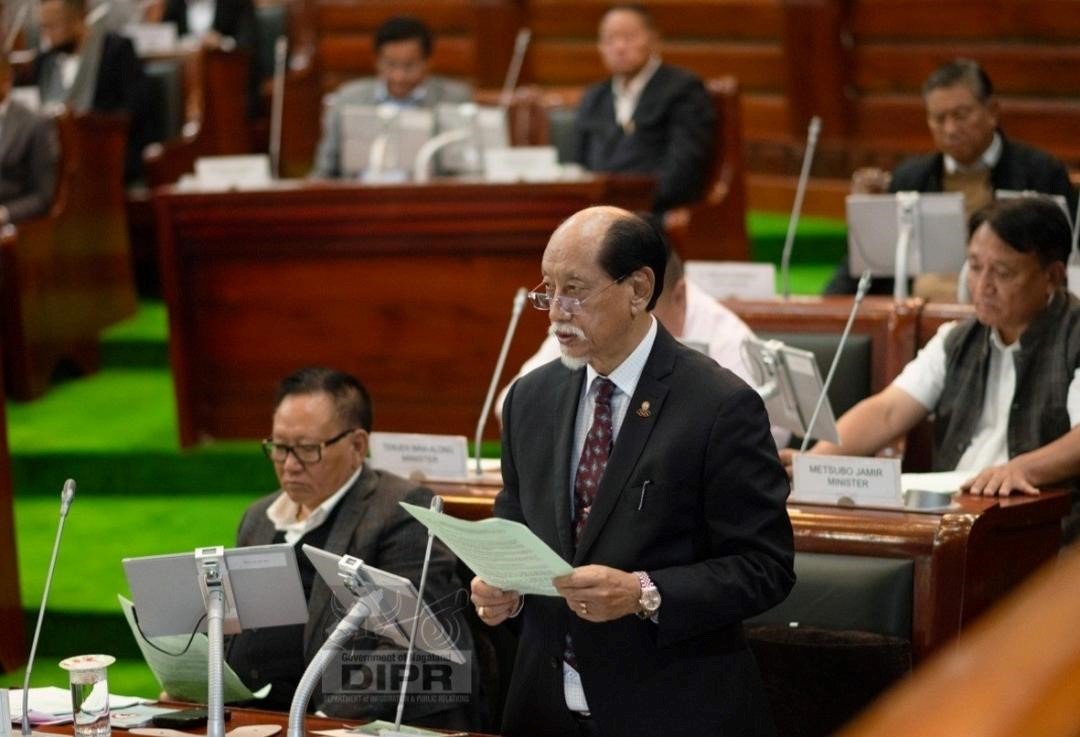
Chief Minister Neiphiu Rio, on Tuesday, informed the Assembly that the lack of land availability and unresolved alignment issues were major factors in delaying progress on the proposed Foothill Road project, even as the Centre had shown willingness to support the initiative.
Rio made the remarks while responding to a starred question at the ongoing Nagaland Legislative Assembly (NLA) session, following queries raised by Achumbemo Kikon regarding the upgradation of the Wokha–Bokajan road and the Aghunato–Shamator road.
Rio also reacted to reports in sections of the media that a “Foothill Road Committee” had issued an ultimatum to the state government to release adequate funds for the project by March 31. He said he was surprised by such reports and questioned the authority of the group issuing the ultimatum, pointing out that the Foothill Road project had been initiated by the state government.
Recalling earlier efforts to implement the project, Rio said that when he served as minister in charge of Works and Housing in 1993, the project had faced resistance from Assam due to the long-standing inter-state border dispute. Although the Government of India had recognised the strategic importance of the road, financial support was not immediately forthcoming, which forced the state government to undertake the work on several occasions using its own resources, mentioned Rio.
He stressed that the road alignment must follow the foothill stretch as originally planned. According to Rio, in certain sectors in Wokha and Peren districts, the alignment had deviated uphill instead of running along the foothills, creating difficulties for long-distance commuters. The government had therefore decided that the alignment must remain along the foothill belt to ensure smoother connectivity and encourage economic activity along the corridor.
Rio said that during a meeting with the Union Minister for Road Transport and Highways, the Centre had conveyed readiness to support the project. However, the Ministry of Road Transport and Highways had stipulated that the state must provide a minimum right-of-way of 30 metres free of cost and obtain forest and environmental clearances before construction could begin.
He clarified that since the Foothill road had not yet been declared a National Highway, compensation for land could not be provided under National Highway norms.
The chief minister also informed the House that a proposed railway line running parallel to the Foothill Road—from Tizit to Dimapur and onward to Khelma—had been approved by the Railway Board during 2011–12 and continued to receive token budget allocations annually. However, he said landowners had reportedly linked the issue of land contribution for the railway line with progress on the Foothill Road project.
He added that land acquisition issues were not limited to the Foothill Road but were affecting several infrastructure projects across the state. He said the Cabinet had directed deputy commissioners to convene meetings with tribal hohos through the District Planning and Development Boards to seek voluntary contribution of 30 metres of land along the proposed alignment. Despite being given three months to respond, no positive outcome had been received so far.
He remarked that infrastructure projects could not move forward without land being made available, stating that roads could not be constructed “in the air or in the sky”.
Earlier, Achumbemo Kikon raised concerns over the poor condition of the Wokha–Bokajan road and stressed its importance as a key route connecting several districts to Dimapur and Kohima.
He said commuters from Noklak, Shamator, Tuensang, Mokokchung and Zunheboto frequently used the road while travelling towards the commercial hub of Dimapur.
Kikon informed the House that the road had originally been constructed in 1991–92 by the Border Roads Organisation and maintained by the agency for more than a decade before being handed over to the state government’s Roads and Bridges department.
He said the apex Lotha tribal body, Lotha Hoho, had submitted a memorandum to the Governor on three occasions—November 7, 2019, August 24, 2022 and June 15, 2023—seeking that the road be handed back to BRO, citing poor maintenance under the department.
Kikon also pointed out that a major bridge along the route had collapsed long ago and had not yet been reconstructed. He urged the government to consider handing over the road to BRO or another agency if the department was unable to maintain it adequately.
He further said that during the visit of Jitendra Singh to Wokha in June 2025, legislators from the district had raised the matter with him.
Download Nagaland Tribune app on Google Play

The legislator also highlighted the condition of the Aghunato–Shamator road, stating that improving the road could shorten the travel distance to Kohima by around 40 kilometres for residents of the eastern districts. He said better road connectivity would benefit patients travelling for medical treatment and reduce travel costs for commuters.
Replying to the queries, Roads and Bridges minister G. Kaito Aye said the Wokha–Bokajan road had originally been constructed around 1992–93 under a one-time grant from the North Eastern Council and implemented through BRO.
He informed that during 2004–05, around 70 km of the total 105 km stretch had been handed over to the state Public Works Department (Roads and Bridges), while the remaining 35 km continued to remain under BRO.
Kaito acknowledged that maintenance of the stretch under the department had been difficult due to limited resources. He said the section under BRO included a collapsed bridge of about 60 metres span, which the organisation had proposed to rebuild.
The minister said the state government will not take over the remaining stretch until the bridge was completed and the entire road was formally handed over by BRO. He added that he will obtain the latest status from BRO and place the matter before the State Planning Board as the department alone did not have adequate resources to undertake major works.
On the Aghunato–Shamator road, Kaito said the total length was about 69 km. Of this, 28 km had been taken up under the Pradhan Mantri Gram Sadak Yojana and work was progressing slowly. He expressed confidence that the stretch would be completed by 2026.
The remaining portion of the road would be taken up under a suitable scheme in due course, he added, while also noting that the route formed part of a proposed National Highway stretch from Showuba to Pangsha.
Also speaking on the matter, Deputy CM, T. R. Zeliang informed the Assembly that the Prime Minister’s Office had issued instructions that no new National Highways would be declared across the country until further orders.
However, he said the Centre had acknowledged the importance of the Foothill Road for Nagaland’s economic development and had conveyed that it could consider declaring the route a National Highway if the state government ensured land availability and statutory clearances.
Zeliang said that if the required conditions were met, the Centre will prepare the detailed project report and undertake the project with 100 percent central funding.
He added that the proposed Foothill Road from Tizit to Khelma was estimated to cost around ₹2,500 crore and urged legislators to engage with tribal hohos and local communities in their districts so that land could be made available and the project could move forward.